Building Code Glossary
Ballast: Building Code Definition
How the IBC 2009 define ballast, where the wording differs, and which chapters depend on the term.
On this page
Last updated September 7, 2026 · Definitions quoted from the 2009 International Codes as transcribed in this site's building-codes collection, with the source chapter linked for each quotation. Usage counts are computed over the chapters hosted here, one copy per code. The [ICC code library](https://codes.iccsafe.org/codes) publishes the current model text and the [ICC adoption maps](https://www.iccsafe.org/advocacy/code-adoption-maps/) show which edition a jurisdiction has adopted; those sources control.
Direct answer
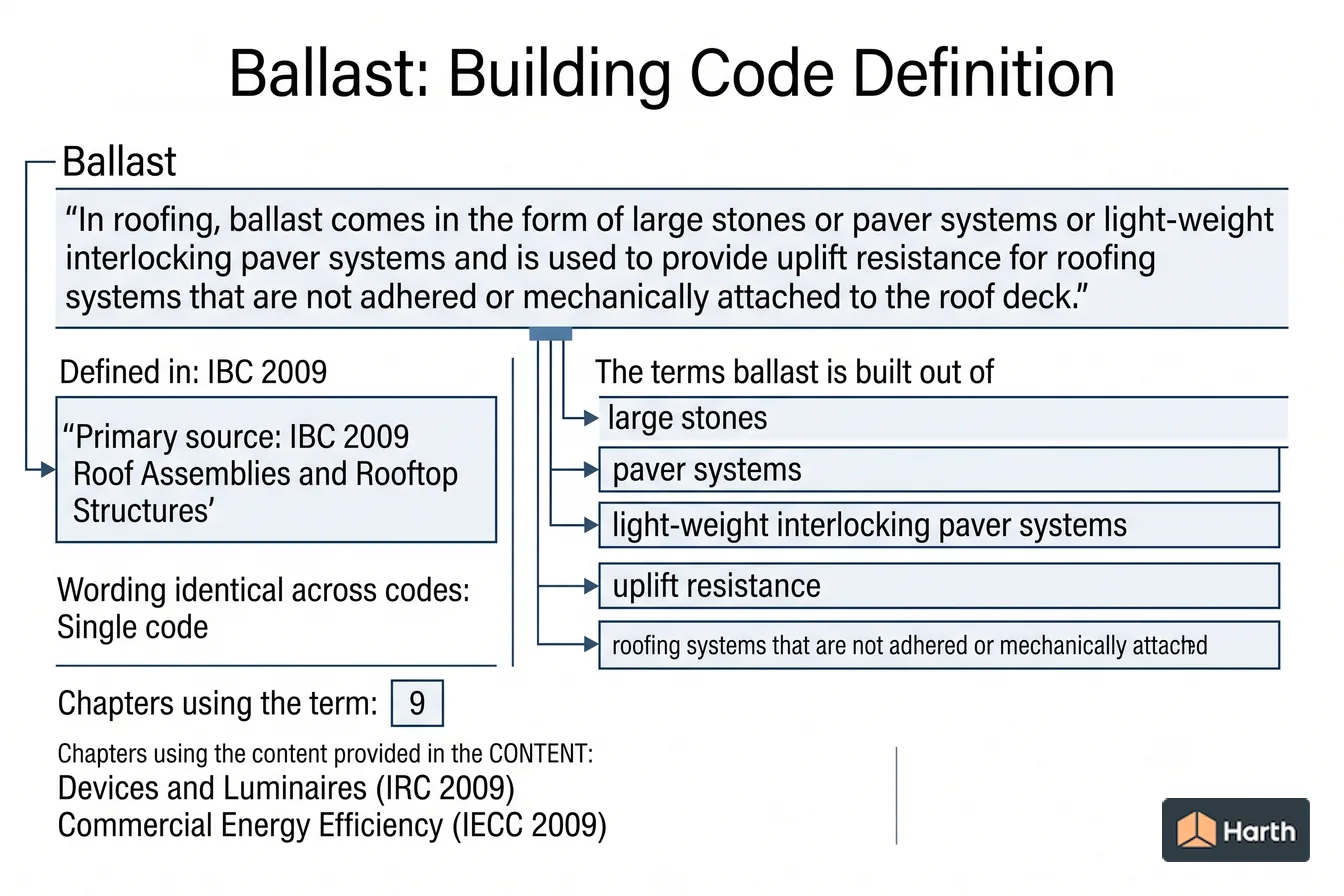
Ballast is a defined term in the International Building Code (IBC) 2009, in Roof Assemblies and Rooftop Structures. The code's own words are: “In roofing, ballast comes in the form of large stones or paver systems or light-weight interlocking paver systems and is used to provide uplift resistance for roofing systems that are not adhered or mechanically attached to the roof deck.” No other I-Code in this corpus defines it, so the IBC 2009 definition is the one to work from. The term is used in 9 chapters of this corpus, most often in Roof Assemblies and Rooftop Structures (IBC 2009), Devices and Luminaires (IRC 2009), Commercial Energy Efficiency (IECC 2009). These pages transcribe the 2009 model text; verify the definition against the edition and amendments your authority having jurisdiction has adopted.
Content and cited inputs reviewed by Scott Barrington, Harth founder and architectural technology specialist · Published 2026-09-07 · Updated 2026-09-07.
What does this term mean?
Ballast — IBC 2009, Roof Assemblies and Rooftop Structures:
In roofing, ballast comes in the form of large stones or paver systems or light-weight interlocking paver systems and is used to provide uplift resistance for roofing systems that are not adhered or mechanically attached to the roof deck.
What must be verified before using this guidance?
Ballast is defined once in this corpus, in the Roof Assemblies and Rooftop Structures chapter of the International Building Code (IBC) 2009:
In roofing, ballast comes in the form of large stones or paver systems or light-weight interlocking paver systems and is used to provide uplift resistance for roofing systems that are not adhered or mechanically attached to the roof deck.
Where ballast is used in the code
The term appears in 9 chapters of the 2009 I-Codes hosted here. The chapters that lean on it hardest are the ones to read next.
| Chapter | Code | Mentions |
|---|---|---|
| Roof Assemblies and Rooftop Structures | IBC 2009 | 19 |
| Devices and Luminaires | IRC 2009 | 11 |
| Commercial Energy Efficiency | IECC 2009 | 5 |
| Administration | IECC 2009 | 3 |
| Flammable and Combustible Liquids | IFC 2009 | 3 |
| Definitions | IBC 2009 | 1 |
| Branch Circuit and Feeder Requirements | IRC 2009 | 1 |
| Definitions | IRC 2009 | 1 |
| Electrical Definitions | IRC 2009 | 1 |
The term in use
How the code actually writes about ballast, quoted from the 2009 text hosted here:
Aggregate used as surfacing for roof coverings and aggregate, gravel or stone used as ballast shall not be used on the roof of a building located in a hurricane-prone region as defined in Section 1609.2, or on any other building with a mean roof height exceeding that permitted by Table 1504.8 based on the exposure category and basic wind speed …
The ballast of a fluorescent luminaire installed indoors shall have integral thermal protection.
Tanks used exclusively for ballast water or Class II or III liquids are allowed to be installed on suitably designed wharves.
The terms ballast is built out of
The definition above leans on 1 other defined term. Each carries its own code definition, and a local amendment to any of them changes what ballast covers:
- Roof Deck — IBC 2009: The flat or sloped surface not including its supporting members or vertical supports.
Ballast: what to open, and in what order
Every row is a document this term depends on. The ICC code library and the ICC adoption maps cover the middle rows.
| Check | Where | Confirmed |
|---|---|---|
| Read the definition in the adopted IBC | Roof Assemblies and Rooftop Structures | |
| Re-check the requirement that uses it | Roof Assemblies and Rooftop Structures (IBC 2009) | |
| Re-check the requirement that uses it | Devices and Luminaires (IRC 2009) | |
| Re-check the requirement that uses it | Commercial Energy Efficiency (IECC 2009) | |
| Re-check the requirement that uses it | Administration (IECC 2009) | |
| Confirm the dependent definition | Roof Deck | |
| Local amendment to any of the above | Jurisdiction's amendment list |
A research aid, not a code determination. The authority having jurisdiction decides which edition and which amendments apply.
Where can you explore related guidance?
- Explore all glossary guidance
- Roof Deck: Building Code Definition
- Aggregate: Building Code Definition
- Roof Assembly: Building Code Definition
- Roof Covering: Building Code Definition
Sources and method
Definitions quoted from the 2009 International Codes as transcribed in this site's building-codes collection, with the source chapter linked for each quotation. Usage counts are computed over the chapters hosted here, one copy per code. The ICC code library publishes the current model text and the ICC adoption maps show which edition a jurisdiction has adopted; those sources control.
Source links
Frequently asked questions
What is the code definition of ballast?
The International Building Code (IBC) 2009 defines it in Roof Assemblies and Rooftop Structures as: “In roofing, ballast comes in the form of large stones or paver systems or light-weight interlocking paver systems and is used to provide uplift resistance for roofing systems that are not adhered or mechanically attached to the roof deck.” The 2009 model text is reproduced here; the definition that binds your project is the one in the edition your jurisdiction has adopted, as amended locally.
Which parts of the code depend on ballast?
In this corpus the term is used across 9 chapters, led by Roof Assemblies and Rooftop Structures in the IBC 2009. Those are the sections whose scope moves if the definition is amended locally, so read them together with Chapter 2 rather than on their own.
What is a ballast in a building?
In the 2009 I-Codes hosted here it is a defined term rather than a description. The IBC 2009 states, in Roof Assemblies and Rooftop Structures: “In roofing, ballast comes in the form of large stones or paver systems or light-weight interlocking paver systems and is used to provide uplift resistance for roofing systems that are not adhered or mechanically attached to the roof deck.” It is defined in IBC 2009. It is not the same as Building, which the IBC 2009 defines separately as “Any structure used or intended for supporting or sheltering any use or occupancy.” Because it is a defined term, whatever the adopted edition says it means is what every section using it means — so check Chapter 2 of that edition and any local amendment before relying on this wording.
What is the definition of ballast?
In the 2009 I-Codes hosted here it is a defined term rather than a description. The IBC 2009 states, in Roof Assemblies and Rooftop Structures: “In roofing, ballast comes in the form of large stones or paver systems or light-weight interlocking paver systems and is used to provide uplift resistance for roofing systems that are not adhered or mechanically attached to the roof deck.” It is defined in IBC 2009. Because it is a defined term, whatever the adopted edition says it means is what every section using it means — so check Chapter 2 of that edition and any local amendment before relying on this wording.
What does IBC mean in building codes?
Building is a separate defined term. The IBC 2009 defines it as: “Any structure used or intended for supporting or sheltering any use or occupancy.” That is not the same as ballast, which the IBC 2009 defines as “In roofing, ballast comes in the form of large stones or paver systems or light-weight interlocking paver systems and is used to provide uplift resistance for roofing systems that are not adhered or mechanically attached to the roof deck.” — read both before applying either, and confirm the wording in the edition your jurisdiction has adopted.
Related pages
- Backwater Valve: Building Code Definition
Backwater Valve — IRC 2009 definition: A device installed in a drain or pipe to prevent backflow of sewage.
- Baled Cotton, Densely Packed: Building Code Definition
Baled Cotton, Densely Packed — IBC 2009 definition: Cotton made into banded bales with a packing density of at least 22 pounds per cubic …
- Baled Cotton: Building Code Definition
Baled Cotton — IBC 2009 definition: A natural seed fiber wrapped in and secured with industry accepted materials, usually consisting of burlap …
- Barricade: Building Code Definition
Barricade — IBC 2009 definition: A structure that consists of a combination of walls, floor and roof, which is designed to …
- Base Flood Elevation: Building Code Definition
Base Flood Elevation — IBC 2009 definition: The elevation of the base flood, including wave height, relative to the National Geodetic Vertical Datum …
- Base Flood: Building Code Definition
Base Flood — IBC 2009 definition: The flood having a I-percent chance of being equaled or exceeded in any given year.