Building Code Glossary
Location, Wet: Building Code Definition
How the IRC 2009 define location, wet, where the wording differs, and which chapters depend on the term.
On this page
Last updated September 7, 2026 · Definitions quoted from the 2009 International Codes as transcribed in this site's building-codes collection, with the source chapter linked for each quotation. Usage counts are computed over the chapters hosted here, one copy per code. The [ICC code library](https://codes.iccsafe.org/codes) publishes the current model text and the [ICC adoption maps](https://www.iccsafe.org/advocacy/code-adoption-maps/) show which edition a jurisdiction has adopted; those sources control.
Direct answer
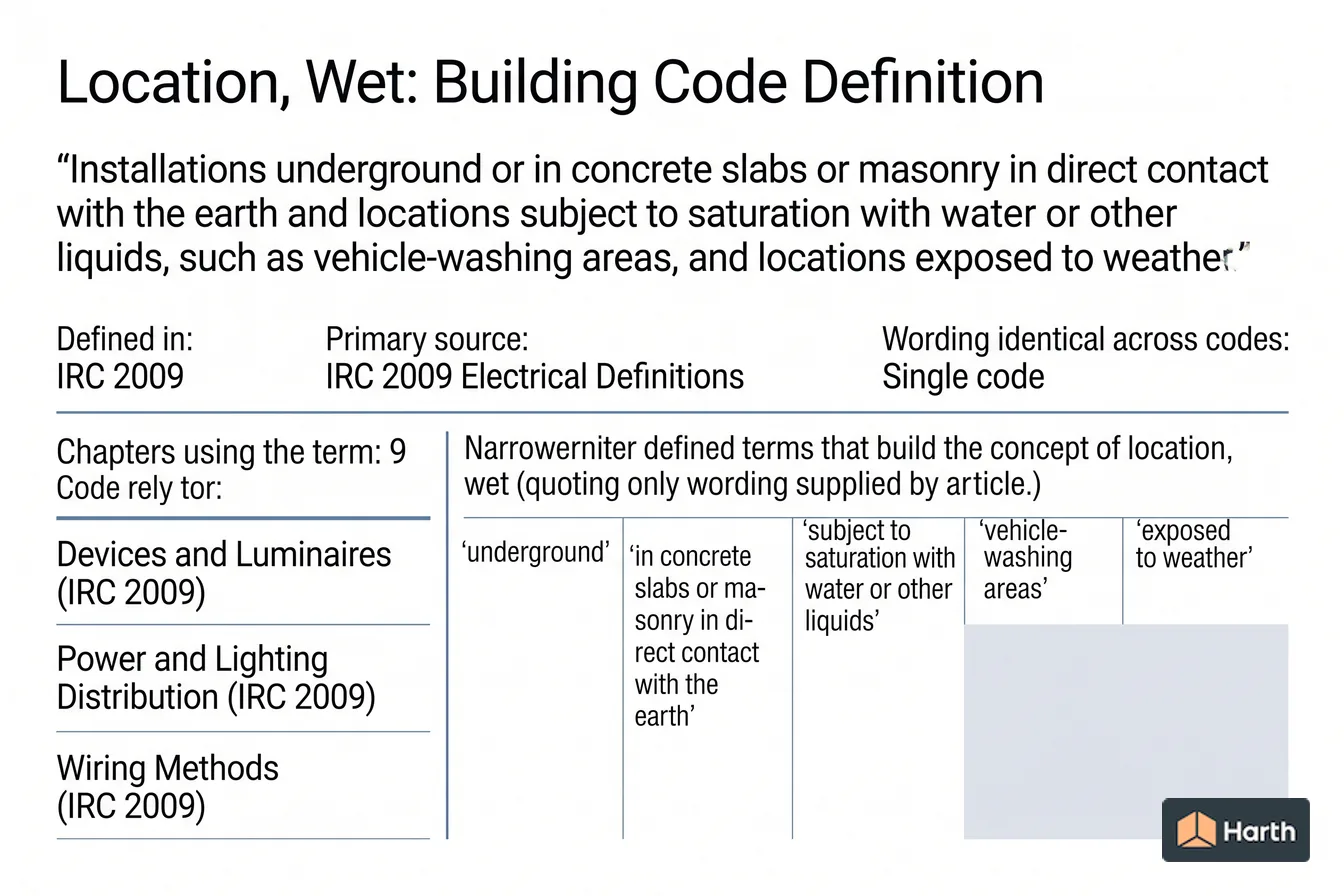
Location, wet is a defined term in the International Residential Code (IRC) 2009, in Electrical Definitions. The code's own words are: “Installations underground or in concrete slabs or masonry in direct contact with the earth and locations subject to saturation with water or other liquids, such as vehicle-washing areas, and locations exposed to weather.” No other I-Code in this corpus defines it, so the IRC 2009 definition is the one to work from. The term is used in 9 chapters of this corpus, most often in Devices and Luminaires (IRC 2009), Power and Lighting Distribution (IRC 2009), Wiring Methods (IRC 2009). These pages transcribe the 2009 model text; verify the definition against the edition and amendments your authority having jurisdiction has adopted.
Content and cited inputs reviewed by Scott Barrington, Harth founder and architectural technology specialist · Published 2026-09-07 · Updated 2026-09-07.
What does this term mean?
Location, Wet — IRC 2009, Electrical Definitions:
Installations underground or in concrete slabs or masonry in direct contact with the earth and locations subject to saturation with water or other liquids, such as vehicle-washing areas, and locations exposed to weather.
What must be verified before using this guidance?
Location, Wet is defined once in this corpus, in the Electrical Definitions chapter of the International Residential Code (IRC) 2009:
Installations underground or in concrete slabs or masonry in direct contact with the earth and locations subject to saturation with water or other liquids, such as vehicle-washing areas, and locations exposed to weather.
Where location, wet is used in the code
The term appears in 9 chapters of the 2009 I-Codes hosted here. The chapters that lean on it hardest are the ones to read next.
| Chapter | Code | Mentions |
|---|---|---|
| Devices and Luminaires | IRC 2009 | 16 |
| Power and Lighting Distribution | IRC 2009 | 12 |
| Wiring Methods | IRC 2009 | 11 |
| Wood | IBC 2009 | 6 |
| Roof-ceiling Construction | IRC 2009 | 6 |
| Building Planning | IRC 2009 | 3 |
| Gypsum Board and Plaster | IBC 2009 | 1 |
| Electrical Definitions | IRC 2009 | 1 |
| Services | IRC 2009 | 1 |
The term in use
How the code actually writes about location, wet, quoted from the 2009 text hosted here:
A surface mounted switch or circuit breaker located in a damp or wet location or outside of a building shall be enclosed in a weatherproof enclosure or cabinet.
Where raceways are installed in wet locations abovegrade, the interior of such raceways shall be considered to be a wet location.
The terms location, wet is built out of
The definition above leans on 2 other defined terms. Each carries its own code definition, and a local amendment to any of them changes what location, wet covers:
- Masonry — IBC 2009: A built-up construction or combination of building units or materials of clay, shale, concrete, glass, gypsum, stone or other approved units bonded together with or without mortar or grout or other accepted methods of joining.
- Exposed — IRC 2009: (As applied to live parts.) Capable of being inadvertently touched or approached nearer than a safe distance by a person.
Location, Wet: what to open, and in what order
Every row is a document this term depends on. The ICC code library and the ICC adoption maps cover the middle rows.
| Check | Where | Confirmed |
|---|---|---|
| Read the definition in the adopted IRC | Electrical Definitions | |
| Re-check the requirement that uses it | Devices and Luminaires (IRC 2009) | |
| Re-check the requirement that uses it | Power and Lighting Distribution (IRC 2009) | |
| Re-check the requirement that uses it | Wiring Methods (IRC 2009) | |
| Re-check the requirement that uses it | Wood (IBC 2009) | |
| Confirm the dependent definition | Masonry | |
| Confirm the dependent definition | Exposed | |
| Local amendment to any of the above | Jurisdiction's amendment list |
A research aid, not a code determination. The authority having jurisdiction decides which edition and which amendments apply.
Where can you explore related guidance?
Sources and method
Definitions quoted from the 2009 International Codes as transcribed in this site's building-codes collection, with the source chapter linked for each quotation. Usage counts are computed over the chapters hosted here, one copy per code. The ICC code library publishes the current model text and the ICC adoption maps show which edition a jurisdiction has adopted; those sources control.
Source links
Frequently asked questions
What is the code definition of location, wet?
The International Residential Code (IRC) 2009 defines it in Electrical Definitions as: “Installations underground or in concrete slabs or masonry in direct contact with the earth and locations subject to saturation with water or other liquids, such as vehicle-washing areas, and locations exposed to weather.” The 2009 model text is reproduced here; the definition that binds your project is the one in the edition your jurisdiction has adopted, as amended locally.
Which parts of the code depend on location, wet?
In this corpus the term is used across 9 chapters, led by Devices and Luminaires in the IRC 2009. Those are the sections whose scope moves if the definition is amended locally, so read them together with Chapter 2 rather than on their own.
What is the NEC definition of a wet location?
In the 2009 I-Codes hosted here it is a defined term rather than a description. The IRC 2009 states, in Electrical Definitions: “Installations underground or in concrete slabs or masonry in direct contact with the earth and locations subject to saturation with water or other liquids, such as vehicle-washing areas, and locations exposed to weather.” It is defined in IRC 2009. Because it is a defined term, whatever the adopted edition says it means is what every section using it means — so check Chapter 2 of that edition and any local amendment before relying on this wording.
Is a bathroom considered a wet location?
In the 2009 I-Codes hosted here it is a defined term rather than a description. The IRC 2009 states, in Electrical Definitions: “Installations underground or in concrete slabs or masonry in direct contact with the earth and locations subject to saturation with water or other liquids, such as vehicle-washing areas, and locations exposed to weather.” It is defined in IRC 2009. It is not the same as Bathroom, which the IRC 2009 defines separately as “An area, including a basin, with one or more of the following: a toilet, a tub or a shower.” Because it is a defined term, whatever the adopted edition says it means is what every section using it means — so check Chapter 2 of that edition and any local amendment before relying on this wording.
Related pages
- Loads: Building Code Definition
Loads — IBC 2009 definition: Forces or other actions that result from the weight of building materials, occupants and their possessions …
- Location, Damp: Building Code Definition
Location, Damp — IRC 2009 definition: Location protected from weather and not subject to saturation with water or other liquids but subject …
- Location, Dry: Building Code Definition
Location, Dry — IRC 2009 definition: A location not normally subject to dampness or wetness.
- Longitudinal Flue Space: Building Code Definition
Longitudinal Flue Space — IFC 2009 definition: The flue space between rows of storage perpendicular to the direction of loading.
- Lot Line: Building Code Definition
Lot Line — IBC 2009 definition: A line dividing one lot from another, or from a street or any public place.
- Lot: Building Code Definition
Lot — IBC 2009 definition: A portion or parcel of land considered as a unit.