Building Code Glossary
Nuisance: Building Code Definition
How the IPC 2009 define nuisance, where the wording differs, and which chapters depend on the term.
On this page
Last updated September 7, 2026 · Definitions quoted from the 2009 International Codes as transcribed in this site's building-codes collection, with the source chapter linked for each quotation. Usage counts are computed over the chapters hosted here, one copy per code. The [ICC code library](https://codes.iccsafe.org/codes) publishes the current model text and the [ICC adoption maps](https://www.iccsafe.org/advocacy/code-adoption-maps/) show which edition a jurisdiction has adopted; those sources control.
Direct answer
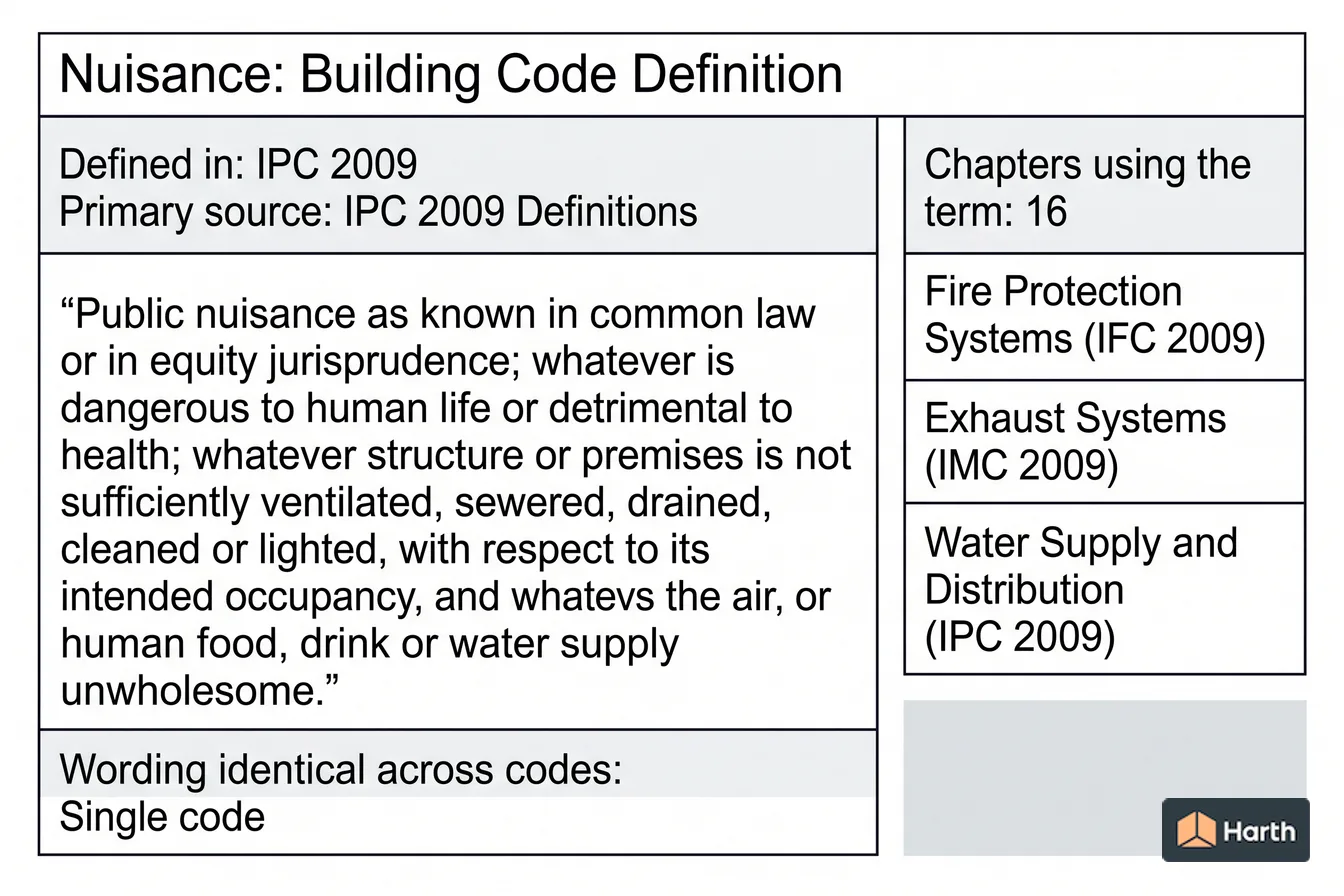
Nuisance is a defined term in the International Plumbing Code (IPC) 2009, in Definitions. The code's own words are: “Public nuisance as known in common law or in equity jurisprudence; whatever is dangerous to human life or detrimental to health; whatever structure or premises is not sufficiently ventilated, sewered, drained, cleaned or lighted, with respect to its intended occupancy, and whatever renders the air, or human food, drink or water supply unwholesome.” No other I-Code in this corpus defines it, so the IPC 2009 definition is the one to work from. The term is used in 16 chapters of this corpus, most often in Fire Protection Systems (IFC 2009), Exhaust Systems (IMC 2009), Water Supply and Distribution (IPC 2009). These pages transcribe the 2009 model text; verify the definition against the edition and amendments your authority having jurisdiction has adopted.
Content and cited inputs reviewed by Scott Barrington, Harth founder and architectural technology specialist · Published 2026-09-07 · Updated 2026-09-07.
What does this term mean?
Nuisance — IPC 2009, Definitions:
Public nuisance as known in common law or in equity jurisprudence; whatever is dangerous to human life or detrimental to health; whatever structure or premises is not sufficiently ventilated, sewered, drained, cleaned or lighted, with respect to its intended occupancy, and whatever renders the air, or human food, drink or water supply unwholesome.
What must be verified before using this guidance?
Nuisance is defined once in this corpus, in the Definitions chapter of the International Plumbing Code (IPC) 2009:
Public nuisance as known in common law or in equity jurisprudence; whatever is dangerous to human life or detrimental to health; whatever structure or premises is not sufficiently ventilated, sewered, drained, cleaned or lighted, with respect to its intended occupancy, and whatever renders the air, or human food, drink or water supply unwholesome.
Where nuisance is used in the code
The term appears in 16 chapters of the 2009 I-Codes hosted here. The chapters that lean on it hardest are the ones to read next.
| Chapter | Code | Mentions |
|---|---|---|
| Fire Protection Systems | IFC 2009 | 5 |
| Exhaust Systems | IMC 2009 | 3 |
| Water Supply and Distribution | IPC 2009 | 3 |
| General Regulations | IMC 2009 | 2 |
| Definitions | IPC 2009 | 2 |
| General Regulations | IPC 2009 | 2 |
| Water Supply and Distribution | IRC 2009 | 2 |
| Definitions | IBC 2009 | 1 |
| Fire Protection Systems | IBC 2009 | 1 |
| Definitions | IFC 2009 | 1 |
| General Requirements | IFC 2009 | 1 |
| Boilers, Water Heaters and Pressure Vessels | IMC 2009 | 1 |
4 further chapters mention the term.
The term in use
How the code actually writes about nuisance, quoted from the 2009 text hosted here:
Where the frequency is extended, records of detector-caused nuisance alarms and subsequent trends of these alarms shall be maintained.
The air removed by every mechanical exhaust system shall be discharged outdoors at a point where it will not cause a nuisance and not less than the distances specified in Section 501.2.1.
The termination of the piping from the relief port or airgap fitting of a backflow preventer shall discharge to an approved indirect waste receptor or to the outdoors where it will not cause damage or create a nuisance.
The terms nuisance is built out of
The definition above leans on 5 other defined terms. Each carries its own code definition, and a local amendment to any of them changes what nuisance covers:
- Ventilated — IRC 2009: Provided with a means to permit circulation ofair sufficient to remove an excess of heat, fumes or vapors.
- Occupancy — IMC 2009: The purpose for which a building, or portion thereof, is utilized or occupied.
- Structure — IPC 2009: That which is built or constructed or a portion thereof.
- Dangerous — IBC 2009: Any building or structure or portion thereof that meets any of the conditions described below shall be deemed dangerous:
- Premises — IMC 2009: A lot, plot or parcel of land, including any structure thereon.
Nuisance: what to open, and in what order
Every row is a document this term depends on. The ICC code library and the ICC adoption maps cover the middle rows.
| Check | Where | Confirmed |
|---|---|---|
| Read the definition in the adopted IPC | Definitions | |
| Re-check the requirement that uses it | Fire Protection Systems (IFC 2009) | |
| Re-check the requirement that uses it | Exhaust Systems (IMC 2009) | |
| Re-check the requirement that uses it | Water Supply and Distribution (IPC 2009) | |
| Re-check the requirement that uses it | General Regulations (IMC 2009) | |
| Confirm the dependent definition | Ventilated | |
| Confirm the dependent definition | Occupancy | |
| Confirm the dependent definition | Structure | |
| Local amendment to any of the above | Jurisdiction's amendment list |
A research aid, not a code determination. The authority having jurisdiction decides which edition and which amendments apply.
Where can you explore related guidance?
- Explore all glossary guidance
- Ventilated: Building Code Definition
- Structure: Building Code Definition
- Occupancy: Building Code Definition
- Dangerous: Building Code Definition
Sources and method
Definitions quoted from the 2009 International Codes as transcribed in this site's building-codes collection, with the source chapter linked for each quotation. Usage counts are computed over the chapters hosted here, one copy per code. The ICC code library publishes the current model text and the ICC adoption maps show which edition a jurisdiction has adopted; those sources control.
Source links
Frequently asked questions
What is the code definition of nuisance?
The International Plumbing Code (IPC) 2009 defines it in Definitions as: “Public nuisance as known in common law or in equity jurisprudence; whatever is dangerous to human life or detrimental to health; whatever structure or premises is not sufficiently ventilated, sewered, drained, cleaned or lighted, with respect to its intended occupancy, and whatever renders the air, or human food, drink or water supply unwholesome.” The 2009 model text is reproduced here; the definition that binds your project is the one in the edition your jurisdiction has adopted, as amended locally.
Which parts of the code depend on nuisance?
In this corpus the term is used across 16 chapters, led by Fire Protection Systems in the IFC 2009. Those are the sections whose scope moves if the definition is amended locally, so read them together with Chapter 2 rather than on their own.
What is an example of nuisance?
In the 2009 I-Codes hosted here it is a defined term rather than a description. The IPC 2009 states, in Definitions: “Public nuisance as known in common law or in equity jurisprudence; whatever is dangerous to human life or detrimental to health; whatever structure or premises is not sufficiently ventilated, sewered, drained, cleaned or lighted, with respect to its intended occupancy, and whatever renders the air, or human food, drink or water supply unwholesome.” It is defined in IPC 2009. Because it is a defined term, whatever the adopted edition says it means is what every section using it means — so check Chapter 2 of that edition and any local amendment before relying on this wording.
Related pages
- Normal Temperature and Pressure (NTP): Building Code Definition
Normal Temperature and Pressure (NTP) — IBC 2009 definition: A temperature of 70°F (21°C) and a pressure of 1 atmosphere [14.7 psia (101 kPa)].
- Nosing: Building Code Definition
Nosing — IBC 2009 definition: The leading edge of treads of stairs and of landings at the top of stairway flights.
- Nuisance Alarm: Building Code Definition
Nuisance Alarm — IBC 2009 definition: An alarm caused by mechanical failure, malfunction, improper installation or lack of proper maintenance, or an …
- Nursing Homes: Building Code Definition
Nursing Homes — IBC 2009 definition: Nursing homes are long-term care facilities on a 24-hour basis, including both intermediate care facilities and …
- Occupancy Category: Building Code Definition
Occupancy Category — IBC 2009 definition: A category used to determine structural requirements based on occupancy.
- Occupancy Classification: Building Code Definition
Occupancy Classification — IFC 2009 definition: For the purposes of this code, certain occupancies are defined as follows: