Building Code Glossary
Permissible Exposure Limit (PEL): Building Code Definition
How the IFC 2009 define permissible exposure limit (pel), where the wording differs, and which chapters depend on the term.
On this page
Last updated September 7, 2026 · Definitions quoted from the 2009 International Codes as transcribed in this site's building-codes collection, with the source chapter linked for each quotation. Usage counts are computed over the chapters hosted here, one copy per code. The [ICC code library](https://codes.iccsafe.org/codes) publishes the current model text and the [ICC adoption maps](https://www.iccsafe.org/advocacy/code-adoption-maps/) show which edition a jurisdiction has adopted; those sources control.
Direct answer
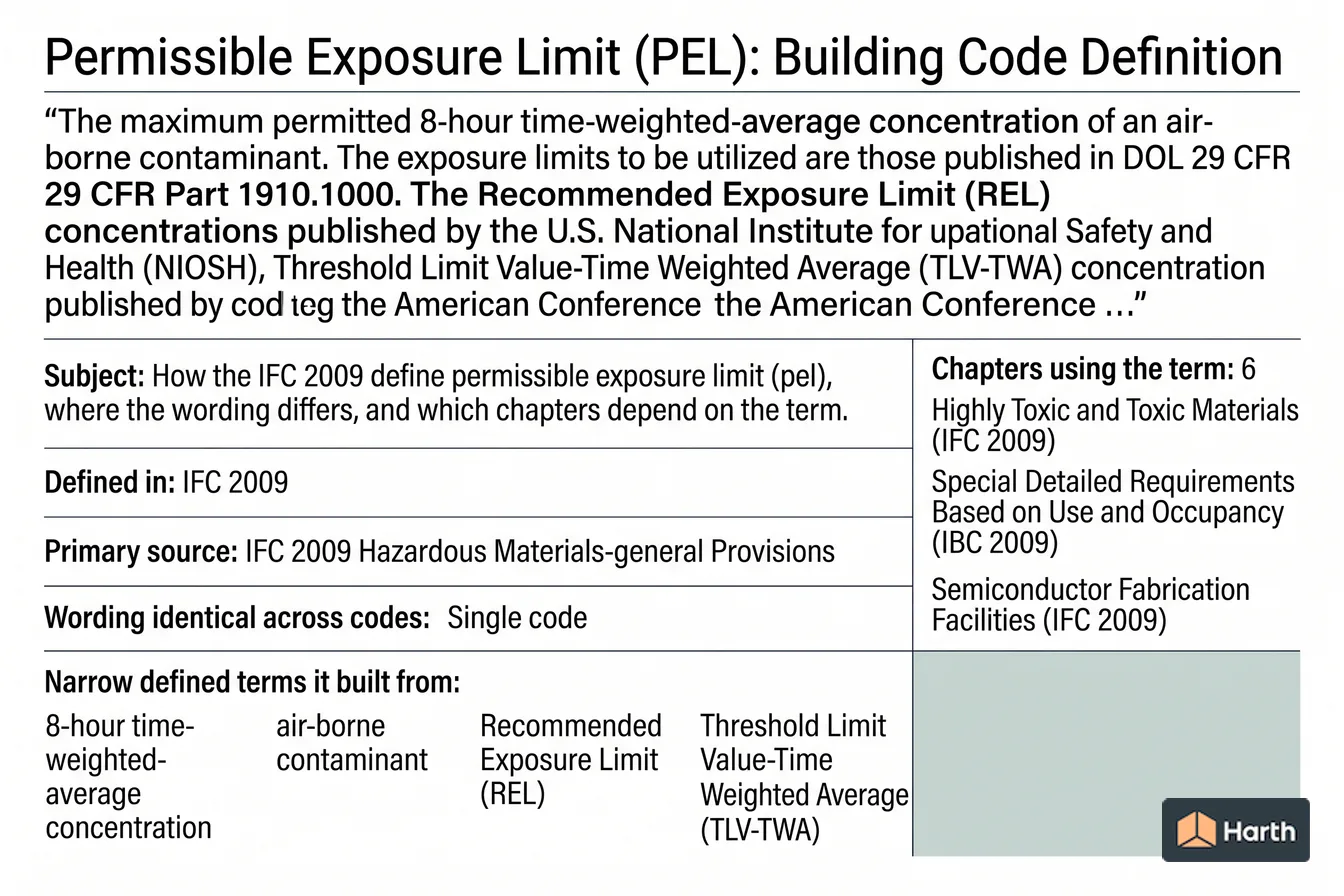
Permissible exposure limit (pel) is a defined term in the International Fire Code (IFC) 2009, in Hazardous Materials-general Provisions. The code's own words are: “The maximum permitted 8-hour time-weighted-average concentration of an air-borne contaminant. The exposure limits to be utilized are those published in DOL 29 CFR Part 1910.1000. The Recommended Exposure Limit (REL) concentrations published by the U.S. National Institute for Occupational Safety and Health (NIOSH), Threshold Limit Value-Time Weighted Average (TLV-TWA) concentrations published by the American Conference …” No other I-Code in this corpus defines it, so the IFC 2009 definition is the one to work from. The term is used in 6 chapters of this corpus, most often in Highly Toxic and Toxic Materials (IFC 2009), Special Detailed Requirements Based on Use and Occupancy (IBC 2009), Semiconductor Fabrication Facilities (IFC 2009). These pages transcribe the 2009 model text; verify the definition against the edition and amendments your authority having jurisdiction has adopted.
Content and cited inputs reviewed by Scott Barrington, Harth founder and architectural technology specialist · Published 2026-09-07 · Updated 2026-09-07.
What does this term mean?
Permissible Exposure Limit (PEL) — IFC 2009, Hazardous Materials-general Provisions:
The maximum permitted 8-hour time-weighted-average concentration of an air-borne contaminant. The exposure limits to be utilized are those published in DOL 29 CFR Part 1910.1000. The Recommended Exposure Limit (REL) concentrations published by the U.S. National Institute for Occupational Safety and Health (NIOSH), Threshold Limit Value-Time Weighted Average (TLV-TWA) concentrations published by the American Conference of Governmental Industrial Hygienists (ACGIH), Workplace Environmental Exposure Level (WEEL) Guides published by the American Industrial Hygiene Association (AIHA), and other approved, consistent measures are allowed as surrogates for hazardous substances not listed in DOL 29 CFR Part 1910.1000.
What must be verified before using this guidance?
Permissible Exposure Limit (PEL) is defined once in this corpus, in the Hazardous Materials-general Provisions chapter of the International Fire Code (IFC) 2009:
The maximum permitted 8-hour time-weighted-average concentration of an air-borne contaminant. The exposure limits to be utilized are those published in DOL 29 CFR Part 1910.1000. The Recommended Exposure Limit (REL) concentrations published by the U.S. National Institute for Occupational Safety and Health (NIOSH), Threshold Limit Value-Time Weighted Average (TLV-TWA) concentrations published by the American Conference of Governmental Industrial Hygienists (ACGIH), Workplace Environmental Exposure Level (WEEL) Guides published by the American Industrial Hygiene Association (AIHA), and other approved, consistent measures are allowed as surrogates for hazardous substances not listed in DOL 29 CFR Part 1910.1000.
Where permissible exposure limit (pel) is used in the code
The term appears in 6 chapters of the 2009 I-Codes hosted here. The chapters that lean on it hardest are the ones to read next.
| Chapter | Code | Mentions |
|---|---|---|
| Highly Toxic and Toxic Materials | IFC 2009 | 7 |
| Special Detailed Requirements Based on Use and Occupancy | IBC 2009 | 5 |
| Semiconductor Fabrication Facilities | IFC 2009 | 4 |
| Fire Protection Systems | IBC 2009 | 1 |
| Definitions | IFC 2009 | 1 |
| Hazardous Materials-general Provisions | IFC 2009 | 1 |
Permissible Exposure Limit (PEL) compared with Ceiling Limit
These two are the closest pair in the 2009 I-Codes: about 81 per cent of their defining words are the same. The code states both and compares neither, so the difference is worth naming.
| Wording unique to it | |
|---|---|
| Permissible Exposure Limit (PEL) (IFC 2009) | permitted, 8, hour, time, weighted, average, exposure, limits, utilized, those, recommended, limit |
| Ceiling Limit (IBC 2009) | one, may, exposed |
Everything else in the two definitions is shared. If a project turns on which of the two applies, those words are the whole of the test — and a local amendment that edits one of them without editing the other moves the boundary between permissible exposure limit (pel) and ceiling limit.
The terms permissible exposure limit (pel) is built out of
The definition above leans on 2 other defined terms. Each carries its own code definition, and a local amendment to any of them changes what permissible exposure limit (pel) covers:
- Approved — IBC 2009: Acceptable to the code official or authority having jurisdiction.
- Listed — IBC 2009: Equipment, materials, products or services included in a list published by an organization acceptable to the code official and concerned with evaluation of products or services that maintains periodic inspection of production of listed equipment or materials or periodic evaluation …
Permissible Exposure Limit (PEL): what to open, and in what order
Every row is a document this term depends on. The ICC code library and the ICC adoption maps cover the middle rows.
| Check | Where | Confirmed |
|---|---|---|
| Read the definition in the adopted IFC | Hazardous Materials-general Provisions | |
| Re-check the requirement that uses it | Highly Toxic and Toxic Materials (IFC 2009) | |
| Re-check the requirement that uses it | Special Detailed Requirements Based on Use and Occupancy (IBC 2009) | |
| Re-check the requirement that uses it | Semiconductor Fabrication Facilities (IFC 2009) | |
| Re-check the requirement that uses it | Fire Protection Systems (IBC 2009) | |
| Confirm the dependent definition | Approved | |
| Confirm the dependent definition | Listed | |
| Local amendment to any of the above | Jurisdiction's amendment list |
A research aid, not a code determination. The authority having jurisdiction decides which edition and which amendments apply.
Where can you explore related guidance?
Sources and method
Definitions quoted from the 2009 International Codes as transcribed in this site's building-codes collection, with the source chapter linked for each quotation. Usage counts are computed over the chapters hosted here, one copy per code. The ICC code library publishes the current model text and the ICC adoption maps show which edition a jurisdiction has adopted; those sources control.
Source links
Frequently asked questions
What is the code definition of permissible exposure limit (pel)?
The International Fire Code (IFC) 2009 defines it in Hazardous Materials-general Provisions as: “The maximum permitted 8-hour time-weighted-average concentration of an air-borne contaminant. The exposure limits to be utilized are those published in DOL 29 CFR Part 1910.1000. The Recommended Exposure Limit (REL) concentrations published by the U.S. National Institute for Occupational Safety and Health (NIOSH), Threshold Limit Value-Time Weighted Average (TLV-TWA) concentrations published by the American Conference of Governmental Industrial Hygienists (ACGIH), Workplace Environmental Exposure Level (WEEL) Guides published by the American Industrial Hygiene Association (AIHA), and other approved, consistent measures are allowed as surrogates for hazardous substances not listed in DOL 29 CFR Part 1910.1000.” The 2009 model text is reproduced here; the definition that binds your project is the one in the edition your jurisdiction has adopted, as amended locally.
Which parts of the code depend on permissible exposure limit (pel)?
In this corpus the term is used across 6 chapters, led by Highly Toxic and Toxic Materials in the IFC 2009. Those are the sections whose scope moves if the definition is amended locally, so read them together with Chapter 2 rather than on their own.
Related pages
- Pellet Vent: Building Code Definition
Pellet Vent — IRC 2009 definition: A vent listed and labeled for use with a listed pellet fuel-burning appliance.
- Penetration Firestop: Building Code Definition
Penetration Firestop — IBC 2009 definition: A through-penetration firestop or a membrane-penetration firestop.
- Penthouse: Building Code Definition
Penthouse — IBC 2009 definition: An enclosed, unoccupied structure above the roof of a building, other than a tank, tower, spire …
- Permit: Building Code Definition
Permit — IBC 2009 definition: An official document or certificate issued by the authority having jurisdiction which authorizes performance of a …
- Person: Building Code Definition
Person — IBC 2009 definition: An individual, heirs, executors, administrators or assigns, and also includes a firm, partnership or corporation, its …
- Personal Care Service: Building Code Definition
Personal Care Service — IBC 2009 definition: The care of residents who do not require chronic or convalescent medical or nursing care.