Building Code Glossary
Refrigerant Safety Classifications: Building Code Definition
How the IMC 2009 define refrigerant safety classifications, where the wording differs, and which chapters depend on the term.
On this page
Last updated September 7, 2026 · Definitions quoted from the 2009 International Codes as transcribed in this site's building-codes collection, with the source chapter linked for each quotation. Usage counts are computed over the chapters hosted here, one copy per code. The [ICC code library](https://codes.iccsafe.org/codes) publishes the current model text and the [ICC adoption maps](https://www.iccsafe.org/advocacy/code-adoption-maps/) show which edition a jurisdiction has adopted; those sources control.
Direct answer
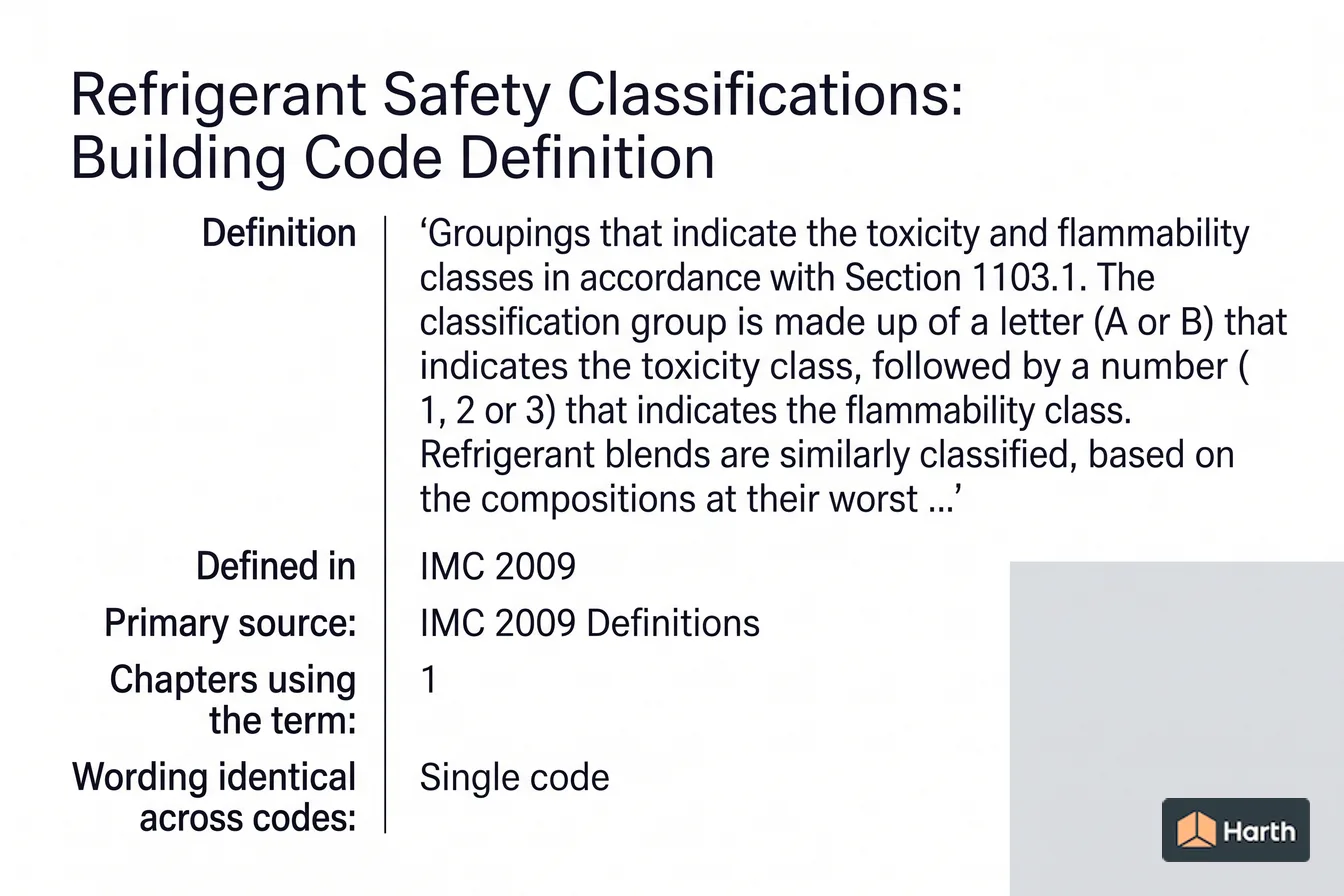
Refrigerant safety classifications is a defined term in the International Mechanical Code (IMC) 2009, in Definitions. The code's own words are: “Groupings that indicate the toxicity and flammability classes in accordance with Section 1103.1. The classification group is made up of a letter (A or B) that indicates the toxicity class, followed by a number (1, 2 or 3) that indicates the flammability class. Refrigerant blends are similarly classified, based on the compositions at their worst …” No other I-Code in this corpus defines it, so the IMC 2009 definition is the one to work from. The term is used in 1 chapters of this corpus, most often in Definitions (IMC 2009). These pages transcribe the 2009 model text; verify the definition against the edition and amendments your authority having jurisdiction has adopted.
Content and cited inputs reviewed by Scott Barrington, Harth founder and architectural technology specialist · Published 2026-09-07 · Updated 2026-09-07.
What does this term mean?
Refrigerant Safety Classifications — IMC 2009, Definitions:
Groupings that indicate the toxicity and flammability classes in accordance with Section 1103.1. The classification group is made up of a letter (A or B) that indicates the toxicity class, followed by a number (1, 2 or 3) that indicates the flammability class. Refrigerant blends are similarly classified, based on the compositions at their worst cases of fractionation, as separately determined for toxicity and flammability. In some cases, the worst case of fractionation is the original formulation.
What must be verified before using this guidance?
Refrigerant Safety Classifications is defined once in this corpus, in the Definitions chapter of the International Mechanical Code (IMC) 2009:
Groupings that indicate the toxicity and flammability classes in accordance with Section 1103.1. The classification group is made up of a letter (A or B) that indicates the toxicity class, followed by a number (1, 2 or 3) that indicates the flammability class. Refrigerant blends are similarly classified, based on the compositions at their worst cases of fractionation, as separately determined for toxicity and flammability. In some cases, the worst case of fractionation is the original formulation.
Where refrigerant safety classifications is used in the code
The term appears in 1 chapters of the 2009 I-Codes hosted here. The chapters that lean on it hardest are the ones to read next.
| Chapter | Code | Mentions |
|---|---|---|
| Definitions | IMC 2009 | 1 |
The terms refrigerant safety classifications is built out of
The definition above leans on 1 other defined term. Each carries its own code definition, and a local amendment to any of them changes what refrigerant safety classifications covers:
- Refrigerant — IRC 2009: A substance used to produce refrigeration by its expansion or evaporation.
Refrigerant Safety Classifications: what to open, and in what order
Every row is a document this term depends on. The ICC code library and the ICC adoption maps cover the middle rows.
| Check | Where | Confirmed |
|---|---|---|
| Read the definition in the adopted IMC | Definitions | |
| Re-check the requirement that uses it | Definitions (IMC 2009) | |
| Confirm the dependent definition | Refrigerant | |
| Local amendment to any of the above | Jurisdiction's amendment list |
A research aid, not a code determination. The authority having jurisdiction decides which edition and which amendments apply.
Where can you explore related guidance?
- Explore all glossary guidance
- Refrigerant: Building Code Definition
- Building: Building Code Definition
- Construction Documents: Building Code Definition
- Registered Design Professional: Building Code Definition
Sources and method
Definitions quoted from the 2009 International Codes as transcribed in this site's building-codes collection, with the source chapter linked for each quotation. Usage counts are computed over the chapters hosted here, one copy per code. The ICC code library publishes the current model text and the ICC adoption maps show which edition a jurisdiction has adopted; those sources control.
Source links
Frequently asked questions
What is the code definition of refrigerant safety classifications?
The International Mechanical Code (IMC) 2009 defines it in Definitions as: “Groupings that indicate the toxicity and flammability classes in accordance with Section 1103.1. The classification group is made up of a letter (A or B) that indicates the toxicity class, followed by a number (1, 2 or 3) that indicates the flammability class. Refrigerant blends are similarly classified, based on the compositions at their worst cases of fractionation, as separately determined for toxicity and flammability. In some cases, the worst case of fractionation is the original formulation.” The 2009 model text is reproduced here; the definition that binds your project is the one in the edition your jurisdiction has adopted, as amended locally.
Which parts of the code depend on refrigerant safety classifications?
In this corpus the term is used across 1 chapters, led by Definitions in the IMC 2009. Those are the sections whose scope moves if the definition is amended locally, so read them together with Chapter 2 rather than on their own.
Related pages
- Reduced Flow Valve: Building Code Definition
Reduced Flow Valve — IFC 2009 definition: A valve equipped with a restricted flow orifice and inserted into a compressedgas cylinder, portable tank …
- Reduced Pressure Principle Backflow Preventer: Building Code Definition
Reduced Pressure Principle Backflow Preventer — IPC 2009 definition: A backflow prevention device consisting of two independently acting check valves, internally force-load…
- Refrigerant Compressor: Building Code Definition
Refrigerant Compressor — IRC 2009 definition: A specific machine, with or without accessories, for compressing a given refrigerant vapor.
- Refrigerant: Building Code Definition
Refrigerant — IRC 2009 definition: A substance used to produce refrigeration by its expansion or evaporation.
- Refrigerated Room or Space: Building Code Definition
Refrigerated Room or Space — IMC 2009 definition: A room or space in which an evaporator or brine coil is located for the purpose …
- Refrigerating System: Building Code Definition
Refrigerating System — IRC 2009 definition: A combination of interconnected parts forming a closed circuit in which refrigerant is circulated for the …