Building Code Glossary
Residential Care/assisted Living Facilities: Building Code Definition
How the IBC 2009, IFC 2009 define residential care/assisted living facilities, where the wording differs, and which chapters depend on the term.
On this page
Last updated September 7, 2026 · Definitions quoted from the 2009 International Codes as transcribed in this site's building-codes collection, with the source chapter linked for each quotation. Usage counts are computed over the chapters hosted here, one copy per code. The [ICC code library](https://codes.iccsafe.org/codes) publishes the current model text and the [ICC adoption maps](https://www.iccsafe.org/advocacy/code-adoption-maps/) show which edition a jurisdiction has adopted; those sources control.
Direct answer
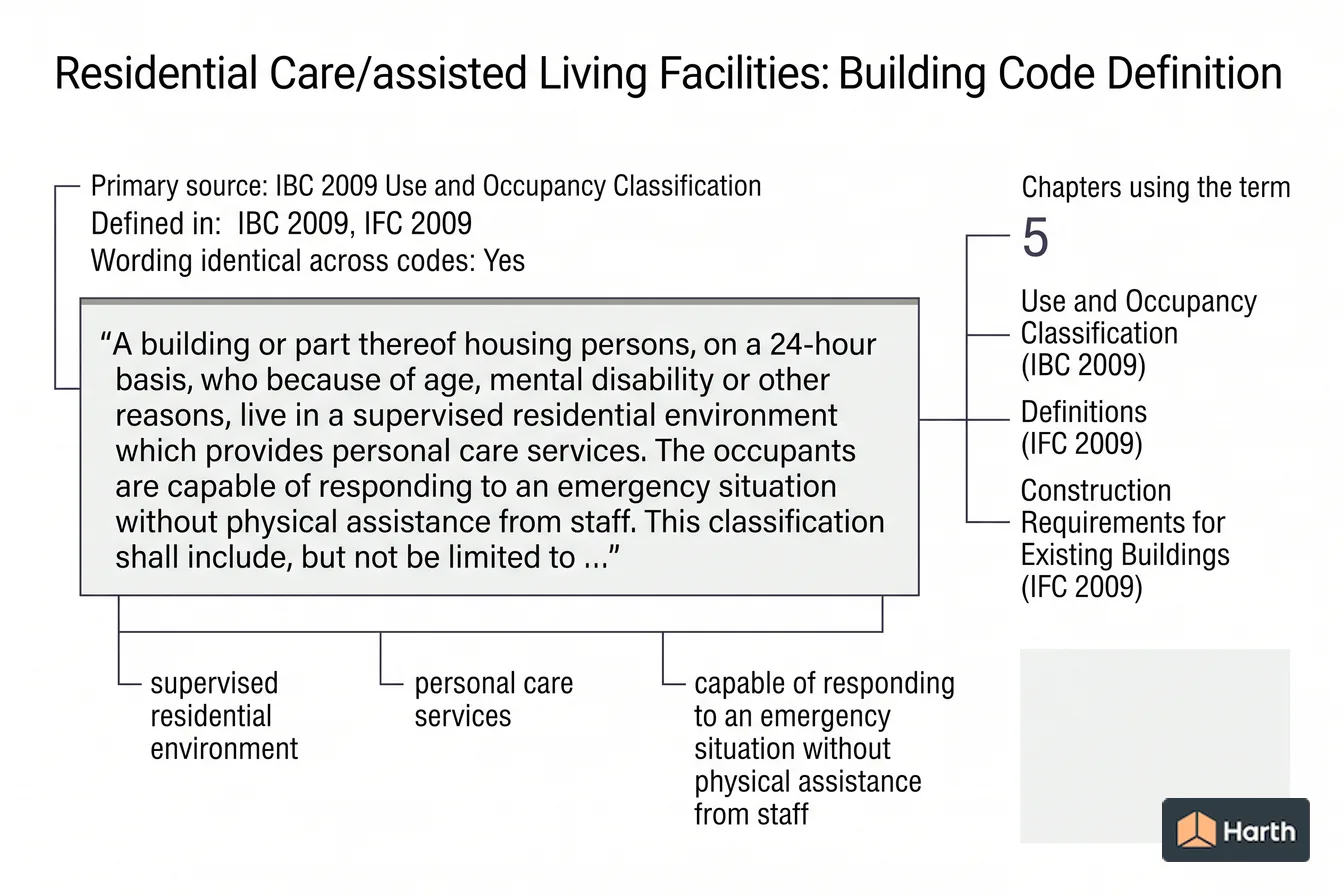
Residential care/assisted living facilities is a defined term in the International Building Code (IBC) 2009, in Use and Occupancy Classification. The code's own words are: “A building or part thereof housing persons, on a 24-hour basis, who because of age, mental disability or other reasons, live in a supervised residential environment which provides personal care services. The occupants are capable of responding to an emergency situation without physical assistance from staff. This classification shall include, but not be limited to …” The IFC 2009 carries the same definition word for word, so the term means the same thing in each. The term is used in 5 chapters of this corpus, most often in Construction Requirements for Existing Buildings (IFC 2009), Definitions (IFC 2009), Use and Occupancy Classification (IBC 2009). These pages transcribe the 2009 model text; verify the definition against the edition and amendments your authority having jurisdiction has adopted.
Content and cited inputs reviewed by Scott Barrington, Harth founder and architectural technology specialist · Published 2026-09-07 · Updated 2026-09-07.
What does this term mean?
Residential Care/assisted Living Facilities — IBC 2009, Use and Occupancy Classification:
A building or part thereof housing persons, on a 24-hour basis, who because of age, mental disability or other reasons, live in a supervised residential environment which provides personal care services. The occupants are capable of responding to an emergency situation without physical assistance from staff. This classification shall include, but not be limited to, the following: residential board and care facilities, assisted living facilities, halfway houses, group homes, congregate care facilities, social rehabilitation facilities, alcohol and drug abuse centers and convalescent facilities.
What must be verified before using this guidance?
Two of the I-Codes in this corpus define Residential Care/assisted Living Facilities, in identical words.
| Code | Where it is defined | Definition |
|---|---|---|
| IBC 2009 | Use and Occupancy Classification | A building or part thereof housing persons, on a 24-hour basis, who because of age, mental disability or other reasons, live in a supervised residential environment which provides personal care services. The occupants are capable of responding to an emergency situation without physical assistance from staff. This classification shall include, but not be limited to, the following: residential board and care facilities, assisted living facilities, halfway houses, group homes, congregate care facilities, social rehabilitation facilities, alcohol and drug abuse centers and convalescent facilities. |
| IFC 2009 | Definitions | A building or part thereof housing persons, on a 24-hour basis, who because of age, mental disability or other reasons, live in a supervised residential environment which provides personal care services. The occupants are capable of responding to an emergency situation without physical assistance from staff. This classification shall include, but not be limited to, the following: residential board and care facilities, assisted living facilities, halfway houses, group homes, congregate care facilities, social rehabilitation facilities, alcohol and drug abuse centers and convalescent facilities. |
Where residential care/assisted living facilities is used in the code
The term appears in 5 chapters of the 2009 I-Codes hosted here. The chapters that lean on it hardest are the ones to read next.
| Chapter | Code | Mentions |
|---|---|---|
| Construction Requirements for Existing Buildings | IFC 2009 | 4 |
| Definitions | IFC 2009 | 3 |
| Use and Occupancy Classification | IBC 2009 | 2 |
| Accessibility | IBC 2009 | 1 |
| Definitions | IBC 2009 | 1 |
The term in use
How the code actually writes about residential care/assisted living facilities, quoted from the 2009 text hosted here:
An automatic fire alarm system shall be installed in existing Group I-I residential care/assisted living facilities in accordance with Section 907.2.6.1.
Accessible units and Type B units shall be provided in general-purpose hospitals, psychiatric facilities, detoxification facilities and residential care/assisted living facilities of Group 1-2 occupancies in accordance with Sections 1107.5.3.1 and 1107.5.3.2.
The terms residential care/assisted living facilities is built out of
The definition above leans on 2 other defined terms. Each carries its own code definition, and a local amendment to any of them changes what residential care/assisted living facilities covers:
- Building — IBC 2009: Any structure used or intended for supporting or sheltering any use or occupancy.
- Shall — IRC 2009: The term, when used in the code, is construed as mandatory.
Residential Care/assisted Living Facilities: what to open, and in what order
Every row is a document this term depends on. The ICC code library and the ICC adoption maps cover the middle rows.
| Check | Where | Confirmed |
|---|---|---|
| Read the definition in the adopted IBC | Use and Occupancy Classification | |
| Read the definition in the adopted IFC | Definitions | |
| Re-check the requirement that uses it | Construction Requirements for Existing Buildings (IFC 2009) | |
| Re-check the requirement that uses it | Definitions (IFC 2009) | |
| Re-check the requirement that uses it | Use and Occupancy Classification (IBC 2009) | |
| Re-check the requirement that uses it | Accessibility (IBC 2009) | |
| Confirm the dependent definition | Building | |
| Confirm the dependent definition | Shall | |
| Local amendment to any of the above | Jurisdiction's amendment list |
A research aid, not a code determination. The authority having jurisdiction decides which edition and which amendments apply.
Where can you explore related guidance?
- Explore all glossary guidance
- Building: Building Code Definition
- Corrosive: Building Code Definition
- Hazardous Materials: Building Code Definition
- Combustible Liquid: Building Code Definition
Sources and method
Definitions quoted from the 2009 International Codes as transcribed in this site's building-codes collection, with the source chapter linked for each quotation. Usage counts are computed over the chapters hosted here, one copy per code. The ICC code library publishes the current model text and the ICC adoption maps show which edition a jurisdiction has adopted; those sources control.
Source links
Frequently asked questions
What is the code definition of residential care/assisted living facilities?
The International Building Code (IBC) 2009 defines it in Use and Occupancy Classification as: “A building or part thereof housing persons, on a 24-hour basis, who because of age, mental disability or other reasons, live in a supervised residential environment which provides personal care services. The occupants are capable of responding to an emergency situation without physical assistance from staff. This classification shall include, but not be limited to, the following: residential board and care facilities, assisted living facilities, halfway houses, group homes, congregate care facilities, social rehabilitation facilities, alcohol and drug abuse centers and convalescent facilities.” The 2009 model text is reproduced here; the definition that binds your project is the one in the edition your jurisdiction has adopted, as amended locally.
Which parts of the code depend on residential care/assisted living facilities?
In this corpus the term is used across 5 chapters, led by Construction Requirements for Existing Buildings in the IFC 2009. Those are the sections whose scope moves if the definition is amended locally, so read them together with Chapter 2 rather than on their own.
What is the definition of a residential care facility?
Facility is a separate defined term. The IBC 2009 defines it as: “All or any portion of buildings, structures, site improvements, elements and pedestrian or vehicular routes located on a site.” That is not the same as residential care/assisted living facilities, which the IBC 2009 defines as “A building or part thereof housing persons, on a 24-hour basis, who because of age, mental disability or other reasons, live in a supervised residential environment which provides personal care services. The occupants are capable of responding to an emergency …” — read both before applying either, and confirm the wording in the edition your jurisdiction has adopted.
Related pages
- Reroofing: Building Code Definition
Reroofing — IBC 2009 definition: The process of recovering or replacing an existing roof covering.
- Residential Aircraft Hangar: Building Code Definition
Residential Aircraft Hangar — IBC 2009 definition: An accessory building less than 2,000 square feet (186 m2) and 20 feet (6096 mm) in …
- Residential Building: Building Code Definition
Residential Building — IECC 2009 definition: For this code, includes R-3 buildings, as well as R-2 and R-4 buildings three stories or …
- Resistance Factor: Building Code Definition
Resistance Factor — IBC 2009 definition: A factor that accounts for deviations of the actual strength from the nominal strength and the …
- Responsible Person: Building Code Definition
Responsible Person — IFC 2009 definition: A person trained in the safety and fire safety considerations concerned with hot work.
- Retail Display Area: Building Code Definition
Retail Display Area — IFC 2009 definition: The area of a Group M occupancy open for the purpose of viewing or purchasing merchandise …