Building Code Glossary
Service Lateral: Building Code Definition
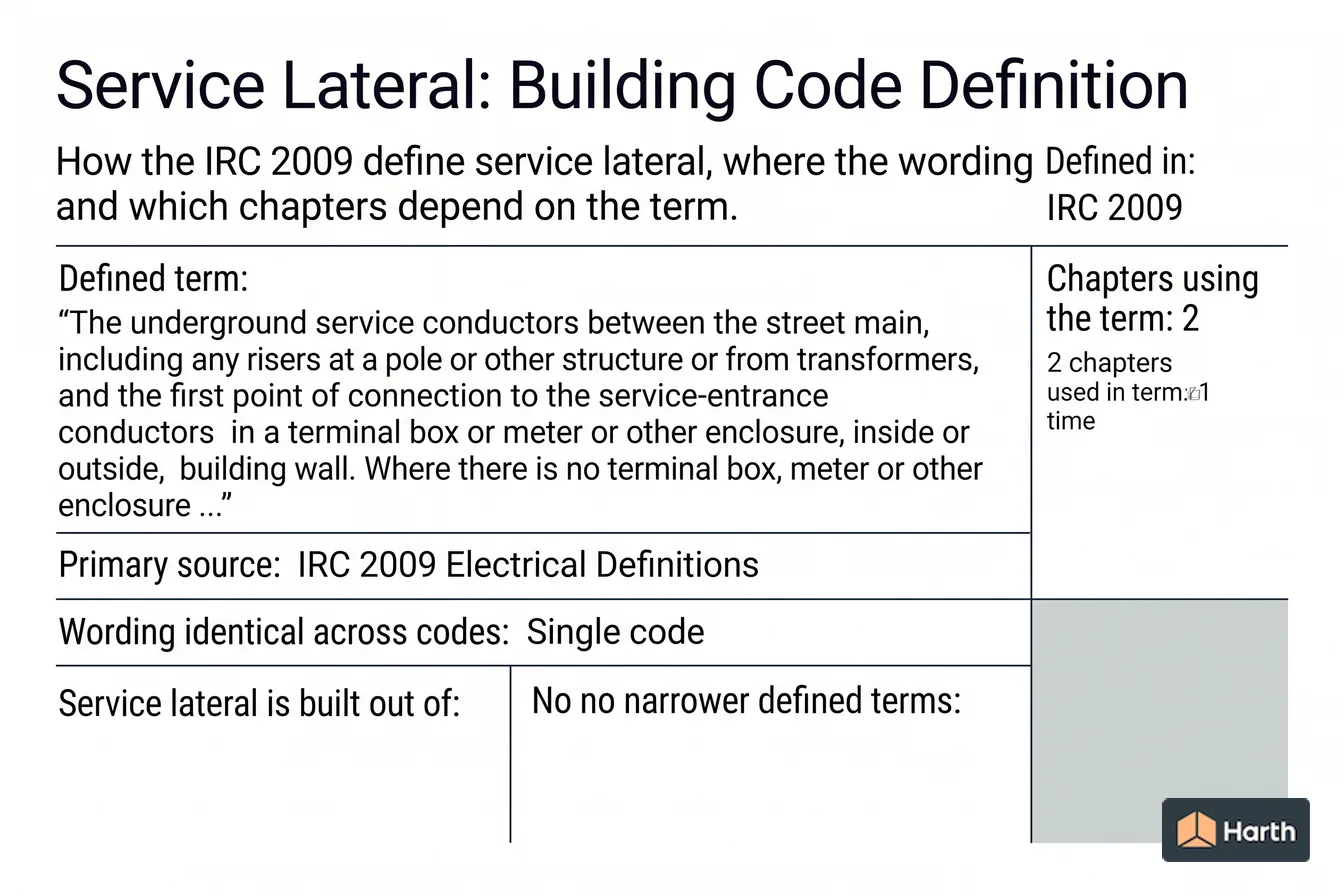
How the IRC 2009 define service lateral, where the wording differs, and which chapters depend on the term.
On this page
Last updated September 7, 2026 · Definitions quoted from the 2009 International Codes as transcribed in this site's building-codes collection, with the source chapter linked for each quotation. Usage counts are computed over the chapters hosted here, one copy per code. The [ICC code library](https://codes.iccsafe.org/codes) publishes the current model text and the [ICC adoption maps](https://www.iccsafe.org/advocacy/code-adoption-maps/) show which edition a jurisdiction has adopted; those sources control.
Direct answer
Service lateral is a defined term in the International Residential Code (IRC) 2009, in Electrical Definitions. The code's own words are: “The underground service conductors between the street main, including any risers at a pole or other structure or from transformers, and the first point of connection to the service-entrance conductors in a terminal box or meter or other enclosure, inside or outside the building wall. Where there is no terminal box, meter or other enclosure …” No other I-Code in this corpus defines it, so the IRC 2009 definition is the one to work from. The term is used in 2 chapters of this corpus, most often in Electrical Definitions (IRC 2009), Services (IRC 2009). These pages transcribe the 2009 model text; verify the definition against the edition and amendments your authority having jurisdiction has adopted.
Content and cited inputs reviewed by Scott Barrington, Harth founder and architectural technology specialist · Published 2026-09-07 · Updated 2026-09-07.
What does this term mean?
Service Lateral — IRC 2009, Electrical Definitions:
The underground service conductors between the street main, including any risers at a pole or other structure or from transformers, and the first point of connection to the service-entrance conductors in a terminal box or meter or other enclosure, inside or outside the building wall. Where there is no terminal box, meter or other enclosure with adequate space, the point of connection shall be considered to be the point of entrance of the service conductors into the building.
What must be verified before using this guidance?
Service Lateral is defined once in this corpus, in the Electrical Definitions chapter of the International Residential Code (IRC) 2009:
The underground service conductors between the street main, including any risers at a pole or other structure or from transformers, and the first point of connection to the service-entrance conductors in a terminal box or meter or other enclosure, inside or outside the building wall. Where there is no terminal box, meter or other enclosure with adequate space, the point of connection shall be considered to be the point of entrance of the service conductors into the building.
Where service lateral is used in the code
The term appears in 2 chapters of the 2009 I-Codes hosted here. The chapters that lean on it hardest are the ones to read next.
| Chapter | Code | Mentions |
|---|---|---|
| Electrical Definitions | IRC 2009 | 2 |
| Services | IRC 2009 | 2 |
The term in use
How the code actually writes about service lateral, quoted from the 2009 text hosted here:
Conductors used as ungrounded service entrance conductors, service lateral conductors, and feeder conductors that serve as the main power feeder to a dwelling unit shall be those listed in Table E3603.1.
The terms service lateral is built out of
The definition above leans on 5 other defined terms. Each carries its own code definition, and a local amendment to any of them changes what service lateral covers:
- Service Conductors — IRC 2009: The conductors from the service point to the service disconnecting means.
- Enclosure — IRC 2009: The case or housing of apparatus, or the fence or walls surrounding an installation, to prevent personnel from accidentally contacting energized parts or to protect the equipment from physical damage.
- Structure — IPC 2009: That which is built or constructed or a portion thereof.
- Building — IBC 2009: Any structure used or intended for supporting or sheltering any use or occupancy.
- Service — IRC 2009: The conductors and equipment for delivering energy from the serving utility to the wiring system of the premises served.
Service Lateral: what to open, and in what order
Every row is a document this term depends on. The ICC code library and the ICC adoption maps cover the middle rows.
| Check | Where | Confirmed |
|---|---|---|
| Read the definition in the adopted IRC | Electrical Definitions | |
| Re-check the requirement that uses it | Electrical Definitions (IRC 2009) | |
| Re-check the requirement that uses it | Services (IRC 2009) | |
| Confirm the dependent definition | Service Conductors | |
| Confirm the dependent definition | Enclosure | |
| Confirm the dependent definition | Structure | |
| Local amendment to any of the above | Jurisdiction's amendment list |
A research aid, not a code determination. The authority having jurisdiction decides which edition and which amendments apply.
Where can you explore related guidance?
- Explore all glossary guidance
- Service Conductors: Building Code Definition
- Structure: Building Code Definition
- Enclosure: Building Code Definition
- Building: Building Code Definition
Sources and method
Definitions quoted from the 2009 International Codes as transcribed in this site's building-codes collection, with the source chapter linked for each quotation. Usage counts are computed over the chapters hosted here, one copy per code. The ICC code library publishes the current model text and the ICC adoption maps show which edition a jurisdiction has adopted; those sources control.
Source links
Frequently asked questions
What is the code definition of service lateral?
The International Residential Code (IRC) 2009 defines it in Electrical Definitions as: “The underground service conductors between the street main, including any risers at a pole or other structure or from transformers, and the first point of connection to the service-entrance conductors in a terminal box or meter or other enclosure, inside or outside the building wall. Where there is no terminal box, meter or other enclosure with adequate space, the point of connection shall be considered to be the point of entrance of the service conductors into the building.” The 2009 model text is reproduced here; the definition that binds your project is the one in the edition your jurisdiction has adopted, as amended locally.
Which parts of the code depend on service lateral?
In this corpus the term is used across 2 chapters, led by Electrical Definitions in the IRC 2009. Those are the sections whose scope moves if the definition is amended locally, so read them together with Chapter 2 rather than on their own.
What is the definition of a service lateral?
In the 2009 I-Codes hosted here it is a defined term rather than a description. The IRC 2009 states, in Electrical Definitions: “The underground service conductors between the street main, including any risers at a pole or other structure or from transformers, and the first point of connection to the service-entrance conductors in a terminal box or meter or other enclosure, inside or outside the building wall. Where there is no terminal box, meter or other enclosure …” It is defined in IRC 2009. Because it is a defined term, whatever the adopted edition says it means is what every section using it means — so check Chapter 2 of that edition and any local amendment before relying on this wording.
What does IRC mean in building code?
Building is a separate defined term. The IBC 2009 defines it as: “Any structure used or intended for supporting or sheltering any use or occupancy.” That is not the same as service lateral, which the IRC 2009 defines as “The underground service conductors between the street main, including any risers at a pole or other structure or from transformers, and the first point of connection to the service-entrance conductors in a terminal box or meter or other enclosure, inside …” — read both before applying either, and confirm the wording in the edition your jurisdiction has adopted.
Related pages
- Service Corridor: Building Code Definition
Service Corridor — IBC 2009 definition: A fully enclosed passage used for transporting HPM and purposes other than required means of egress.
- Service Entrance: Building Code Definition
Service Entrance — IBC 2009 definition: An entrance intended primarily for delivery of goods or services.
- Service Equipment: Building Code Definition
Service Equipment — IRC 2009 definition: The necessary equipment, usually consisting of a circuit breaker(s) or switch(es) and fuse(s), and their accessories …
- Service Water Heating: Building Code Definition
Service Water Heating — IECC 2009 definition: Supply of hot water for purposes other than comfort heating.
- Service: Building Code Definition
Service — IRC 2009 definition: The conductors and equipment for delivering energy from the serving utility to the wiring system of …
- Sewage Ejectors: Building Code Definition
Sewage Ejectors — IPC 2009 definition: A device for lifting sewage by entraining the sewage in a high-velocity jet of steam, air …