Building Code Glossary
Specific Gravity: Building Code Definition
How the IRC 2009 define specific gravity, where the wording differs, and which chapters depend on the term.
On this page
Last updated September 7, 2026 · Definitions quoted from the 2009 International Codes as transcribed in this site's building-codes collection, with the source chapter linked for each quotation. Usage counts are computed over the chapters hosted here, one copy per code. The [ICC code library](https://codes.iccsafe.org/codes) publishes the current model text and the [ICC adoption maps](https://www.iccsafe.org/advocacy/code-adoption-maps/) show which edition a jurisdiction has adopted; those sources control.
Direct answer
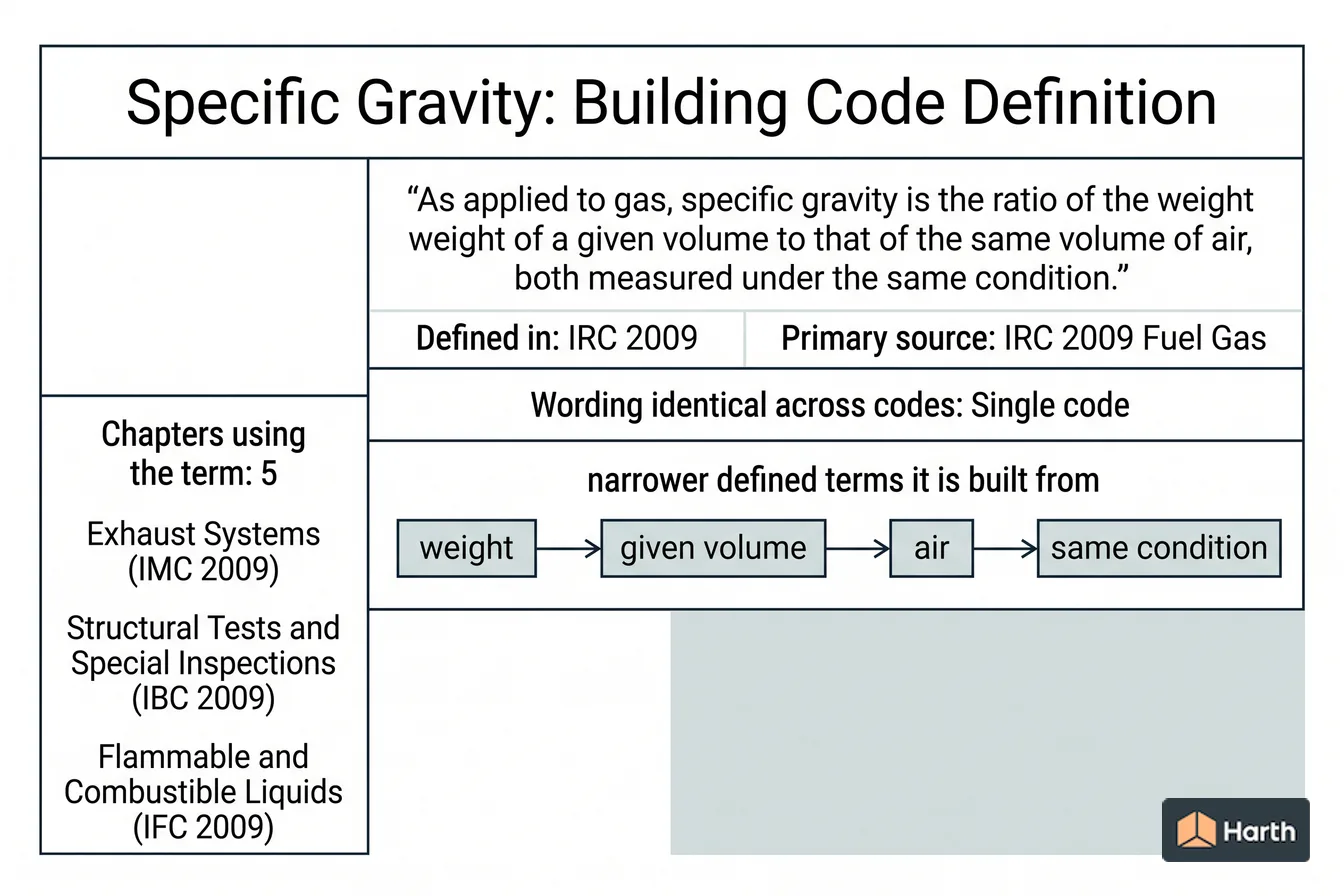
Specific gravity is a defined term in the International Residential Code (IRC) 2009, in Fuel Gas. The code's own words are: “As applied to gas, specific gravity is the ratio of the weight of a given volume to that of the same volume of air, both measured under the same condition.” No other I-Code in this corpus defines it, so the IRC 2009 definition is the one to work from. The term is used in 5 chapters of this corpus, most often in Exhaust Systems (IMC 2009), Structural Tests and Special Inspections (IBC 2009), Flammable and Combustible Liquids (IFC 2009). These pages transcribe the 2009 model text; verify the definition against the edition and amendments your authority having jurisdiction has adopted.
Content and cited inputs reviewed by Scott Barrington, Harth founder and architectural technology specialist · Published 2026-09-07 · Updated 2026-09-07.
What does this term mean?
Specific Gravity — IRC 2009, Fuel Gas:
As applied to gas, specific gravity is the ratio of the weight of a given volume to that of the same volume of air, both measured under the same condition.
What must be verified before using this guidance?
Specific Gravity is defined once in this corpus, in the Fuel Gas chapter of the International Residential Code (IRC) 2009:
As applied to gas, specific gravity is the ratio of the weight of a given volume to that of the same volume of air, both measured under the same condition.
Where specific gravity is used in the code
The term appears in 5 chapters of the 2009 I-Codes hosted here. The chapters that lean on it hardest are the ones to read next.
| Chapter | Code | Mentions |
|---|---|---|
| Exhaust Systems | IMC 2009 | 4 |
| Structural Tests and Special Inspections | IBC 2009 | 2 |
| Flammable and Combustible Liquids | IFC 2009 | 2 |
| Fuel Gas | IRC 2009 | 2 |
| Wall Construction | IRC 2009 | 2 |
The term in use
How the code actually writes about specific gravity, quoted from the 2009 text hosted here:
The vertical load-bearing capacity, torsional moment capacity and deflection characteristics of joist hangers shall be determined in accordance with ASTM D 1761 using lumber having a specific gravity of 0.49 or greater, but not greater than 0.55, as determined in accordance with AF&PA NDS for the joist and headers.
Design of ventilation systems shall consider the relatively high specific gravity of the vapors.
Substitution of other wood specieslgrades that meet or exceed the mechanical properties and specific gravity of No.2 Spruce-pine-fir shall be permitted.
Specific Gravity: what to open, and in what order
Every row is a document this term depends on. The ICC code library and the ICC adoption maps cover the middle rows.
| Check | Where | Confirmed |
|---|---|---|
| Read the definition in the adopted IRC | Fuel Gas | |
| Re-check the requirement that uses it | Exhaust Systems (IMC 2009) | |
| Re-check the requirement that uses it | Structural Tests and Special Inspections (IBC 2009) | |
| Re-check the requirement that uses it | Flammable and Combustible Liquids (IFC 2009) | |
| Re-check the requirement that uses it | Fuel Gas (IRC 2009) | |
| Local amendment to any of the above | Jurisdiction's amendment list |
A research aid, not a code determination. The authority having jurisdiction decides which edition and which amendments apply.
Where can you explore related guidance?
- Explore all glossary guidance
- Code Official: Building Code Definition
- Code: Building Code Definition
- Fuel Gas: Building Code Definition
- Vent: Building Code Definition
Sources and method
Definitions quoted from the 2009 International Codes as transcribed in this site's building-codes collection, with the source chapter linked for each quotation. Usage counts are computed over the chapters hosted here, one copy per code. The ICC code library publishes the current model text and the ICC adoption maps show which edition a jurisdiction has adopted; those sources control.
Source links
Frequently asked questions
What is the code definition of specific gravity?
The International Residential Code (IRC) 2009 defines it in Fuel Gas as: “As applied to gas, specific gravity is the ratio of the weight of a given volume to that of the same volume of air, both measured under the same condition.” The 2009 model text is reproduced here; the definition that binds your project is the one in the edition your jurisdiction has adopted, as amended locally.
Which parts of the code depend on specific gravity?
In this corpus the term is used across 5 chapters, led by Exhaust Systems in the IMC 2009. Those are the sections whose scope moves if the definition is amended locally, so read them together with Chapter 2 rather than on their own.
What does 1.000 specific gravity mean?
In the 2009 I-Codes hosted here it is a defined term rather than a description. The IRC 2009 states, in Fuel Gas: “As applied to gas, specific gravity is the ratio of the weight of a given volume to that of the same volume of air, both measured under the same condition.” It is defined in IRC 2009. Because it is a defined term, whatever the adopted edition says it means is what every section using it means — so check Chapter 2 of that edition and any local amendment before relying on this wording.
What is the specific gravity of 20 mm coarse aggregate?
In the 2009 I-Codes hosted here it is a defined term rather than a description. The IRC 2009 states, in Fuel Gas: “As applied to gas, specific gravity is the ratio of the weight of a given volume to that of the same volume of air, both measured under the same condition.” It is defined in IRC 2009. It is not the same as Aggregate, which the IBC 2009 defines separately as “In roofing, crushed stone, crushed slag or water-worn gravel used for surfacing for roof coverings.” Because it is a defined term, whatever the adopted edition says it means is what every section using it means — so check Chapter 2 of that edition and any local amendment before relying on this wording.
Related pages
- Special Industrial Explosive Device: Building Code Definition
Special Industrial Explosive Device — IFC 2009 definition: An explosive power pack containing an explosive charge in the form of a cartridge or construction …
- Special Inspection: Building Code Definition
Special Inspection — IBC 2009 definition: Inspection as herein required of the materials, installation, fabrication, erection or placement of components and connections …
- Special Structural Wall: Building Code Definition
Special Structural Wall — IBC 2009 definition: A cast-in-place or precast wall complying with the requirements of 21 .1.3 through 21.1.7,21.9 and 21.10 …
- Spillproof Vacuum Breaker: Building Code Definition
Spillproof Vacuum Breaker — IPC 2009 definition: An assembly consisting of one check valve force-loaded closed and an air-inlet vent valve force-loaded open …
- Splice: Building Code Definition
Splice — IBC 2009 definition: The result of a factory and/or field method of joining or connecting two or more lengths …
- Spline: Building Code Definition
Spline — IRC 2009 definition: A strip of wood structural panel cut from the same material used for the panel facings …