Building Code Glossary
Stack Bond: Building Code Definition
How the IBC 2009, IRC 2009 define stack bond, where the wording differs, and which chapters depend on the term.
On this page
Last updated September 7, 2026 · Definitions quoted from the 2009 International Codes as transcribed in this site's building-codes collection, with the source chapter linked for each quotation. Usage counts are computed over the chapters hosted here, one copy per code. The [ICC code library](https://codes.iccsafe.org/codes) publishes the current model text and the [ICC adoption maps](https://www.iccsafe.org/advocacy/code-adoption-maps/) show which edition a jurisdiction has adopted; those sources control.
Direct answer
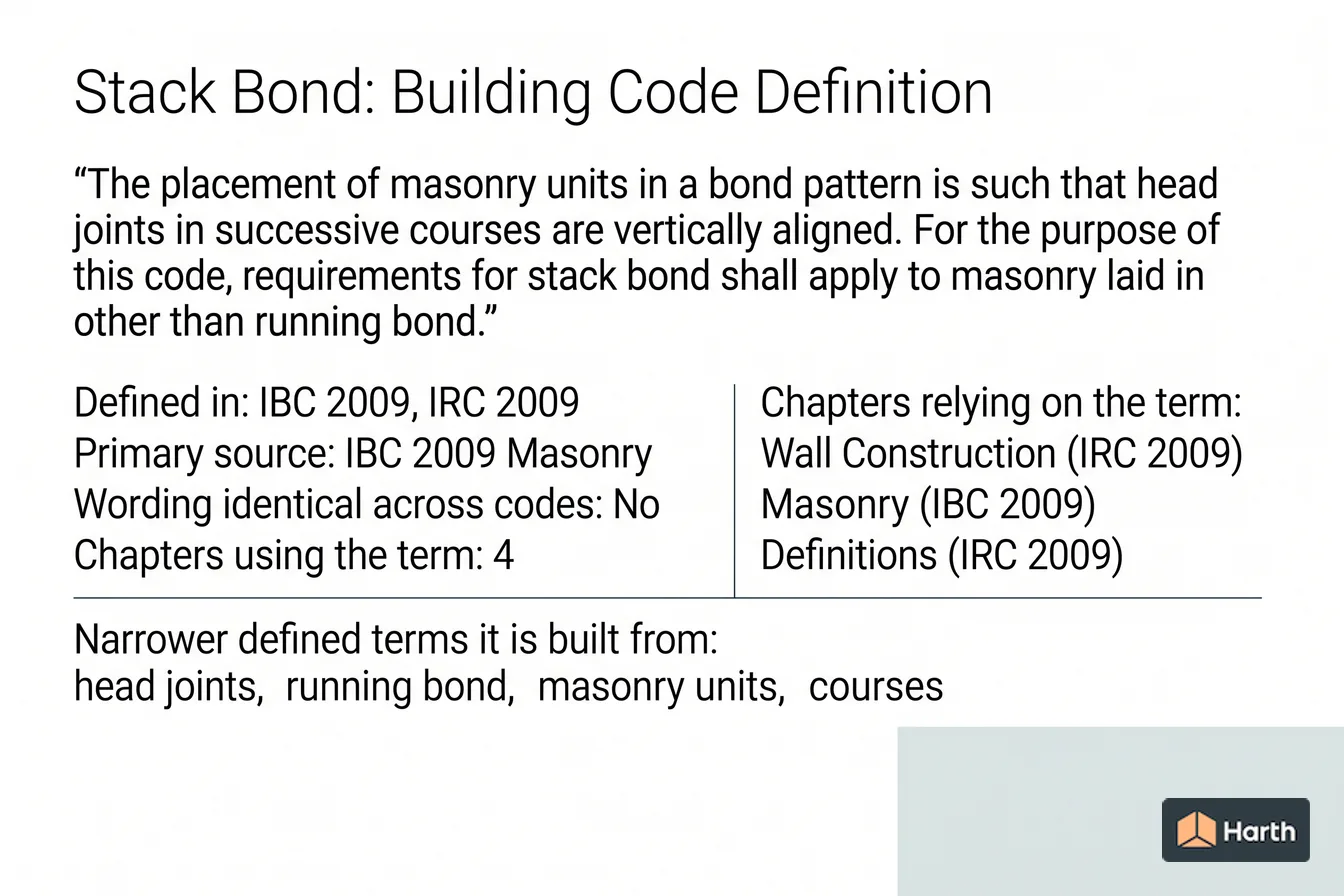
Stack bond is a defined term in the International Building Code (IBC) 2009, in Masonry. The code's own words are: “The placement of masonry units in a bond pattern is such that head joints in successive courses are vertically aligned. For the purpose of this code, requirements for stack bond shall apply to masonry laid in other than running bond.” The IRC 2009 defines the same term with different wording, so the controlling text depends on which code governs the question in front of you — the comparison below sets the versions side by side. The term is used in 4 chapters of this corpus, most often in Wall Construction (IRC 2009), Masonry (IBC 2009), Definitions (IRC 2009). These pages transcribe the 2009 model text; verify the definition against the edition and amendments your authority having jurisdiction has adopted.
Content and cited inputs reviewed by Scott Barrington, Harth founder and architectural technology specialist · Published 2026-09-07 · Updated 2026-09-07.
What does this term mean?
Stack Bond — IBC 2009, Masonry:
The placement of masonry units in a bond pattern is such that head joints in successive courses are vertically aligned. For the purpose of this code, requirements for stack bond shall apply to masonry laid in other than running bond.
What must be verified before using this guidance?
Two of the I-Codes in this corpus define Stack Bond, and the wording is not identical — read the version that governs your question.
| Code | Where it is defined | Definition |
|---|---|---|
| IBC 2009 | Masonry | The placement of masonry units in a bond pattern is such that head joints in successive courses are vertically aligned. For the purpose of this code, requirements for stack bond shall apply to masonry laid in other than running bond. |
| IRC 2009 | Definitions | The placement of masonry units in a bond pattern is such that head joints in successive courses are vertically aligned. For the purpose of this code, requirements for stack bond shall apply to all masonry laid in other than running bond. |
Where stack bond is used in the code
The term appears in 4 chapters of the 2009 I-Codes hosted here. The chapters that lean on it hardest are the ones to read next.
| Chapter | Code | Mentions |
|---|---|---|
| Wall Construction | IRC 2009 | 11 |
| Masonry | IBC 2009 | 2 |
| Definitions | IRC 2009 | 2 |
| Definitions | IBC 2009 | 1 |
The term in use
How the code actually writes about stack bond, quoted from the 2009 text hosted here:
Stack bond masonry that is not part of the lateral-force-resisting system shall have a horizontal cross-sectional area of reinforcement ofat least 0.0015 times the gross cross-sectional area of masonry.
The terms stack bond is built out of
The definition above leans on 4 other defined terms. Each carries its own code definition, and a local amendment to any of them changes what stack bond covers:
- Running Bond — IBC 2009: The placement of masonry units such that headjoints in successive courses are horizontally offset at least one-quarter the unit length.
- Masonry — IBC 2009: A built-up construction or combination of building units or materials of clay, shale, concrete, glass, gypsum, stone or other approved units bonded together with or without mortar or grout or other accepted methods of joining.
- Stack — IRC 2009: Any main vertical DWV line, including offsets, that extends one or more stories as directly as possible to its vent terminal.
- Shall — IRC 2009: The term, when used in the code, is construed as mandatory.
Stack Bond: what to open, and in what order
Every row is a document this term depends on. The ICC code library and the ICC adoption maps cover the middle rows.
| Check | Where | Confirmed |
|---|---|---|
| Read the definition in the adopted IBC | Masonry | |
| Read the definition in the adopted IRC | Definitions | |
| Re-check the requirement that uses it | Wall Construction (IRC 2009) | |
| Re-check the requirement that uses it | Masonry (IBC 2009) | |
| Re-check the requirement that uses it | Definitions (IRC 2009) | |
| Re-check the requirement that uses it | Definitions (IBC 2009) | |
| Confirm the dependent definition | Running Bond | |
| Confirm the dependent definition | Masonry | |
| Confirm the dependent definition | Stack | |
| Local amendment to any of the above | Jurisdiction's amendment list |
A research aid, not a code determination. The authority having jurisdiction decides which edition and which amendments apply.
Where can you explore related guidance?
- Explore all glossary guidance
- Running Bond: Building Code Definition
- Masonry: Building Code Definition
- Stack: Building Code Definition
Sources and method
Definitions quoted from the 2009 International Codes as transcribed in this site's building-codes collection, with the source chapter linked for each quotation. Usage counts are computed over the chapters hosted here, one copy per code. The ICC code library publishes the current model text and the ICC adoption maps show which edition a jurisdiction has adopted; those sources control.
Source links
Frequently asked questions
What is the code definition of stack bond?
The International Building Code (IBC) 2009 defines it in Masonry as: “The placement of masonry units in a bond pattern is such that head joints in successive courses are vertically aligned. For the purpose of this code, requirements for stack bond shall apply to masonry laid in other than running bond.” The 2009 model text is reproduced here; the definition that binds your project is the one in the edition your jurisdiction has adopted, as amended locally.
Which parts of the code depend on stack bond?
In this corpus the term is used across 4 chapters, led by Wall Construction in the IRC 2009. Those are the sections whose scope moves if the definition is amended locally, so read them together with Chapter 2 rather than on their own.
What is the difference between CMU stack bond and running bond?
In the 2009 I-Codes hosted here it is a defined term rather than a description. The IBC 2009 states, in Masonry: “The placement of masonry units in a bond pattern is such that head joints in successive courses are vertically aligned. For the purpose of this code, requirements for stack bond shall apply to masonry laid in other than running bond.” It is defined in IBC 2009, IRC 2009. It is not the same as Running Bond, which the IBC 2009 defines separately as “The placement of masonry units such that headjoints in successive courses are horizontally offset at least one-quarter the unit length.” Because it is a defined term, whatever the adopted edition says it means is what every section using it means — so check Chapter 2 of that edition and any local amendment before relying on this wording.
What is masonry stacked bond?
Masonry is a separate defined term. The IBC 2009 defines it as: “A built-up construction or combination of building units or materials of clay, shale, concrete, glass, gypsum, stone or other approved units bonded together with or without mortar or grout or other accepted methods of joining.” That is not the same as stack bond, which the IBC 2009 defines as “The placement of masonry units in a bond pattern is such that head joints in successive courses are vertically aligned. For the purpose of this code, requirements for stack bond shall apply to masonry laid in other than running bond.” — read both before applying either, and confirm the wording in the edition your jurisdiction has adopted.
What is running bond in masonry?
Running Bond is a separate defined term. The IBC 2009 defines it as: “The placement of masonry units such that headjoints in successive courses are horizontally offset at least one-quarter the unit length.” That is not the same as stack bond, which the IBC 2009 defines as “The placement of masonry units in a bond pattern is such that head joints in successive courses are vertically aligned. For the purpose of this code, requirements for stack bond shall apply to masonry laid in other than running bond.” — read both before applying either, and confirm the wording in the edition your jurisdiction has adopted.
Related pages
- Spray Room: Building Code Definition
Spray Room — IFC 2009 definition: A room designed to accommodate spraying operations constructed in accordance with the International BUilding Code and …
- Sprayed Fire-resistant Materials: Building Code Definition
Sprayed Fire-resistant Materials — IBC 2009 definition: Cementitious or fibrous materials that are sprayed to provide fire-resistant protection of the substrates.
- Spraying Space: Building Code Definition
Spraying Space — IFC 2009 definition: An area in which dangerous quantities of flammable vapors or combustible residues, dusts or deposits are …
- Stack Vent: Building Code Definition
Stack Vent — IRC 2009 definition: The extension of soil or waste stack above the highest horizontal drain connected.
- Stack Venting: Building Code Definition
Stack Venting — IRC 2009 definition: A method of venting a fixture or fixtures through the soil or waste stack without individual …
- Stack: Building Code Definition
Stack — IRC 2009 definition: Any main vertical DWV line, including offsets, that extends one or more stories as directly as …