Building Code Glossary
Substantial Improvement: Building Code Definition
How the IBC 2009 define substantial improvement, where the wording differs, and which chapters depend on the term.
On this page
Last updated September 7, 2026 · Definitions quoted from the 2009 International Codes as transcribed in this site's building-codes collection, with the source chapter linked for each quotation. Usage counts are computed over the chapters hosted here, one copy per code. The [ICC code library](https://codes.iccsafe.org/codes) publishes the current model text and the [ICC adoption maps](https://www.iccsafe.org/advocacy/code-adoption-maps/) show which edition a jurisdiction has adopted; those sources control.
Direct answer
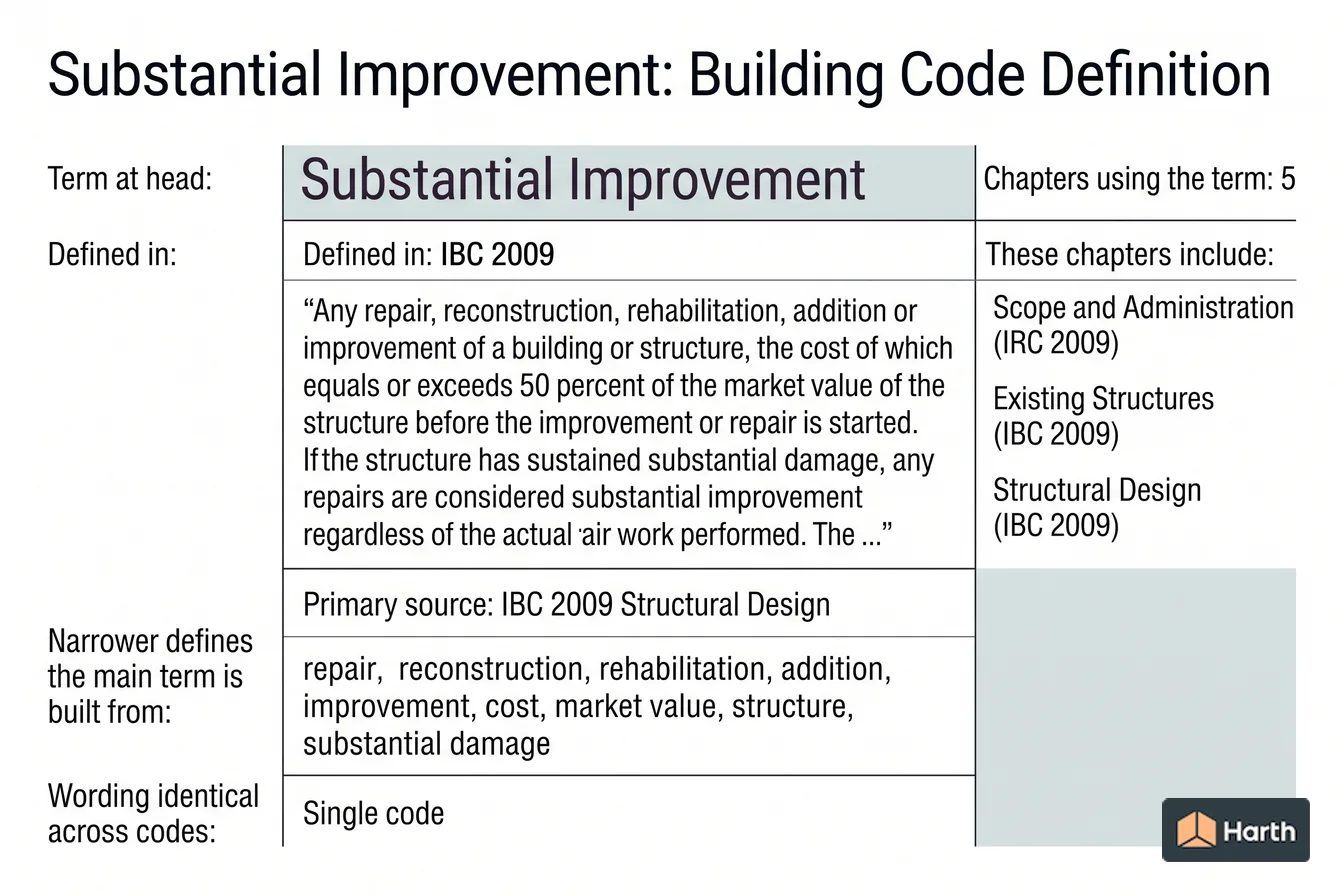
Substantial improvement is a defined term in the International Building Code (IBC) 2009, in Structural Design. The code's own words are: “Any repair, reconstruction, rehabilitation, addition or improvement of a building or structure, the cost of which equals or exceeds 50 percent of the market value of the structure before the improvement or repair is started. Ifthe structure has sustained substantial damage, any repairs are considered substantial improvement regardless of the actual repair work performed. The …” No other I-Code in this corpus defines it, so the IBC 2009 definition is the one to work from. The term is used in 5 chapters of this corpus, most often in Scope and Administration (IRC 2009), Existing Structures (IBC 2009), Structural Design (IBC 2009). These pages transcribe the 2009 model text; verify the definition against the edition and amendments your authority having jurisdiction has adopted.
Content and cited inputs reviewed by Scott Barrington, Harth founder and architectural technology specialist · Published 2026-09-07 · Updated 2026-09-07.
What does this term mean?
Substantial Improvement — IBC 2009, Structural Design:
Any repair, reconstruction, rehabilitation, addition or improvement of a building or structure, the cost of which equals or exceeds 50 percent of the market value of the structure before the improvement or repair is started. Ifthe structure has sustained substantial damage, any repairs are considered substantial improvement regardless of the actual repair work performed. The term does not, however, include either:
What must be verified before using this guidance?
Substantial Improvement is defined once in this corpus, in the Structural Design chapter of the International Building Code (IBC) 2009:
Any repair, reconstruction, rehabilitation, addition or improvement of a building or structure, the cost of which equals or exceeds 50 percent of the market value of the structure before the improvement or repair is started. Ifthe structure has sustained substantial damage, any repairs are considered substantial improvement regardless of the actual repair work performed. The term does not, however, include either:
Where substantial improvement is used in the code
The term appears in 5 chapters of the 2009 I-Codes hosted here. The chapters that lean on it hardest are the ones to read next.
| Chapter | Code | Mentions |
|---|---|---|
| Scope and Administration | IRC 2009 | 14 |
| Existing Structures | IBC 2009 | 10 |
| Structural Design | IBC 2009 | 5 |
| Building Planning | IRC 2009 | 2 |
| Definitions | IBC 2009 | 1 |
The term in use
How the code actually writes about substantial improvement, quoted from the 2009 text hosted here:
If the building official finds that the value of proposed work equals or exceeds 50 percent of the market value of the building or structure before the damage has occurred or the improvement is started, the finding shall be provided to the board of appeals for a determination of substantial improvement or substantial damage.
For buildings and structures in flood hazard areas established in Section 1612.3, any addition that constitutes substantial improvement of the existing structure, as defined in Section 1612.2, shall comply with the flood design requirements for new construction, and all aspects of the existing structure shall be brought into compliance with the requirements for new construction for flood design.
Within flood hazard areas as established in Section 1612.3, all new construction of buildings, structures and portions of buildings and structures, including substantial improvement and restoration of substantial damage to buildings and structures, shall be designed and constructed to resist the effects of flood hazards and flood loads.
The terms substantial improvement is built out of
The definition above leans on 5 other defined terms. Each carries its own code definition, and a local amendment to any of them changes what substantial improvement covers:
- Substantial Damage — IBC 2009: Damage of any origin sustained by a structure whereby the cost of restoring the structure to its before-damaged condition would equal or exceed 50 percent of the market value of the structure before the damage occurred.
- Structure — IPC 2009: That which is built or constructed or a portion thereof.
- Building — IBC 2009: Any structure used or intended for supporting or sheltering any use or occupancy.
- Addition — IBC 2009: An extension or increase in floor area or height of a building or structure.
- Repair — IBC 2009: The reconstruction or renewal ofany part ofan existing building for the purpose of its maintenance.
Substantial Improvement: what to open, and in what order
Every row is a document this term depends on. The ICC code library and the ICC adoption maps cover the middle rows.
| Check | Where | Confirmed |
|---|---|---|
| Read the definition in the adopted IBC | Structural Design | |
| Re-check the requirement that uses it | Scope and Administration (IRC 2009) | |
| Re-check the requirement that uses it | Existing Structures (IBC 2009) | |
| Re-check the requirement that uses it | Structural Design (IBC 2009) | |
| Re-check the requirement that uses it | Building Planning (IRC 2009) | |
| Confirm the dependent definition | Substantial Damage | |
| Confirm the dependent definition | Structure | |
| Confirm the dependent definition | Building | |
| Local amendment to any of the above | Jurisdiction's amendment list |
A research aid, not a code determination. The authority having jurisdiction decides which edition and which amendments apply.
Where can you explore related guidance?
- Explore all glossary guidance
- Substantial Damage: Building Code Definition
- Structure: Building Code Definition
- Building: Building Code Definition
- Addition: Building Code Definition
Sources and method
Definitions quoted from the 2009 International Codes as transcribed in this site's building-codes collection, with the source chapter linked for each quotation. Usage counts are computed over the chapters hosted here, one copy per code. The ICC code library publishes the current model text and the ICC adoption maps show which edition a jurisdiction has adopted; those sources control.
Source links
Frequently asked questions
What is the code definition of substantial improvement?
The International Building Code (IBC) 2009 defines it in Structural Design as: “Any repair, reconstruction, rehabilitation, addition or improvement of a building or structure, the cost of which equals or exceeds 50 percent of the market value of the structure before the improvement or repair is started. Ifthe structure has sustained substantial damage, any repairs are considered substantial improvement regardless of the actual repair work performed. The term does not, however, include either:” The 2009 model text is reproduced here; the definition that binds your project is the one in the edition your jurisdiction has adopted, as amended locally.
Which parts of the code depend on substantial improvement?
In this corpus the term is used across 5 chapters, led by Scope and Administration in the IRC 2009. Those are the sections whose scope moves if the definition is amended locally, so read them together with Chapter 2 rather than on their own.
What is considered a substantial improvement in the Florida Building Code?
In the 2009 I-Codes hosted here it is a defined term rather than a description. The IBC 2009 states, in Structural Design: “Any repair, reconstruction, rehabilitation, addition or improvement of a building or structure, the cost of which equals or exceeds 50 percent of the market value of the structure before the improvement or repair is started. Ifthe structure has sustained substantial damage, any repairs are considered substantial improvement regardless of the actual repair work performed. The …” It is defined in IBC 2009. It is not the same as Building, which the IBC 2009 defines separately as “Any structure used or intended for supporting or sheltering any use or occupancy.” Because it is a defined term, whatever the adopted edition says it means is what every section using it means — so check Chapter 2 of that edition and any local amendment before relying on this wording.
What is considered substantial damage?
Substantial Damage is a separate defined term. The IBC 2009 defines it as: “Damage of any origin sustained by a structure whereby the cost of restoring the structure to its before-damaged condition would equal or exceed 50 percent of the market value of the structure before the damage occurred.” That is not the same as substantial improvement, which the IBC 2009 defines as “Any repair, reconstruction, rehabilitation, addition or improvement of a building or structure, the cost of which equals or exceeds 50 percent of the market value of the structure before the improvement or repair is started. Ifthe structure has sustained substantial …” — read both before applying either, and confirm the wording in the edition your jurisdiction has adopted.
What is considered a building improvement?
Building is a separate defined term. The IBC 2009 defines it as: “Any structure used or intended for supporting or sheltering any use or occupancy.” That is not the same as substantial improvement, which the IBC 2009 defines as “Any repair, reconstruction, rehabilitation, addition or improvement of a building or structure, the cost of which equals or exceeds 50 percent of the market value of the structure before the improvement or repair is started. Ifthe structure has sustained substantial …” — read both before applying either, and confirm the wording in the edition your jurisdiction has adopted.
Related pages
- Structure: Building Code Definition
Structure — IPC 2009 definition: That which is built or constructed or a portion thereof.
- Subsoil Drain: Building Code Definition
Subsoil Drain — IRC 2009 definition: A drain that collects subsurface water or seepage water and conveys such water to a place …
- Substantial Damage: Building Code Definition
Substantial Damage — IBC 2009 definition: Damage of any origin sustained by a structure whereby the cost of restoring the structure to …
- Suite: Building Code Definition
Suite — IBC 2009 definition: A group of patient treatment rooms or patient sleeping rooms within Group 1-2 occupancies where staff …
- Sump Pump: Building Code Definition
Sump Pump — IRC 2009 definition: A pump installed to empty a sump.
- Sump Vent: Building Code Definition
Sump Vent — IPC 2009 definition: A vent from pneumatic sewage ejectors, or similar equipment, that terminates separately to the open air.