Building Code Glossary
Technically Infeasible: Building Code Definition
How the IBC 2009 define technically infeasible, where the wording differs, and which chapters depend on the term.
On this page
Last updated September 7, 2026 · Definitions quoted from the 2009 International Codes as transcribed in this site's building-codes collection, with the source chapter linked for each quotation. Usage counts are computed over the chapters hosted here, one copy per code. The [ICC code library](https://codes.iccsafe.org/codes) publishes the current model text and the [ICC adoption maps](https://www.iccsafe.org/advocacy/code-adoption-maps/) show which edition a jurisdiction has adopted; those sources control.
Direct answer
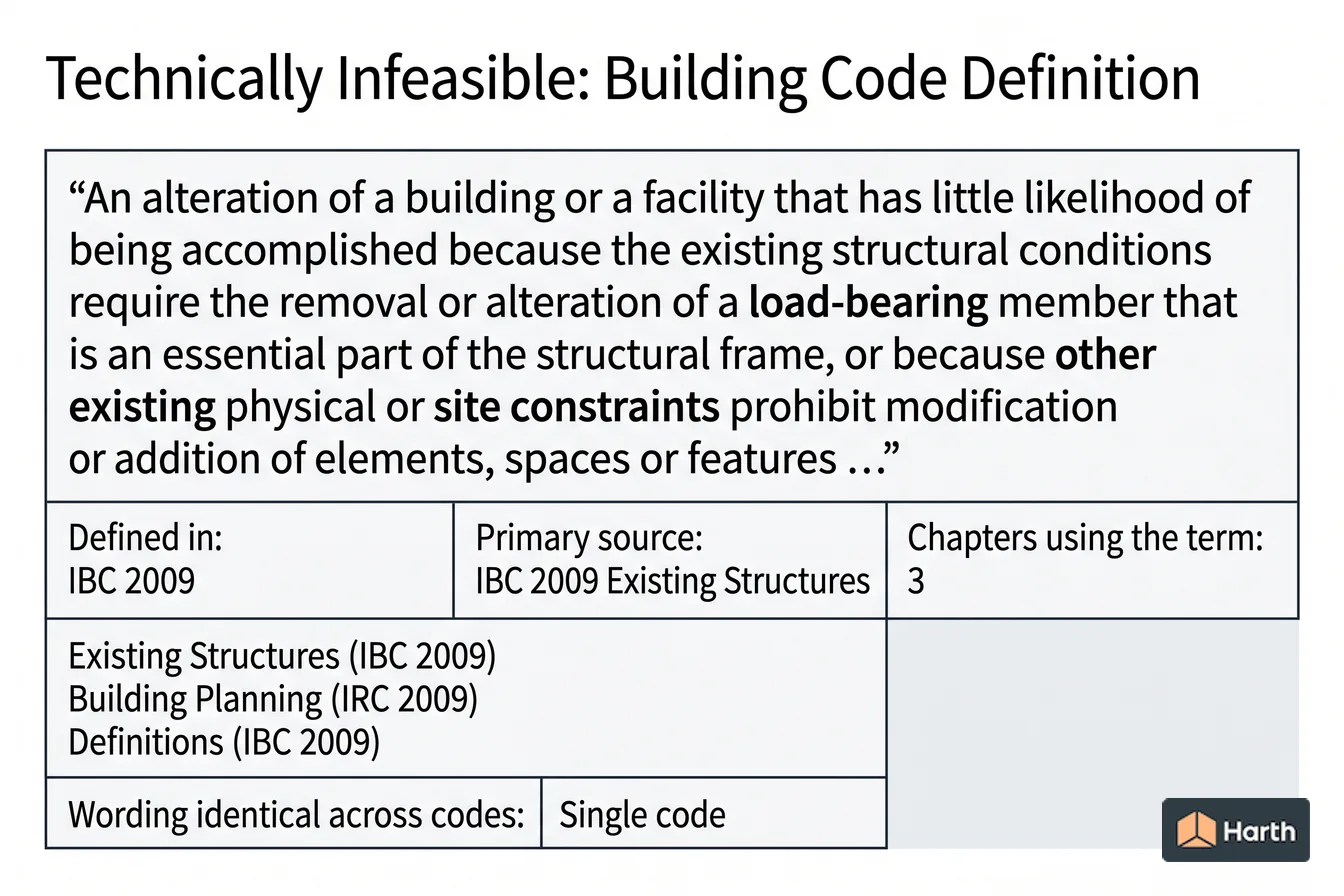
Technically infeasible is a defined term in the International Building Code (IBC) 2009, in Existing Structures. The code's own words are: “An alteration of a building or a facility that has little likelihood of being accomplished because the existing structural conditions require the removal or alteration of a load-bearing member that is an essential part of the structural frame, or because other existing physical or site constraints prohibit modification or addition of elements, spaces or features …” No other I-Code in this corpus defines it, so the IBC 2009 definition is the one to work from. The term is used in 3 chapters of this corpus, most often in Existing Structures (IBC 2009), Building Planning (IRC 2009), Definitions (IBC 2009). These pages transcribe the 2009 model text; verify the definition against the edition and amendments your authority having jurisdiction has adopted.
Content and cited inputs reviewed by Scott Barrington, Harth founder and architectural technology specialist · Published 2026-09-07 · Updated 2026-09-07.
What does this term mean?
Technically Infeasible — IBC 2009, Existing Structures:
An alteration of a building or a facility that has little likelihood of being accomplished because the existing structural conditions require the removal or alteration of a load-bearing member that is an essential part of the structural frame, or because other existing physical or site constraints prohibit modification or addition of elements, spaces or features which are in full and strict compliance with the minimum requirements for new construction and which are necessary to provide accessibility.
What must be verified before using this guidance?
Technically Infeasible is defined once in this corpus, in the Existing Structures chapter of the International Building Code (IBC) 2009:
An alteration of a building or a facility that has little likelihood of being accomplished because the existing structural conditions require the removal or alteration of a load-bearing member that is an essential part of the structural frame, or because other existing physical or site constraints prohibit modification or addition of elements, spaces or features which are in full and strict compliance with the minimum requirements for new construction and which are necessary to provide accessibility.
Where technically infeasible is used in the code
The term appears in 3 chapters of the 2009 I-Codes hosted here. The chapters that lean on it hardest are the ones to read next.
| Chapter | Code | Mentions |
|---|---|---|
| Existing Structures | IBC 2009 | 8 |
| Building Planning | IRC 2009 | 3 |
| Definitions | IBC 2009 | 1 |
The term in use
How the code actually writes about technically infeasible, quoted from the 2009 text hosted here:
A building, facility or element that is altered shall comply with the applicable provisions in Chapter 11 of this code and ICC Al17.1, unless technically infeasible.
Where it is technically infeasible to comply with the new construction standards for any of these requirements for a change of group or occupancy, the above items shall conform to the requirements to the maximum extent technically feasible.
— IBC 2009, Existing Structures
The terms technically infeasible is built out of
The definition above leans on 5 other defined terms. Each carries its own code definition, and a local amendment to any of them changes what technically infeasible covers:
- Alteration — IBC 2009: Any construction or renovation to an existing structure other than repair or addition.
- Building — IBC 2009: Any structure used or intended for supporting or sheltering any use or occupancy.
- Addition — IBC 2009: An extension or increase in floor area or height of a building or structure.
- Facility — IBC 2009: All or any portion of buildings, structures, site improvements, elements and pedestrian or vehicular routes located on a site.
- Existing — IFC 2009: Buildings, facilities or conditions that are already in existence, constructed or officially authorized prior to the adoption of this code.
Technically Infeasible: what to open, and in what order
Every row is a document this term depends on. The ICC code library and the ICC adoption maps cover the middle rows.
| Check | Where | Confirmed |
|---|---|---|
| Read the definition in the adopted IBC | Existing Structures | |
| Re-check the requirement that uses it | Existing Structures (IBC 2009) | |
| Re-check the requirement that uses it | Building Planning (IRC 2009) | |
| Re-check the requirement that uses it | Definitions (IBC 2009) | |
| Confirm the dependent definition | Alteration | |
| Confirm the dependent definition | Building | |
| Confirm the dependent definition | Addition | |
| Local amendment to any of the above | Jurisdiction's amendment list |
A research aid, not a code determination. The authority having jurisdiction decides which edition and which amendments apply.
Where can you explore related guidance?
- Explore all glossary guidance
- Alteration: Building Code Definition
- Facility: Building Code Definition
- Existing: Building Code Definition
- Building: Building Code Definition
Sources and method
Definitions quoted from the 2009 International Codes as transcribed in this site's building-codes collection, with the source chapter linked for each quotation. Usage counts are computed over the chapters hosted here, one copy per code. The ICC code library publishes the current model text and the ICC adoption maps show which edition a jurisdiction has adopted; those sources control.
Source links
Frequently asked questions
What is the code definition of technically infeasible?
The International Building Code (IBC) 2009 defines it in Existing Structures as: “An alteration of a building or a facility that has little likelihood of being accomplished because the existing structural conditions require the removal or alteration of a load-bearing member that is an essential part of the structural frame, or because other existing physical or site constraints prohibit modification or addition of elements, spaces or features which are in full and strict compliance with the minimum requirements for new construction and which are necessary to provide accessibility.” The 2009 model text is reproduced here; the definition that binds your project is the one in the edition your jurisdiction has adopted, as amended locally.
Which parts of the code depend on technically infeasible?
In this corpus the term is used across 3 chapters, led by Existing Structures in the IBC 2009. Those are the sections whose scope moves if the definition is amended locally, so read them together with Chapter 2 rather than on their own.
What does "technically infeasible" mean?
In the 2009 I-Codes hosted here it is a defined term rather than a description. The IBC 2009 states, in Existing Structures: “An alteration of a building or a facility that has little likelihood of being accomplished because the existing structural conditions require the removal or alteration of a load-bearing member that is an essential part of the structural frame, or because other existing physical or site constraints prohibit modification or addition of elements, spaces or features …” It is defined in IBC 2009. Because it is a defined term, whatever the adopted edition says it means is what every section using it means — so check Chapter 2 of that edition and any local amendment before relying on this wording.
What is a type V building?
Building is a separate defined term. The IBC 2009 defines it as: “Any structure used or intended for supporting or sheltering any use or occupancy.” That is not the same as technically infeasible, which the IBC 2009 defines as “An alteration of a building or a facility that has little likelihood of being accomplished because the existing structural conditions require the removal or alteration of a load-bearing member that is an essential part of the structural frame, or because …” — read both before applying either, and confirm the wording in the edition your jurisdiction has adopted.
Related pages
- Tank, Stationary: Building Code Definition
Tank, Stationary — IFC 2009 definition: Packaging designed primarily for stationary installations not intended for loading, unloading or attachment to a transport …
- Tank Vehicle: Building Code Definition
Tank Vehicle — IFC 2009 definition: A vehicle other than a railroad tank car or boat, with a cargo tank mounted thereon …
- Tank: Building Code Definition
Tank — IFC 2009 definition: A vessel containing more than 60 gallons (227 L).
- Temperature-relief Valve: Building Code Definition
Temperature-relief Valve — IRC 2009 definition: A temperature-actuated valve designed to discharge automatically at the temperature at which it is set.
- Tempered Water: Building Code Definition
Tempered Water — IPC 2009 definition: Water having a temperature range between 85°F (29°C) and 110°F (43°C).
- Tent: Building Code Definition
Tent — IBC 2009 definition: A structure, enclosure or shelter, with or without side- walls or drops, constructed of fabric or …