Building Code Glossary
Trouble Signal: Building Code Definition
How the IBC 2009, IFC 2009 define trouble signal, where the wording differs, and which chapters depend on the term.
On this page
Last updated September 7, 2026 · Definitions quoted from the 2009 International Codes as transcribed in this site's building-codes collection, with the source chapter linked for each quotation. Usage counts are computed over the chapters hosted here, one copy per code. The [ICC code library](https://codes.iccsafe.org/codes) publishes the current model text and the [ICC adoption maps](https://www.iccsafe.org/advocacy/code-adoption-maps/) show which edition a jurisdiction has adopted; those sources control.
Direct answer
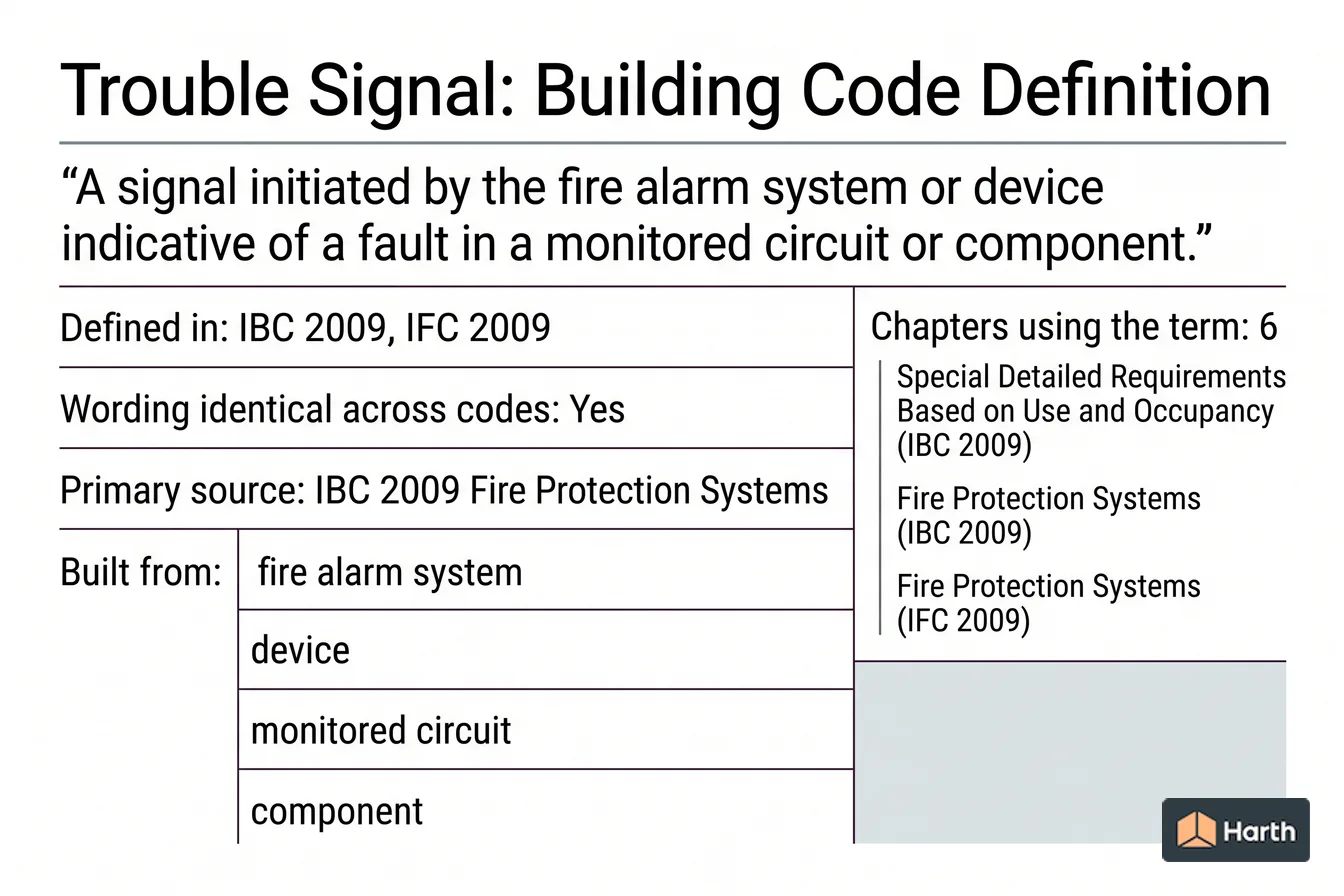
Trouble signal is a defined term in the International Building Code (IBC) 2009, in Fire Protection Systems. The code's own words are: “A signal initiated by the fire alarm system or device indicative of a fault in a monitored circuit or component.” The IFC 2009 carries the same definition word for word, so the term means the same thing in each. The term is used in 6 chapters of this corpus, most often in Fire Protection Systems (IBC 2009), Special Detailed Requirements Based on Use and Occupancy (IBC 2009), Fire Protection Systems (IFC 2009). These pages transcribe the 2009 model text; verify the definition against the edition and amendments your authority having jurisdiction has adopted. Record the jurisdiction, the adopted edition, the application date and any local amendment that rewrites the definition before you use it on a live project, because a term redefined by amendment changes every requirement that depends on it.
Content and cited inputs reviewed by Scott Barrington, Harth founder and architectural technology specialist · Published 2026-09-07 · Updated 2026-09-07.
What does this term mean?
Trouble Signal — IBC 2009, Fire Protection Systems:
A signal initiated by the fire alarm system or device indicative of a fault in a monitored circuit or component.
What must be verified before using this guidance?
Two of the I-Codes in this corpus define Trouble Signal, in identical words.
| Code | Where it is defined | Definition |
|---|---|---|
| IBC 2009 | Fire Protection Systems | A signal initiated by the fire alarm system or device indicative of a fault in a monitored circuit or component. |
| IFC 2009 | Fire Protection Systems | A signal initiated by the fire alarm system or device indicative of a fault in a monitored circuit or component. |
Where trouble signal is used in the code
The term appears in 6 chapters of the 2009 I-Codes hosted here. The chapters that lean on it hardest are the ones to read next.
| Chapter | Code | Mentions |
|---|---|---|
| Fire Protection Systems | IBC 2009 | 7 |
| Special Detailed Requirements Based on Use and Occupancy | IBC 2009 | 7 |
| Fire Protection Systems | IFC 2009 | 7 |
| Motor Fuel-dispensing Facilities and Repair Garages | IFC 2009 | 3 |
| Definitions | IBC 2009 | 1 |
| Definitions | IFC 2009 | 1 |
The term in use
How the code actually writes about trouble signal, quoted from the 2009 text hosted here:
Failure ofthe gas detection system shall result in the deactivation ofthe heating system, activation of the mechanical ventilation system and where the system is interlocked with gas detection and causes a trouble signal to sound in an approved location.
Loss of power or circuit continuity to the electronic monitoring device shall initiate a trouble signal.
— IBC 2009, Fire Protection Systems
with the gas detection system and cause a trouble signal to sound in an approved location.
— IBC 2009, Special Detailed Requirements Based on Use and Occupancy
The terms trouble signal is built out of
The definition above leans on 4 other defined terms. Each carries its own code definition, and a local amendment to any of them changes what trouble signal covers:
- Fire Alarm System — IBC 2009: A system or portion of a combination system consisting of components and circuits arranged to monitor and annunciate the status of fire alarm or supervisory signal-initiating devices and to initiate the appropriate response to those signals.
- Fire Alarm — IFC 2009: The giving, signaling or transmission to any public fire station, or company or to any officer or employee thereof, whether by telephone, spoken word or otherwise, of information to the effect that there is a fire at or near the …
- System — IFC 2009: An assembly of equipment consisting of a tank, container or containers, appurtenances, pumps, compressors and connecting piping.
- Device — IRC 2009: Aunit of an electrical system that carries or controls electrical energy as it principal function.
Trouble Signal: what to open, and in what order
Every row is a document this term depends on. The ICC code library and the ICC adoption maps cover the middle rows.
| Check | Where | Confirmed |
|---|---|---|
| Read the definition in the adopted IBC | Fire Protection Systems | |
| Read the definition in the adopted IFC | Fire Protection Systems | |
| Re-check the requirement that uses it | Fire Protection Systems (IBC 2009) | |
| Re-check the requirement that uses it | Special Detailed Requirements Based on Use and Occupancy (IBC 2009) | |
| Re-check the requirement that uses it | Fire Protection Systems (IFC 2009) | |
| Re-check the requirement that uses it | Motor Fuel-dispensing Facilities and Repair Garages (IFC 2009) | |
| Confirm the dependent definition | Fire Alarm System | |
| Confirm the dependent definition | Fire Alarm | |
| Confirm the dependent definition | System | |
| Local amendment to any of the above | Jurisdiction's amendment list |
A research aid, not a code determination. The authority having jurisdiction decides which edition and which amendments apply.
Where can you explore related guidance?
- Explore all glossary guidance
- Fire Alarm System: Building Code Definition
- Fire Alarm: Building Code Definition
- System: Building Code Definition
- Device: Building Code Definition
Sources and method
Definitions quoted from the 2009 International Codes as transcribed in this site's building-codes collection, with the source chapter linked for each quotation. Usage counts are computed over the chapters hosted here, one copy per code. The ICC code library publishes the current model text and the ICC adoption maps show which edition a jurisdiction has adopted; those sources control.
Source links
Frequently asked questions
What is the code definition of trouble signal?
The International Building Code (IBC) 2009 defines it in Fire Protection Systems as: “A signal initiated by the fire alarm system or device indicative of a fault in a monitored circuit or component.” The 2009 model text is reproduced here; the definition that binds your project is the one in the edition your jurisdiction has adopted, as amended locally.
Which parts of the code depend on trouble signal?
In this corpus the term is used across 6 chapters, led by Fire Protection Systems in the IBC 2009. Those are the sections whose scope moves if the definition is amended locally, so read them together with Chapter 2 rather than on their own.
What's the difference between a supervisory signal and a trouble signal?
In the 2009 I-Codes hosted here it is a defined term rather than a description. The IBC 2009 states, in Fire Protection Systems: “A signal initiated by the fire alarm system or device indicative of a fault in a monitored circuit or component.” It is defined in IBC 2009, IFC 2009. It is not the same as Supervisory Signal, which the IBC 2009 defines separately as “A signal indicating the need of action in connection with the supervision of guard tours, the fire suppression systems or equipment or the maintenance features of related systems.” Because it is a defined term, whatever the adopted edition says it means is what every section using it means — so check Chapter 2 of that edition and any local amendment before relying on this wording.
What is a fire trouble signal?
In the 2009 I-Codes hosted here it is a defined term rather than a description. The IBC 2009 states, in Fire Protection Systems: “A signal initiated by the fire alarm system or device indicative of a fault in a monitored circuit or component.” It is defined in IBC 2009, IFC 2009. Because it is a defined term, whatever the adopted edition says it means is what every section using it means — so check Chapter 2 of that edition and any local amendment before relying on this wording.
What does trouble mean on an alarm system?
System is a separate defined term. The IFC 2009 defines it as: “An assembly of equipment consisting of a tank, container or containers, appurtenances, pumps, compressors and connecting piping.” That is not the same as trouble signal, which the IBC 2009 defines as “A signal initiated by the fire alarm system or device indicative of a fault in a monitored circuit or component.” — read both before applying either, and confirm the wording in the edition your jurisdiction has adopted.
Related pages
- Trap: Building Code Definition
Trap — IRC 2009 definition: A fitting, either separate or built into a fixture, that provides a liquid seal to prevent …
- Treated Wood: Building Code Definition
Treated Wood — IBC 2009 definition: Wood and wood-based materials that use vacuum-pressure impregnation processes to enhance fire retardant or preservative properties.
- Trim: Building Code Definition
Trim — IBC 2009 definition: Picture molds, chair rails, baseboards, handrails, door and window frames and similar decorative or protective materials …
- Truss Design Drawing: Building Code Definition
Truss Design Drawing — IRC 2009 definition: The graphic depiction of an individual truss, which describes the design and physical characteristics of the …
- Tube Trailer: Building Code Definition
Tube Trailer — IFC 2009 definition: A semitrailer on which a number of tubular gas cylinders have been mounted.
- Type A Unit: Building Code Definition
Type A Unit — IBC 2009 definition: A dwelling unit or sleeping unit designed and constructed for accessibility in accordance with this code …