Building Code Glossary
Brazing: Building Code Definition
How the IRC 2009, IMC 2009 define brazing, where the wording differs, and which chapters depend on the term.
On this page
Last updated September 7, 2026 · Definitions quoted from the 2009 International Codes as transcribed in this site's building-codes collection, with the source chapter linked for each quotation. Usage counts are computed over the chapters hosted here, one copy per code. The [ICC code library](https://codes.iccsafe.org/codes) publishes the current model text and the [ICC adoption maps](https://www.iccsafe.org/advocacy/code-adoption-maps/) show which edition a jurisdiction has adopted; those sources control.
Direct answer
Brazing is a defined term in the International Residential Code (IRC) 2009, in Fuel Gas. The code's own words are: “A metal joining process wherein coalescence is produced by the use ofa nonferrous filler metal having a melting point above 1,000°F (538°C), but lower than that of the base metal beingjoined. The filler material is distributed between the closely fitted surfaces of the joint by capillary action.” The IMC 2009 defines the same term with different wording, so the controlling text depends on which code governs the question in front of you — the comparison below sets the versions side by side. The term is used in 9 chapters of this corpus, most often in Exhaust Systems (IMC 2009), Fuel Gas (IRC 2009), Fire Protection Systems (IBC 2009). These pages transcribe the 2009 model text; verify the definition against the edition and amendments your authority having jurisdiction has adopted.
Content and cited inputs reviewed by Scott Barrington, Harth founder and architectural technology specialist · Published 2026-09-07 · Updated 2026-09-07.
What does this term mean?
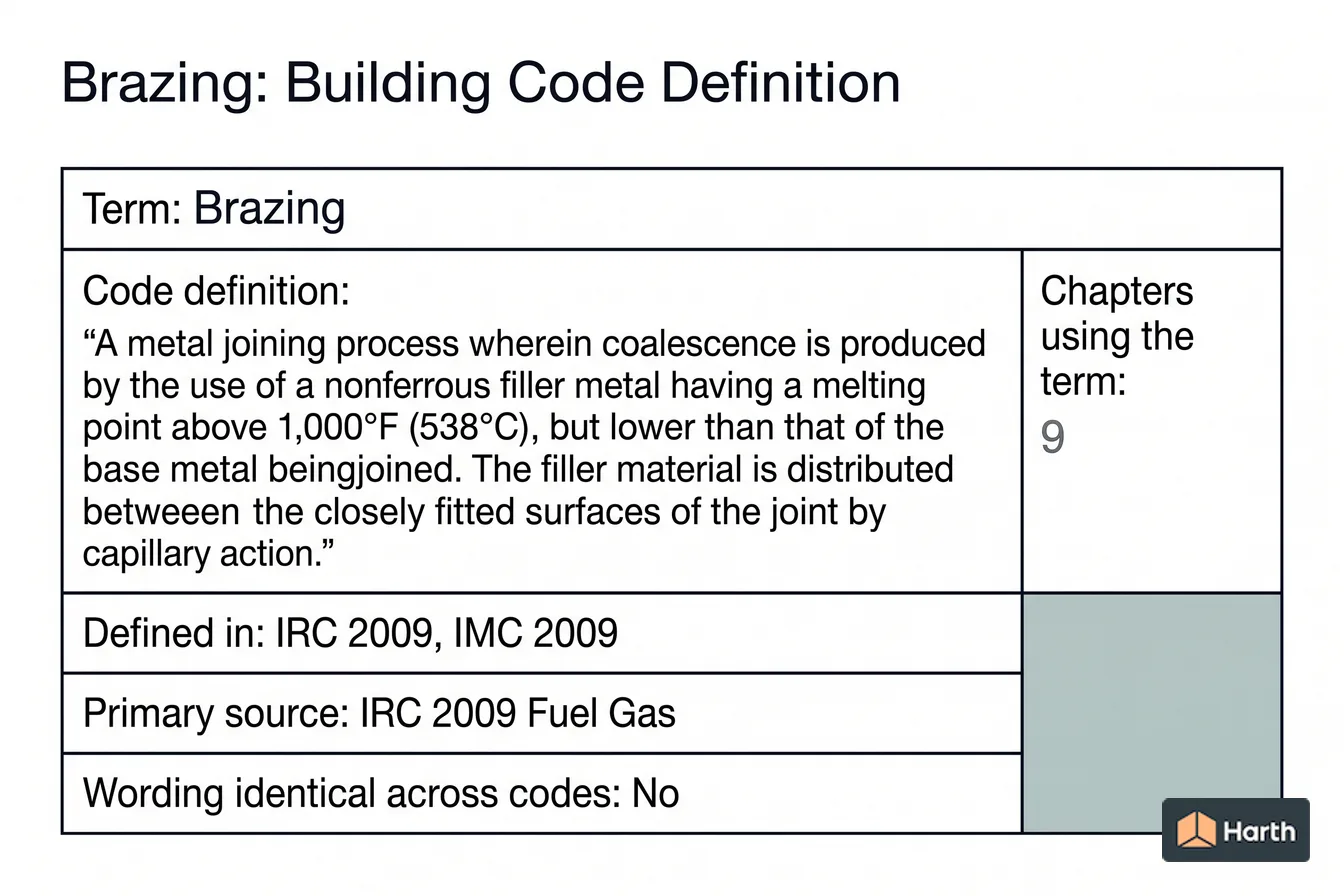
Brazing — IRC 2009, Fuel Gas:
A metal joining process wherein coalescence is produced by the use ofa nonferrous filler metal having a melting point above 1,000°F (538°C), but lower than that of the base metal beingjoined. The filler material is distributed between the closely fitted surfaces of the joint by capillary action.
What must be verified before using this guidance?
Two of the I-Codes in this corpus define Brazing, and the wording is not identical — read the version that governs your question.
| Code | Where it is defined | Definition |
|---|---|---|
| IRC 2009 | Fuel Gas | A metal joining process wherein coalescence is produced by the use ofa nonferrous filler metal having a melting point above 1,000°F (538°C), but lower than that of the base metal beingjoined. The filler material is distributed between the closely fitted surfaces of the joint by capillary action. |
| IMC 2009 | Definitions | A metal joining process wherein coalescence is produced by the use of a nonferrous filler metal having a melting point above 1,000°F (538°C), but lower than that ofthe base metal being joined. The filler material is distributed between the closely fitted surfaces of the joint by capillary attraction. |
Where brazing is used in the code
The term appears in 9 chapters of the 2009 I-Codes hosted here. The chapters that lean on it hardest are the ones to read next.
| Chapter | Code | Mentions |
|---|---|---|
| Exhaust Systems | IMC 2009 | 10 |
| Fuel Gas | IRC 2009 | 8 |
| Fire Protection Systems | IBC 2009 | 4 |
| Fire Protection Systems | IFC 2009 | 4 |
| Fixtures, Faucets and Fixture Fittings | IPC 2009 | 3 |
| Hydronic Piping | IMC 2009 | 2 |
| Welding and Other Hot Work | IFC 2009 | 1 |
| Definitions | IMC 2009 | 1 |
| Hvdronic Piping | IRC 2009 | 1 |
The term in use
How the code actually writes about brazing, quoted from the 2009 text hosted here:
Where nonferrous pipe is brazed, the brazing materials shall have a melting point in excess of I,OOO°F (538°C).
other joints shall be brazed using a BCuP5 brazing alloy with solidus above 1,1OO°F (593°C) and liquidus below 1,500°F (816°C).
Sheet copper shall be joined by brazing or soldering.
The terms brazing is built out of
The definition above leans on 1 other defined term. Each carries its own code definition, and a local amendment to any of them changes what brazing covers:
- Joint — IBC 2009: The linear opening in or between adjacent fire-resistance-rated assemblies that is designed to allow independent movement of the building in any plane caused by thermal, seismic, wind or any other loading.
Brazing: what to open, and in what order
Every row is a document this term depends on. The ICC code library and the ICC adoption maps cover the middle rows.
| Check | Where | Confirmed |
|---|---|---|
| Read the definition in the adopted IRC | Fuel Gas | |
| Read the definition in the adopted IMC | Definitions | |
| Re-check the requirement that uses it | Exhaust Systems (IMC 2009) | |
| Re-check the requirement that uses it | Fuel Gas (IRC 2009) | |
| Re-check the requirement that uses it | Fire Protection Systems (IBC 2009) | |
| Re-check the requirement that uses it | Fire Protection Systems (IFC 2009) | |
| Confirm the dependent definition | Joint | |
| Local amendment to any of the above | Jurisdiction's amendment list |
A research aid, not a code determination. The authority having jurisdiction decides which edition and which amendments apply.
Where can you explore related guidance?
- Explore all glossary guidance
- Joint: Building Code Definition
- Code Official: Building Code Definition
- Code: Building Code Definition
- Fuel Gas: Building Code Definition
Sources and method
Definitions quoted from the 2009 International Codes as transcribed in this site's building-codes collection, with the source chapter linked for each quotation. Usage counts are computed over the chapters hosted here, one copy per code. The ICC code library publishes the current model text and the ICC adoption maps show which edition a jurisdiction has adopted; those sources control.
Source links
Frequently asked questions
What is the code definition of brazing?
The International Residential Code (IRC) 2009 defines it in Fuel Gas as: “A metal joining process wherein coalescence is produced by the use ofa nonferrous filler metal having a melting point above 1,000°F (538°C), but lower than that of the base metal beingjoined. The filler material is distributed between the closely fitted surfaces of the joint by capillary action.” The 2009 model text is reproduced here; the definition that binds your project is the one in the edition your jurisdiction has adopted, as amended locally.
Which parts of the code depend on brazing?
In this corpus the term is used across 9 chapters, led by Exhaust Systems in the IMC 2009. Those are the sections whose scope moves if the definition is amended locally, so read them together with Chapter 2 rather than on their own.
What is the definition of brazing?
In the 2009 I-Codes hosted here it is a defined term rather than a description. The IRC 2009 states, in Fuel Gas: “A metal joining process wherein coalescence is produced by the use ofa nonferrous filler metal having a melting point above 1,000°F (538°C), but lower than that of the base metal beingjoined. The filler material is distributed between the closely fitted surfaces of the joint by capillary action.” It is defined in IRC 2009, IMC 2009. Because it is a defined term, whatever the adopted edition says it means is what every section using it means — so check Chapter 2 of that edition and any local amendment before relying on this wording.
Related pages
- Branch Vent: Building Code Definition
Branch Vent — IPC 2009 definition: A vent connecting one or more individual vents with a vent stack or stack vent.
- Branch: Building Code Definition
Branch — IRC 2009 definition: Any part of the piping system other than a riser, main or stack.
- Brazed Joint: Building Code Definition
Brazed Joint — IMC 2009 definition: A gas-tight joint obtained by the joining of metal parts with metallic mixtures or alloys which …
- Btu/h: Building Code Definition
Btu/h — IRC 2009 definition: The listed maximum capacity of an appliance, absorption unit or burner expressed in British thermal units …
- Btu: Building Code Definition
Btu — IRC 2009 definition: Abbreviation for British thermal unit, which is the quantity of heat required to raise the temperature …
- Building Drain: Building Code Definition
Building Drain — IRC 2009 definition: The lowest piping that collects the discharge from all other drainage piping inside the house and …