Building Code Glossary
Btu/h: Building Code Definition
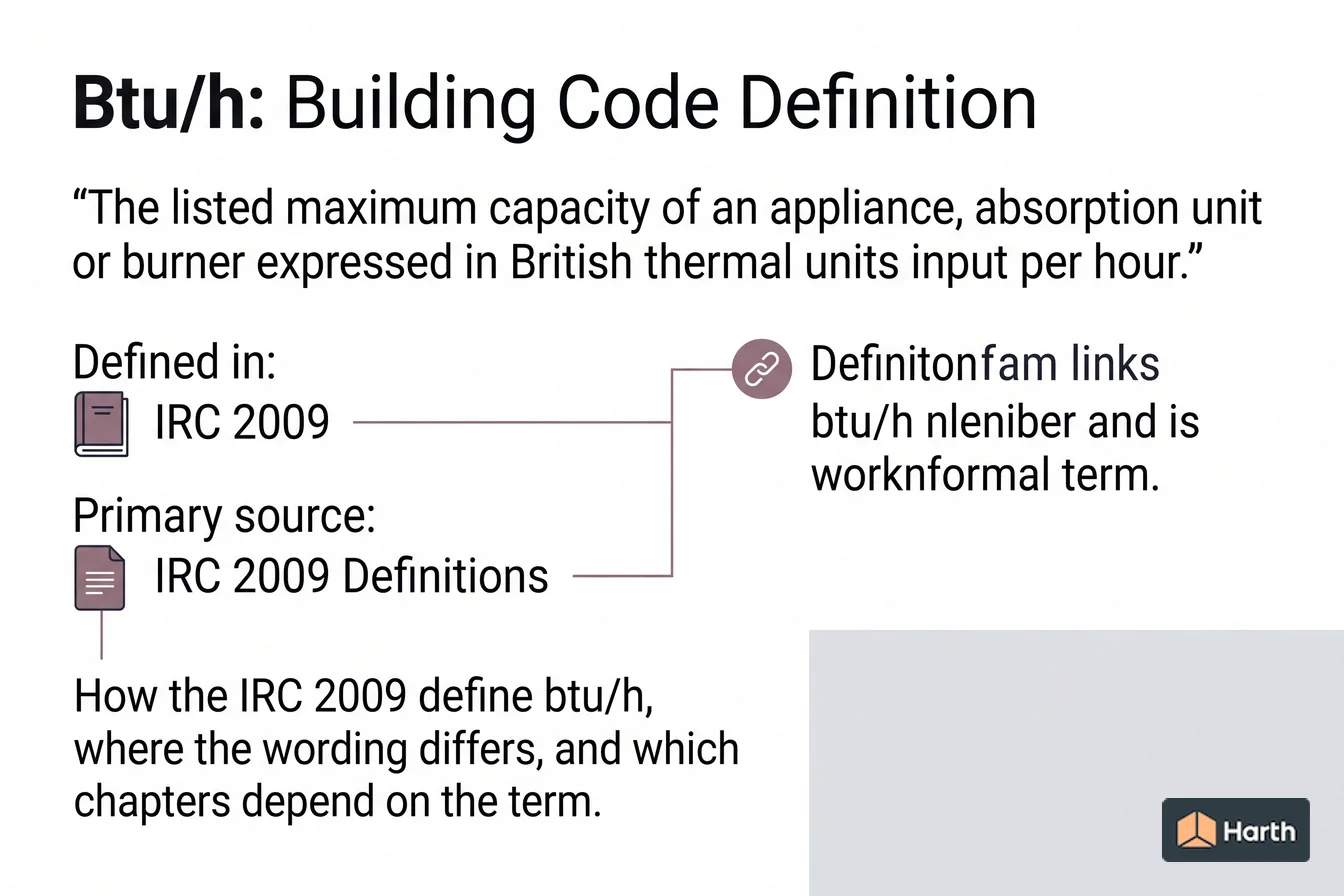
How the IRC 2009 define btu/h, where the wording differs, and which chapters depend on the term.
On this page
Last updated September 7, 2026 · Definitions quoted from the 2009 International Codes as transcribed in this site's building-codes collection, with the source chapter linked for each quotation. Usage counts are computed over the chapters hosted here, one copy per code. The [ICC code library](https://codes.iccsafe.org/codes) publishes the current model text and the [ICC adoption maps](https://www.iccsafe.org/advocacy/code-adoption-maps/) show which edition a jurisdiction has adopted; those sources control.
Direct answer
Btu/h is a defined term in the International Residential Code (IRC) 2009, in Definitions. The code's own words are: “The listed maximum capacity of an appliance, absorption unit or burner expressed in British thermal units input per hour.” No other I-Code in this corpus defines it, so the IRC 2009 definition is the one to work from. The term is used in 14 chapters of this corpus, most often in Commercial Energy Efficiency (IECC 2009), Fuel Gas (IRC 2009), Fire and Smoke Protection Features (IBC 2009). These pages transcribe the 2009 model text; verify the definition against the edition and amendments your authority having jurisdiction has adopted. Record the jurisdiction, the adopted edition, the application date and any local amendment that rewrites the definition before you use it on a live project, because a term redefined by amendment changes every requirement that depends on it.
Content and cited inputs reviewed by Scott Barrington, Harth founder and architectural technology specialist · Published 2026-09-07 · Updated 2026-09-07.
What does this term mean?
Btu/h — IRC 2009, Definitions:
The listed maximum capacity of an appliance, absorption unit or burner expressed in British thermal units input per hour.
What must be verified before using this guidance?
Btu/h is defined once in this corpus, in the Definitions chapter of the International Residential Code (IRC) 2009:
The listed maximum capacity of an appliance, absorption unit or burner expressed in British thermal units input per hour.
Where btu/h is used in the code
The term appears in 14 chapters of the 2009 I-Codes hosted here. The chapters that lean on it hardest are the ones to read next.
| Chapter | Code | Mentions |
|---|---|---|
| Commercial Energy Efficiency | IECC 2009 | 12 |
| Fuel Gas | IRC 2009 | 11 |
| Fire and Smoke Protection Features | IBC 2009 | 5 |
| Specific Appliances, Fireplaces and Solid Fuel-burning Equipment | IMC 2009 | 5 |
| Duct Systems | IRC 2009 | 5 |
| General Mechanical System Requirements | IRC 2009 | 5 |
| Heating and Cooling Equipment | IRC 2009 | 5 |
| Definitions | IRC 2009 | 4 |
| Definitions | IECC 2009 | 3 |
| Special Detailed Requirements Based on Use and Occupancy | IBC 2009 | 2 |
| Administration | IECC 2009 | 2 |
| Boilers, Water Heaters and Pressure Vessels | IMC 2009 | 2 |
2 further chapters mention the term.
The term in use
How the code actually writes about btu/h, quoted from the 2009 text hosted here:
Hydronic systems of at least 300,000 Btu/h (87,930 W) design output capacity supplying heated and chilled water to comfort conditioning systems shall include controls that meet the requirements of Section 503.4.3.
Each opening shall have a minimum free area of 1 square inch per 1,000 Btu/h (2,200 mm2/kW) of the total input rating of all appliances in the space, but not less than 100 square inches (0.06 m2).
The minimum unobstructed total area of the outside and return air ducts or openings to a heat pump shall be not less than 6 square inches per 1,000 Btu/h (13 208 mm2/kW) output rating or as indicated by the conditions of the listing of the heat pump.
The terms btu/h is built out of
The definition above leans on 3 other defined terms. Each carries its own code definition, and a local amendment to any of them changes what btu/h covers:
- Appliance — IRC 2009: Utilization equipment, normally built in standardized sizes or types, that is installed or connected as a unit to perform one or more functions such as clothes washing, air conditioning, food mixing, deep frying, etc.
- Listed — IBC 2009: Equipment, materials, products or services included in a list published by an organization acceptable to the code official and concerned with evaluation of products or services that maintains periodic inspection of production of listed equipment or materials or periodic evaluation …
- Burner — IRC 2009: A device for the final conveyance of the gas, or a mixture of gas and air, to the combustion zone.
Btu/h: what to open, and in what order
Every row is a document this term depends on. The ICC code library and the ICC adoption maps cover the middle rows.
| Check | Where | Confirmed |
|---|---|---|
| Read the definition in the adopted IRC | Definitions | |
| Re-check the requirement that uses it | Commercial Energy Efficiency (IECC 2009) | |
| Re-check the requirement that uses it | Fuel Gas (IRC 2009) | |
| Re-check the requirement that uses it | Fire and Smoke Protection Features (IBC 2009) | |
| Re-check the requirement that uses it | Specific Appliances, Fireplaces and Solid Fuel-burning Equipment (IMC 2009) | |
| Confirm the dependent definition | Appliance | |
| Confirm the dependent definition | Listed | |
| Confirm the dependent definition | Burner | |
| Local amendment to any of the above | Jurisdiction's amendment list |
A research aid, not a code determination. The authority having jurisdiction decides which edition and which amendments apply.
Where can you explore related guidance?
- Explore all glossary guidance
- Appliance: Building Code Definition
- Listed: Building Code Definition
- Burner: Building Code Definition
Sources and method
Definitions quoted from the 2009 International Codes as transcribed in this site's building-codes collection, with the source chapter linked for each quotation. Usage counts are computed over the chapters hosted here, one copy per code. The ICC code library publishes the current model text and the ICC adoption maps show which edition a jurisdiction has adopted; those sources control.
Source links
Frequently asked questions
What is the code definition of btu/h?
The International Residential Code (IRC) 2009 defines it in Definitions as: “The listed maximum capacity of an appliance, absorption unit or burner expressed in British thermal units input per hour.” The 2009 model text is reproduced here; the definition that binds your project is the one in the edition your jurisdiction has adopted, as amended locally.
Which parts of the code depend on btu/h?
In this corpus the term is used across 14 chapters, led by Commercial Energy Efficiency in the IECC 2009. Those are the sections whose scope moves if the definition is amended locally, so read them together with Chapter 2 rather than on their own.
Related pages
- Branch: Building Code Definition
Branch — IRC 2009 definition: Any part of the piping system other than a riser, main or stack.
- Brazed Joint: Building Code Definition
Brazed Joint — IMC 2009 definition: A gas-tight joint obtained by the joining of metal parts with metallic mixtures or alloys which …
- Brazing: Building Code Definition
Brazing — IRC 2009 definition: A metal joining process wherein coalescence is produced by the use ofa nonferrous filler metal having …
- Btu: Building Code Definition
Btu — IRC 2009 definition: Abbreviation for British thermal unit, which is the quantity of heat required to raise the temperature …
- Building Drain: Building Code Definition
Building Drain — IRC 2009 definition: The lowest piping that collects the discharge from all other drainage piping inside the house and …
- Building Element: Building Code Definition
Building Element — IBC 2009 definition: A fundamental component of building construction, listed in Table 601, which mayor may not be of …