Building Code Glossary
Combustible Dust: Building Code Definition
How the IBC 2009, IFC 2009 define combustible dust, where the wording differs, and which chapters depend on the term.
On this page
Last updated September 7, 2026 · Definitions quoted from the 2009 International Codes as transcribed in this site's building-codes collection, with the source chapter linked for each quotation. Usage counts are computed over the chapters hosted here, one copy per code. The [ICC code library](https://codes.iccsafe.org/codes) publishes the current model text and the [ICC adoption maps](https://www.iccsafe.org/advocacy/code-adoption-maps/) show which edition a jurisdiction has adopted; those sources control.
Direct answer
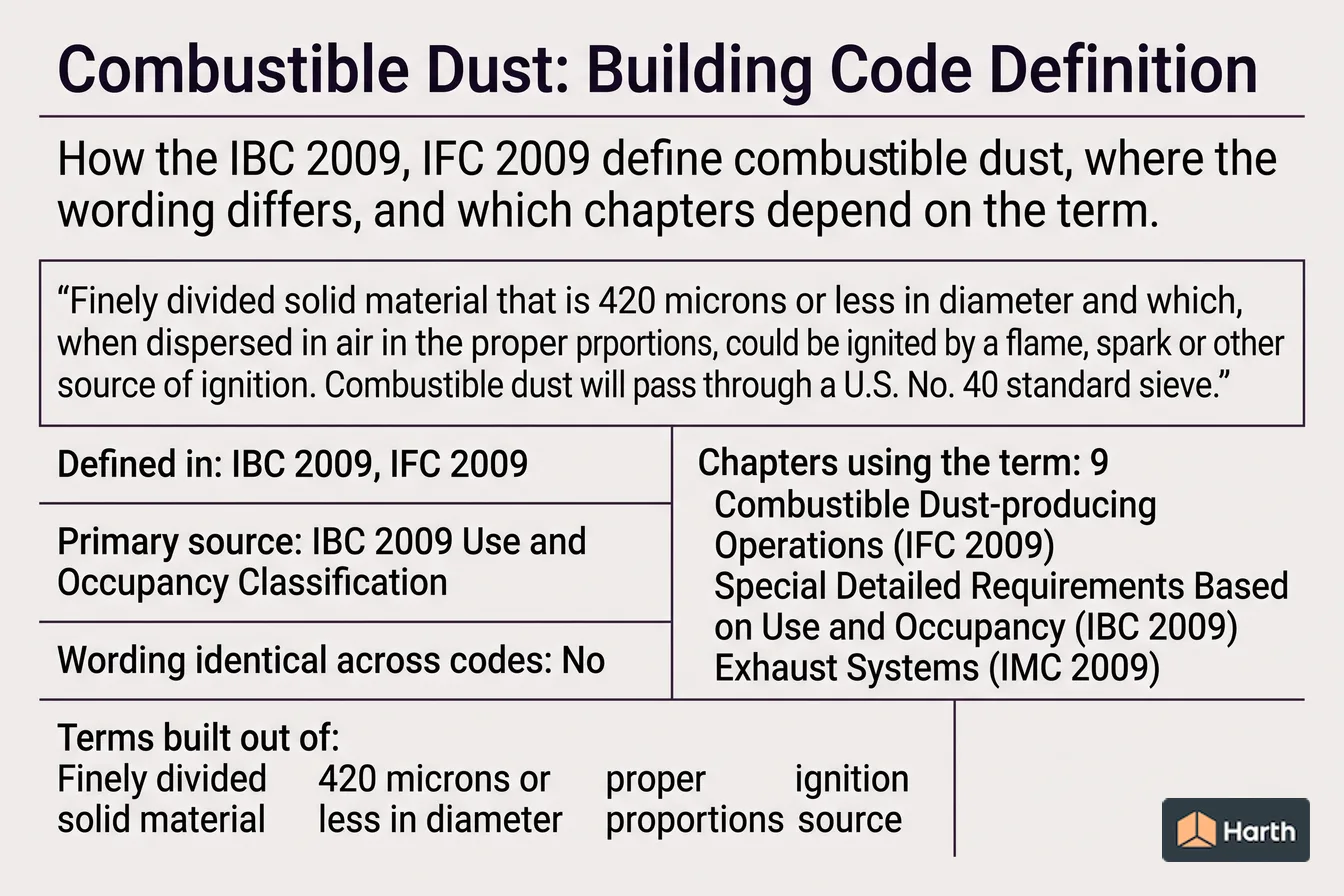
Combustible dust is a defined term in the International Building Code (IBC) 2009, in Use and Occupancy Classification. The code's own words are: “Finely divided solid material that is 420 microns or less in diameter and which, when dispersed in air in the proper proportions, could be ignited by a flame, spark or other source of ignition. Combustible dust will pass through a U.S. No. 40 standard sieve.” The IFC 2009 defines the same term with different wording, so the controlling text depends on which code governs the question in front of you — the comparison below sets the versions side by side. The term is used in 9 chapters of this corpus, most often in Combustible Dust-producing Operations (IFC 2009), Special Detailed Requirements Based on Use and Occupancy (IBC 2009), Exhaust Systems (IMC 2009). These pages transcribe the 2009 model text; verify the definition against the edition and amendments your authority having jurisdiction has adopted.
Content and cited inputs reviewed by Scott Barrington, Harth founder and architectural technology specialist · Published 2026-09-07 · Updated 2026-09-07.
What does this term mean?
Combustible Dust — IBC 2009, Use and Occupancy Classification:
Finely divided solid material that is 420 microns or less in diameter and which, when dispersed in air in the proper proportions, could be ignited by a flame, spark or other source of ignition. Combustible dust will pass through a U.S. No. 40 standard sieve.
What must be verified before using this guidance?
Two of the I-Codes in this corpus define Combustible Dust, and the wording is not identical — read the version that governs your question.
| Code | Where it is defined | Definition |
|---|---|---|
| IBC 2009 | Use and Occupancy Classification | Finely divided solid material that is 420 microns or less in diameter and which, when dispersed in air in the proper proportions, could be ignited by a flame, spark or other source of ignition. Combustible dust will pass through a U.S. No. 40 standard sieve. |
| IFC 2009 | Combustible Dust-producing Operations | Finely divided solid material which is 420 microns or less in diameter and which, when dispersed in air in the proper proportions, could be ignited by a flame, spark or other source of ignition. Combustible dust will pass through a U.S. No. 40 standard sieve. |
Where combustible dust is used in the code
The term appears in 9 chapters of the 2009 I-Codes hosted here. The chapters that lean on it hardest are the ones to read next.
| Chapter | Code | Mentions |
|---|---|---|
| Combustible Dust-producing Operations | IFC 2009 | 14 |
| Special Detailed Requirements Based on Use and Occupancy | IBC 2009 | 8 |
| Exhaust Systems | IMC 2009 | 7 |
| Use and Occupancy Classification | IBC 2009 | 4 |
| Definitions | IFC 2009 | 4 |
| Lumber Yards and Woodworking Facilities | IFC 2009 | 4 |
| Scope and Administration | IFC 2009 | 4 |
| Definitions | IBC 2009 | 1 |
| Industrial Ovens | IFC 2009 | 1 |
The term in use
How the code actually writes about combustible dust, quoted from the 2009 text hosted here:
Permits shall be required for combustible dust-producing operations as set forth in Section 105.6.
Equipment or machinery located inside buildings that generates or emits combustible dust shall be provided with an approved dust collection and exhaust system installed in accordance with Chapter 13 and the International Mechanical Code.
The terms combustible dust is built out of
The definition above leans on 2 other defined terms. Each carries its own code definition, and a local amendment to any of them changes what combustible dust covers:
- Diameter — IRC 2009: Unless specifically stated, the term "diameter" is the nominal diameter as designated by the approved material standard.
- Solid — IBC 2009: A material that has a melting point, decomposes or sublimes at a temperature greater than 68°F (20°C).
Combustible Dust: what to open, and in what order
Every row is a document this term depends on. The ICC code library and the ICC adoption maps cover the middle rows.
| Check | Where | Confirmed |
|---|---|---|
| Read the definition in the adopted IBC | Use and Occupancy Classification | |
| Read the definition in the adopted IFC | Combustible Dust-producing Operations | |
| Re-check the requirement that uses it | Combustible Dust-producing Operations (IFC 2009) | |
| Re-check the requirement that uses it | Special Detailed Requirements Based on Use and Occupancy (IBC 2009) | |
| Re-check the requirement that uses it | Exhaust Systems (IMC 2009) | |
| Re-check the requirement that uses it | Use and Occupancy Classification (IBC 2009) | |
| Confirm the dependent definition | Diameter | |
| Confirm the dependent definition | Solid | |
| Local amendment to any of the above | Jurisdiction's amendment list |
A research aid, not a code determination. The authority having jurisdiction decides which edition and which amendments apply.
Where can you explore related guidance?
Sources and method
Definitions quoted from the 2009 International Codes as transcribed in this site's building-codes collection, with the source chapter linked for each quotation. Usage counts are computed over the chapters hosted here, one copy per code. The ICC code library publishes the current model text and the ICC adoption maps show which edition a jurisdiction has adopted; those sources control.
Source links
Frequently asked questions
What is the code definition of combustible dust?
The International Building Code (IBC) 2009 defines it in Use and Occupancy Classification as: “Finely divided solid material that is 420 microns or less in diameter and which, when dispersed in air in the proper proportions, could be ignited by a flame, spark or other source of ignition. Combustible dust will pass through a U.S. No. 40 standard sieve.” The 2009 model text is reproduced here; the definition that binds your project is the one in the edition your jurisdiction has adopted, as amended locally.
Which parts of the code depend on combustible dust?
In this corpus the term is used across 9 chapters, led by Combustible Dust-producing Operations in the IFC 2009. Those are the sections whose scope moves if the definition is amended locally, so read them together with Chapter 2 rather than on their own.
What are the OSHA requirements for combustible dust?
In the 2009 I-Codes hosted here it is a defined term rather than a description. The IBC 2009 states, in Use and Occupancy Classification: “Finely divided solid material that is 420 microns or less in diameter and which, when dispersed in air in the proper proportions, could be ignited by a flame, spark or other source of ignition. Combustible dust will pass through a U.S. No. 40 standard sieve.” It is defined in IBC 2009, IFC 2009. Because it is a defined term, whatever the adopted edition says it means is what every section using it means — so check Chapter 2 of that edition and any local amendment before relying on this wording.
What are the 5 elements of a combustible dust explosion?
In the 2009 I-Codes hosted here it is a defined term rather than a description. The IBC 2009 states, in Use and Occupancy Classification: “Finely divided solid material that is 420 microns or less in diameter and which, when dispersed in air in the proper proportions, could be ignited by a flame, spark or other source of ignition. Combustible dust will pass through a U.S. No. 40 standard sieve.” It is defined in IBC 2009, IFC 2009. It is not the same as Explosion, which the IBC 2009 defines separately as “An effect produced by the sudden violent expansion of gases, which may be accompanied by a shock wave or disruption, or both, of enclosing materials or structures. An explosion could result from any of the …” Because it is a defined term, whatever the adopted edition says it means is what every section using it means — so check Chapter 2 of that edition and any local amendment before relying on this wording.
Related pages
- Collector: Building Code Definition
Collector — IBC 2009 definition: A horizontal diaphragm element parallel and in line with the applied force that collects and transfers …
- Combination Fire/smoke Damper: Building Code Definition
Combination Fire/smoke Damper — IBC 2009 definition: A listed device installed in ducts and air transfer openings designed to close automatically upon the …
- Combination Waste and Vent System: Building Code Definition
Combination Waste and Vent System — IRC 2009 definition: A specially designed system of waste piping embodying the horizontal wet venting of one or more …
- Combustible Fibers: Building Code Definition
Combustible Fibers — IBC 2009 definition: Readily ignitable and free-burning materials in a fibrous or shredded form, such as cocoa fiber, cloth …
- Combustible Liquid: Building Code Definition
Combustible Liquid — IBC 2009 definition: A liquid having a closed cup flash point at or above 100°F (38°C).
- Combustible Liquids: Building Code Definition
Combustible Liquids — IMC 2009 definition: Any liquids having a flash point at or above 100°F (38°C), and that are divided into …