Building Code Glossary
Combination Fire/smoke Damper: Building Code Definition
How the IBC 2009, IMC 2009 define combination fire/smoke damper, where the wording differs, and which chapters depend on the term.
On this page
Last updated September 7, 2026 · Definitions quoted from the 2009 International Codes as transcribed in this site's building-codes collection, with the source chapter linked for each quotation. Usage counts are computed over the chapters hosted here, one copy per code. The [ICC code library](https://codes.iccsafe.org/codes) publishes the current model text and the [ICC adoption maps](https://www.iccsafe.org/advocacy/code-adoption-maps/) show which edition a jurisdiction has adopted; those sources control.
Direct answer
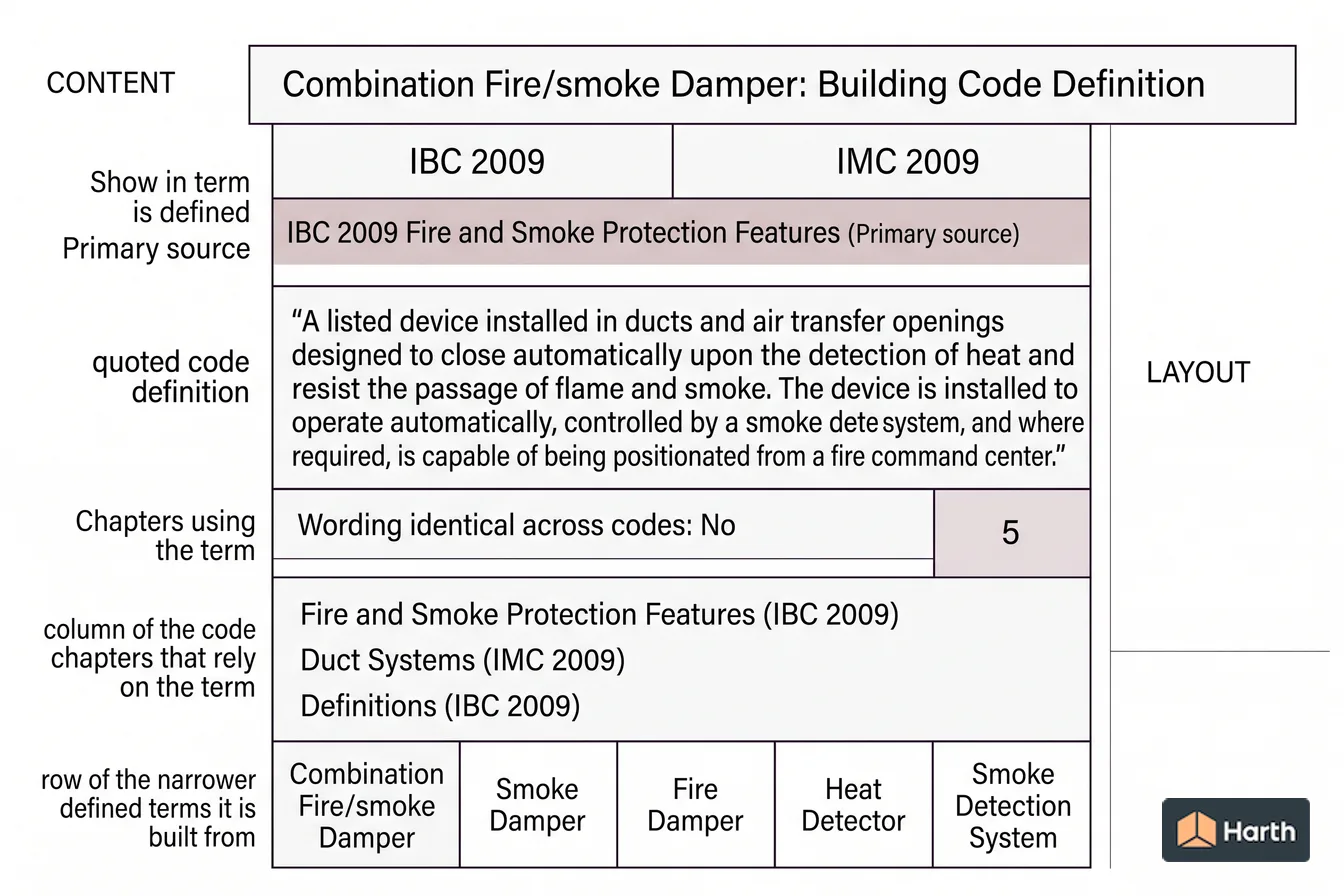
Combination fire/smoke damper is a defined term in the International Building Code (IBC) 2009, in Fire and Smoke Protection Features. The code's own words are: “A listed device installed in ducts and air transfer openings designed to close automatically upon the detection of heat and resist the passage of flame and smoke. The device is installed to operate automatically, controlled by a smoke detection system, and where required, is capable of being positioned from a fire command center.” The IMC 2009 defines the same term with different wording, so the controlling text depends on which code governs the question in front of you — the comparison below sets the versions side by side. The term is used in 5 chapters of this corpus, most often in Fire and Smoke Protection Features (IBC 2009), Duct Systems (IMC 2009), Definitions (IBC 2009). These pages transcribe the 2009 model text; verify the definition against the edition and amendments your authority having jurisdiction has adopted.
Content and cited inputs reviewed by Scott Barrington, Harth founder and architectural technology specialist · Published 2026-09-07 · Updated 2026-09-07.
What does this term mean?
Combination Fire/smoke Damper — IBC 2009, Fire and Smoke Protection Features:
A listed device installed in ducts and air transfer openings designed to close automatically upon the detection of heat and resist the passage of flame and smoke. The device is installed to operate automatically, controlled by a smoke detection system, and where required, is capable of being positioned from a fire command center.
What must be verified before using this guidance?
Two of the I-Codes in this corpus define Combination Fire/smoke Damper, and the wording is not identical — read the version that governs your question.
| Code | Where it is defined | Definition |
|---|---|---|
| IBC 2009 | Fire and Smoke Protection Features | A listed device installed in ducts and air transfer openings designed to close automatically upon the detection of heat and resist the passage of flame and smoke. The device is installed to operate automatically, controlled by a smoke detection system, and where required, is capable of being positioned from a fire command center. |
| IMC 2009 | Definitions | A listed device installed in ducts and air transfer openings designed to close automatically upon the detection of heat and resist the passage of flame and smoke. The device is installed to operate automatically, be controlled by a smoke detection system, and where required, is capable of being positioned from a fire command center. |
Where combination fire/smoke damper is used in the code
The term appears in 5 chapters of the 2009 I-Codes hosted here. The chapters that lean on it hardest are the ones to read next.
| Chapter | Code | Mentions |
|---|---|---|
| Fire and Smoke Protection Features | IBC 2009 | 26 |
| Duct Systems | IMC 2009 | 23 |
| Definitions | IBC 2009 | 1 |
| Definitions | IMC 2009 | 1 |
| Exhaust Systems | IMC 2009 | 1 |
The term in use
How the code actually writes about combination fire/smoke damper, quoted from the 2009 text hosted here:
Combination fire/smoke damper actuation shall be in accordance with Sections 716.3.3.1 and 716.3.3.2.
Combination fire/smoke damper actuation shall be in accordance with Sections 607.3.3.1 and 607.3.3.2.
Combination Fire/smoke Damper compared with Smoke Damper
These two are the closest pair in the 2009 I-Codes: about 85 per cent of their defining words are the same. The code states both and compares neither, so the difference is worth naming.
| Wording unique to it | |
|---|---|
| Combination Fire/smoke Damper (IBC 2009) | close, upon, heat, flame |
| Smoke Damper (IBC 2009) | — no wording of its own |
Everything else in the two definitions is shared. If a project turns on which of the two applies, those words are the whole of the test — and a local amendment that edits one of them without editing the other moves the boundary between combination fire/smoke damper and smoke damper.
The terms combination fire/smoke damper is built out of
The definition above leans on 4 other defined terms. Each carries its own code definition, and a local amendment to any of them changes what combination fire/smoke damper covers:
- Fire Command Center — IBC 2009: The principal attended or unattended location where the status of detection, alarm communications and control systems is displayed, and from which the system(s) can be manually controlled.
- Listed — IBC 2009: Equipment, materials, products or services included in a list published by an organization acceptable to the code official and concerned with evaluation of products or services that maintains periodic inspection of production of listed equipment or materials or periodic evaluation …
- System — IFC 2009: An assembly of equipment consisting of a tank, container or containers, appurtenances, pumps, compressors and connecting piping.
- Device — IRC 2009: Aunit of an electrical system that carries or controls electrical energy as it principal function.
Combination Fire/smoke Damper: what to open, and in what order
Every row is a document this term depends on. The ICC code library and the ICC adoption maps cover the middle rows.
| Check | Where | Confirmed |
|---|---|---|
| Read the definition in the adopted IBC | Fire and Smoke Protection Features | |
| Read the definition in the adopted IMC | Definitions | |
| Re-check the requirement that uses it | Fire and Smoke Protection Features (IBC 2009) | |
| Re-check the requirement that uses it | Duct Systems (IMC 2009) | |
| Re-check the requirement that uses it | Definitions (IBC 2009) | |
| Re-check the requirement that uses it | Definitions (IMC 2009) | |
| Confirm the dependent definition | Fire Command Center | |
| Confirm the dependent definition | Listed | |
| Confirm the dependent definition | System | |
| Local amendment to any of the above | Jurisdiction's amendment list |
A research aid, not a code determination. The authority having jurisdiction decides which edition and which amendments apply.
Where can you explore related guidance?
- Explore all glossary guidance
- Fire Command Center: Building Code Definition
- System: Building Code Definition
- Listed: Building Code Definition
- Device: Building Code Definition
Sources and method
Definitions quoted from the 2009 International Codes as transcribed in this site's building-codes collection, with the source chapter linked for each quotation. Usage counts are computed over the chapters hosted here, one copy per code. The ICC code library publishes the current model text and the ICC adoption maps show which edition a jurisdiction has adopted; those sources control.
Source links
Frequently asked questions
What is the code definition of combination fire/smoke damper?
The International Building Code (IBC) 2009 defines it in Fire and Smoke Protection Features as: “A listed device installed in ducts and air transfer openings designed to close automatically upon the detection of heat and resist the passage of flame and smoke. The device is installed to operate automatically, controlled by a smoke detection system, and where required, is capable of being positioned from a fire command center.” The 2009 model text is reproduced here; the definition that binds your project is the one in the edition your jurisdiction has adopted, as amended locally.
Do the I-Codes define combination fire/smoke damper the same way?
No. IBC 2009, IMC 2009 all define the term, but the wording is not identical, and a difference in wording can change which requirements are triggered. The comparison table above sets the versions side by side so you can read the one that governs your question.
Which parts of the code depend on combination fire/smoke damper?
In this corpus the term is used across 5 chapters, led by Fire and Smoke Protection Features in the IBC 2009. Those are the sections whose scope moves if the definition is amended locally, so read them together with Chapter 2 rather than on their own.
Is a fire damper required for a 1 hour fire rated wall?
Fire Damper is a separate defined term. The IBC 2009 defines it as: “A listed device installed in ducts and air transfer openings designed to close automatically upon detection of heat and resist the passage of flame. Fire dampers are classified for use in either static systems that will automatically shut down in the event of a fire …” That is not the same as combination fire/smoke damper, which the IBC 2009 defines as “A listed device installed in ducts and air transfer openings designed to close automatically upon the detection of heat and resist the passage of flame and smoke. The device is installed to operate automatically, controlled by a smoke detection system …” — read both before applying either, and confirm the wording in the edition your jurisdiction has adopted.
Related pages
- Code: Building Code Definition
Code — IRC 2009 definition: These regulations, subsequent amendments thereto, or any emergency rule or regulation that the administrative authority having …
- Collar Joint: Building Code Definition
Collar Joint — IBC 2009 definition: Verticallongitudinaljoint between wythes of masonry or between masonry and backup construction that is permitted to be …
- Collector: Building Code Definition
Collector — IBC 2009 definition: A horizontal diaphragm element parallel and in line with the applied force that collects and transfers …
- Combination Waste and Vent System: Building Code Definition
Combination Waste and Vent System — IRC 2009 definition: A specially designed system of waste piping embodying the horizontal wet venting of one or more …
- Combustible Dust: Building Code Definition
Combustible Dust — IBC 2009 definition: Finely divided solid material that is 420 microns or less in diameter and which, when dispersed …
- Combustible Fibers: Building Code Definition
Combustible Fibers — IBC 2009 definition: Readily ignitable and free-burning materials in a fibrous or shredded form, such as cocoa fiber, cloth …