Building Code Glossary
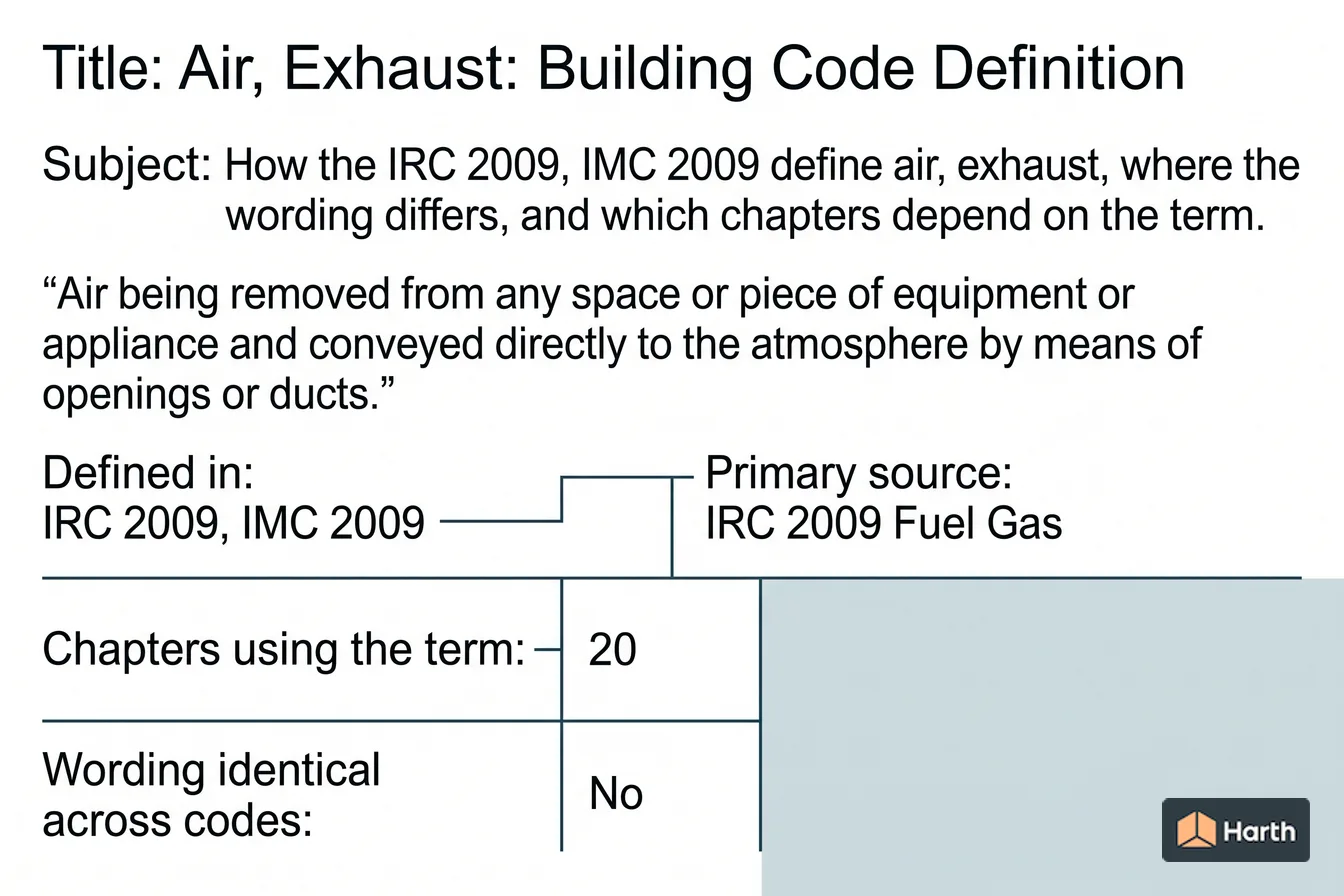
Air, Exhaust: Building Code Definition
How the IRC 2009, IMC 2009 define air, exhaust, where the wording differs, and which chapters depend on the term.
On this page
Last updated September 7, 2026 · Definitions quoted from the 2009 International Codes as transcribed in this site's building-codes collection, with the source chapter linked for each quotation. Usage counts are computed over the chapters hosted here, one copy per code. The [ICC code library](https://codes.iccsafe.org/codes) publishes the current model text and the [ICC adoption maps](https://www.iccsafe.org/advocacy/code-adoption-maps/) show which edition a jurisdiction has adopted; those sources control.
Direct answer
Air, exhaust is a defined term in the International Residential Code (IRC) 2009, in Fuel Gas. The code's own words are: “Air being removed from any space or piece of equipment or appliance and conveyed directly to the atmosphere by means of openings or ducts.” The IMC 2009 defines the same term with different wording, so the controlling text depends on which code governs the question in front of you — the comparison below sets the versions side by side. The term is used in 20 chapters of this corpus, most often in Exhaust Systems (IMC 2009), Special Detailed Requirements Based on Use and Occupancy (IBC 2009), Fire Protection Systems (IBC 2009). These pages transcribe the 2009 model text; verify the definition against the edition and amendments your authority having jurisdiction has adopted.
Content and cited inputs reviewed by Scott Barrington, Harth founder and architectural technology specialist · Published 2026-09-07 · Updated 2026-09-07.
What does this term mean?
Air, Exhaust — IRC 2009, Fuel Gas:
Air being removed from any space or piece of equipment or appliance and conveyed directly to the atmosphere by means of openings or ducts.
What must be verified before using this guidance?
Two of the I-Codes in this corpus define Air, Exhaust, and the wording is not identical — read the version that governs your question.
| Code | Where it is defined | Definition |
|---|---|---|
| IRC 2009 | Fuel Gas | Air being removed from any space or piece of equipment or appliance and conveyed directly to the atmosphere by means of openings or ducts. |
| IMC 2009 | Definitions | Air being removed from any space, appliance or piece of equipment and conveyed directly to the atmosphere by means of openings or ducts. |
Where air, exhaust is used in the code
The term appears in 20 chapters of the 2009 I-Codes hosted here. The chapters that lean on it hardest are the ones to read next.
| Chapter | Code | Mentions |
|---|---|---|
| Exhaust Systems | IMC 2009 | 25 |
| Special Detailed Requirements Based on Use and Occupancy | IBC 2009 | 21 |
| Fire Protection Systems | IBC 2009 | 11 |
| Fire Protection Systems | IFC 2009 | 7 |
| Definitions | IMC 2009 | 7 |
| Hazardous Materials-general Provisions | IFC 2009 | 6 |
| Ventilation | IMC 2009 | 6 |
| Commercial Energy Efficiency | IECC 2009 | 4 |
| Refrigeration | IMC 2009 | 4 |
| Exhaust Systems | IRC 2009 | 4 |
| Existing Structures | IBC 2009 | 3 |
| Fire and Smoke Protection Features | IBC 2009 | 3 |
8 further chapters mention the term.
The term in use
How the code actually writes about air, exhaust, quoted from the 2009 text hosted here:
Exhaust hood systems capable of exhausting in excess of 400 cfm (0.19 m3/s) shall be provided with makeup air at a rate approximately equal to the exhaust air rate.
The lamp exhaust is permitted to serve to exhaust air from the projection room to provide room air circulation.
Supply air shall enter and exhaust air shall discharge from the vestibule through separate, tightly constructed ducts used only for that purpose.
The terms air, exhaust is built out of
The definition above leans on 2 other defined terms. Each carries its own code definition, and a local amendment to any of them changes what air, exhaust covers:
- Equipment — IRC 2009: All piping, ducts, vents, control devices and other components of systems other than appliances that are permanently installed and integrated to provide control of environmental conditions for buildings.
- Appliance — IRC 2009: Utilization equipment, normally built in standardized sizes or types, that is installed or connected as a unit to perform one or more functions such as clothes washing, air conditioning, food mixing, deep frying, etc.
Air, Exhaust: what to open, and in what order
Every row is a document this term depends on. The ICC code library and the ICC adoption maps cover the middle rows.
| Check | Where | Confirmed |
|---|---|---|
| Read the definition in the adopted IRC | Fuel Gas | |
| Read the definition in the adopted IMC | Definitions | |
| Re-check the requirement that uses it | Exhaust Systems (IMC 2009) | |
| Re-check the requirement that uses it | Special Detailed Requirements Based on Use and Occupancy (IBC 2009) | |
| Re-check the requirement that uses it | Fire Protection Systems (IBC 2009) | |
| Re-check the requirement that uses it | Fire Protection Systems (IFC 2009) | |
| Confirm the dependent definition | Equipment | |
| Confirm the dependent definition | Appliance | |
| Local amendment to any of the above | Jurisdiction's amendment list |
A research aid, not a code determination. The authority having jurisdiction decides which edition and which amendments apply.
Where can you explore related guidance?
- Explore all glossary guidance
- Equipment: Building Code Definition
- Appliance: Building Code Definition
Sources and method
Definitions quoted from the 2009 International Codes as transcribed in this site's building-codes collection, with the source chapter linked for each quotation. Usage counts are computed over the chapters hosted here, one copy per code. The ICC code library publishes the current model text and the ICC adoption maps show which edition a jurisdiction has adopted; those sources control.
Source links
Frequently asked questions
What is the code definition of air, exhaust?
The International Residential Code (IRC) 2009 defines it in Fuel Gas as: “Air being removed from any space or piece of equipment or appliance and conveyed directly to the atmosphere by means of openings or ducts.” The 2009 model text is reproduced here; the definition that binds your project is the one in the edition your jurisdiction has adopted, as amended locally.
Which parts of the code depend on air, exhaust?
In this corpus the term is used across 20 chapters, led by Exhaust Systems in the IMC 2009. Those are the sections whose scope moves if the definition is amended locally, so read them together with Chapter 2 rather than on their own.
What are the code requirements for exhaust fan venting?
Venting is a separate defined term. The IRC 2009 defines it as: “Removal of combustion products to the outdoors.” That is not the same as air, exhaust, which the IRC 2009 defines as “Air being removed from any space or piece of equipment or appliance and conveyed directly to the atmosphere by means of openings or ducts.” — read both before applying either, and confirm the wording in the edition your jurisdiction has adopted.
What are the requirements for ventilation in Ohio?
Ventilation is a separate defined term. The IBC 2009 defines it as: “The natural or mechanical process of supplying conditioned or unconditioned air to, or removing such air from, any space.” That is not the same as air, exhaust, which the IRC 2009 defines as “Air being removed from any space or piece of equipment or appliance and conveyed directly to the atmosphere by means of openings or ducts.” — read both before applying either, and confirm the wording in the edition your jurisdiction has adopted.
What is the definition of environmental air exhaust?
In the 2009 I-Codes hosted here it is a defined term rather than a description. The IRC 2009 states, in Fuel Gas: “Air being removed from any space or piece of equipment or appliance and conveyed directly to the atmosphere by means of openings or ducts.” It is defined in IRC 2009, IMC 2009. It is not the same as Environmental Air, which the IMC 2009 defines separately as “Air that is conveyed to or from occupied areas through ducts which are not part of the heating or air-conditioning system, such as ventilation for human usage, domestic kitchen range exhaust, bathroom exhaust and domestic …” Because it is a defined term, whatever the adopted edition says it means is what every section using it means — so check Chapter 2 of that edition and any local amendment before relying on this wording.
Related pages
- Air-conditioning System: Building Code Definition
Air-conditioning System — IRC 2009 definition: A system that consists of heat exchangers, blowers, filters, supply, exhaust and return-air systems, and shall …
- Air Conditioning: Building Code Definition
Air Conditioning — IMC 2009 definition: The treatment of air so as to control simultaneously the temperature, humidity, cleanness and distribution of …
- Air Distribution System: Building Code Definition
Air Distribution System — IMC 2009 definition: Any system of ducts, plenums and air-handling equipment that circulates air within a space or spaces …
- Air-handling Unit: Building Code Definition
Air-handling Unit — IRC 2009 definition: A blower or fan used for the purpose of distributing supply air to a room, space …
- Air-inflated Structure: Building Code Definition
Air-inflated Structure — IBC 2009 definition: A structure that uses air-pressurized membrane beams, arches or other elements to enclose space.
- Air, Makeup: Building Code Definition
Air, Makeup — IRC 2009 definition: Air that is provided to replace air being exhausted.