Building Code Glossary
Fabricated Item: Building Code Definition
How the IBC 2009 define fabricated item, where the wording differs, and which chapters depend on the term.
On this page
Last updated September 7, 2026 · Definitions quoted from the 2009 International Codes as transcribed in this site's building-codes collection, with the source chapter linked for each quotation. Usage counts are computed over the chapters hosted here, one copy per code. The [ICC code library](https://codes.iccsafe.org/codes) publishes the current model text and the [ICC adoption maps](https://www.iccsafe.org/advocacy/code-adoption-maps/) show which edition a jurisdiction has adopted; those sources control.
Direct answer
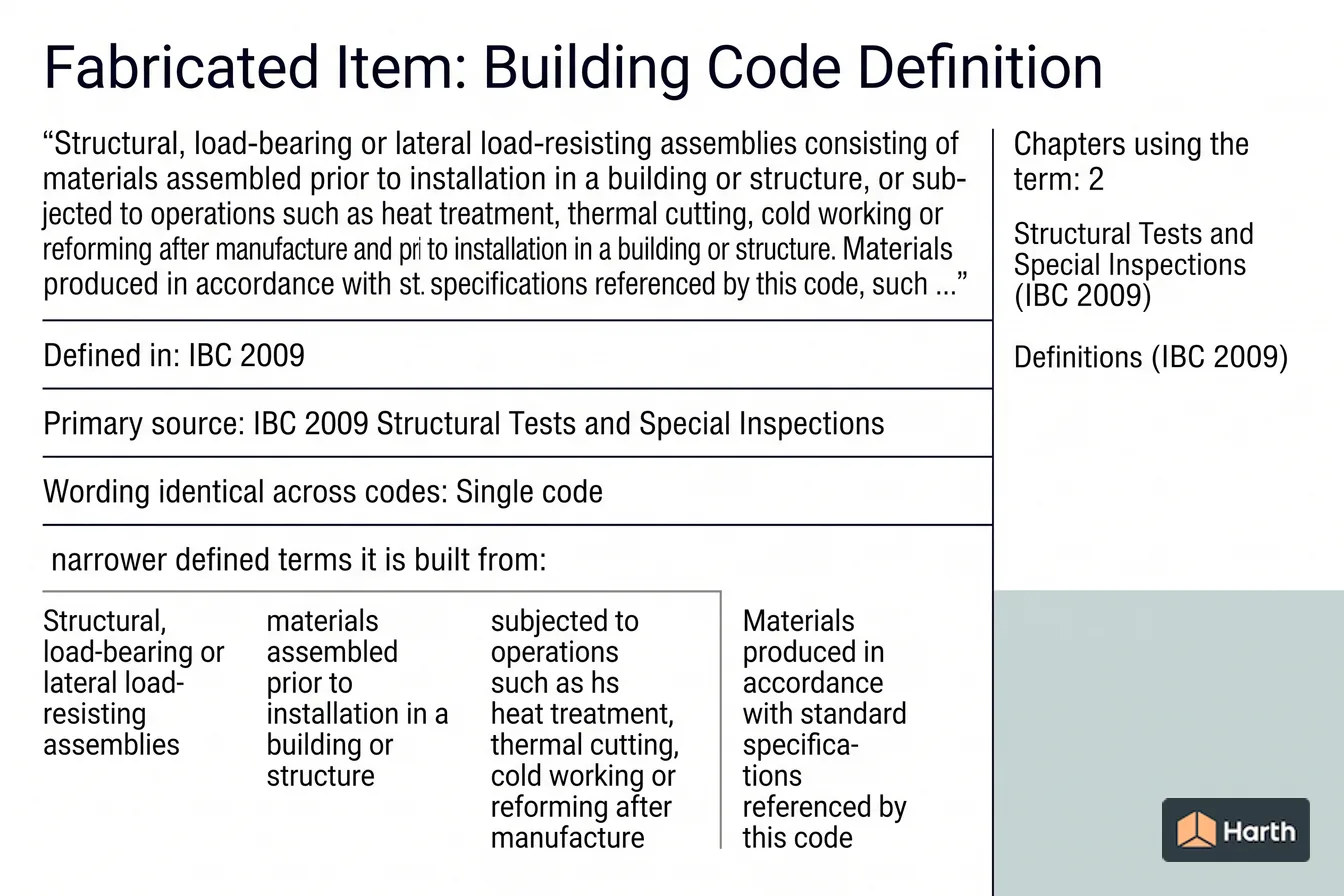
Fabricated item is a defined term in the International Building Code (IBC) 2009, in Structural Tests and Special Inspections. The code's own words are: “Structural, load-bearing or lateral load-resisting assemblies consisting of materials assembled prior to installation in a building or structure, or subjected to operations such as heat treatment, thermal cutting, cold working or reforming after manufacture and prior to installation in a building or structure. Materials produced in accordance with standard specifications referenced by this code, such …” No other I-Code in this corpus defines it, so the IBC 2009 definition is the one to work from. The term is used in 2 chapters of this corpus, most often in Structural Tests and Special Inspections (IBC 2009), Definitions (IBC 2009). These pages transcribe the 2009 model text; verify the definition against the edition and amendments your authority having jurisdiction has adopted.
Content and cited inputs reviewed by Scott Barrington, Harth founder and architectural technology specialist · Published 2026-09-07 · Updated 2026-09-07.
What does this term mean?
Fabricated Item — IBC 2009, Structural Tests and Special Inspections:
Structural, load-bearing or lateral load-resisting assemblies consisting of materials assembled prior to installation in a building or structure, or subjected to operations such as heat treatment, thermal cutting, cold working or reforming after manufacture and prior to installation in a building or structure. Materials produced in accordance with standard specifications referenced by this code, such as rolled structural steel shapes, steel-reinforcing bars, masonry units, and wood structural panels or in accordance with a standard, listed in Chapter 35, which provides requirements for quality control done under the supervision of a third-party quality control agency shall not be considered “fabricated items.”
What must be verified before using this guidance?
Fabricated Item is defined once in this corpus, in the Structural Tests and Special Inspections chapter of the International Building Code (IBC) 2009:
Structural, load-bearing or lateral load-resisting assemblies consisting of materials assembled prior to installation in a building or structure, or subjected to operations such as heat treatment, thermal cutting, cold working or reforming after manufacture and prior to installation in a building or structure. Materials produced in accordance with standard specifications referenced by this code, such as rolled structural steel shapes, steel-reinforcing bars, masonry units, and wood structural panels or in accordance with a standard, listed in Chapter 35, which provides requirements for quality control done under the supervision of a third-party quality control agency shall not be considered “fabricated items.”
Where fabricated item is used in the code
The term appears in 2 chapters of the 2009 I-Codes hosted here. The chapters that lean on it hardest are the ones to read next.
| Chapter | Code | Mentions |
|---|---|---|
| Structural Tests and Special Inspections | IBC 2009 | 5 |
| Definitions | IBC 2009 | 1 |
The terms fabricated item is built out of
The definition above leans on 5 other defined terms. Each carries its own code definition, and a local amendment to any of them changes what fabricated item covers:
- Structure — IPC 2009: That which is built or constructed or a portion thereof.
- Building — IBC 2009: Any structure used or intended for supporting or sheltering any use or occupancy.
- Control — IRC 2009: A manual or automatic device designed to regulate the gas, air, water or electrical supply to, or operation of, a mechanical system.
- Masonry — IBC 2009: A built-up construction or combination of building units or materials of clay, shale, concrete, glass, gypsum, stone or other approved units bonded together with or without mortar or grout or other accepted methods of joining.
- Listed — IBC 2009: Equipment, materials, products or services included in a list published by an organization acceptable to the code official and concerned with evaluation of products or services that maintains periodic inspection of production of listed equipment or materials or periodic evaluation …
Fabricated Item: what to open, and in what order
Every row is a document this term depends on. The ICC code library and the ICC adoption maps cover the middle rows.
| Check | Where | Confirmed |
|---|---|---|
| Read the definition in the adopted IBC | Structural Tests and Special Inspections | |
| Re-check the requirement that uses it | Structural Tests and Special Inspections (IBC 2009) | |
| Re-check the requirement that uses it | Definitions (IBC 2009) | |
| Confirm the dependent definition | Structure | |
| Confirm the dependent definition | Building | |
| Confirm the dependent definition | Control | |
| Local amendment to any of the above | Jurisdiction's amendment list |
A research aid, not a code determination. The authority having jurisdiction decides which edition and which amendments apply.
Where can you explore related guidance?
- Explore all glossary guidance
- Structure: Building Code Definition
- Building: Building Code Definition
- Masonry: Building Code Definition
- Control: Building Code Definition
Sources and method
Definitions quoted from the 2009 International Codes as transcribed in this site's building-codes collection, with the source chapter linked for each quotation. Usage counts are computed over the chapters hosted here, one copy per code. The ICC code library publishes the current model text and the ICC adoption maps show which edition a jurisdiction has adopted; those sources control.
Source links
Frequently asked questions
What is the code definition of fabricated item?
The International Building Code (IBC) 2009 defines it in Structural Tests and Special Inspections as: “Structural, load-bearing or lateral load-resisting assemblies consisting of materials assembled prior to installation in a building or structure, or subjected to operations such as heat treatment, thermal cutting, cold working or reforming after manufacture and prior to installation in a building or structure. Materials produced in accordance with standard specifications referenced by this code, such as rolled structural steel shapes, steel-reinforcing bars, masonry units, and wood structural panels or in accordance with a standard, listed in Chapter 35, which provides requirements for quality control done under the supervision of a third-party quality control agency shall not be considered “fabricated items.”” The 2009 model text is reproduced here; the definition that binds your project is the one in the edition your jurisdiction has adopted, as amended locally.
Which parts of the code depend on fabricated item?
In this corpus the term is used across 2 chapters, led by Structural Tests and Special Inspections in the IBC 2009. Those are the sections whose scope moves if the definition is amended locally, so read them together with Chapter 2 rather than on their own.
What are the building classifications used in building codes based on?
Building is a separate defined term. The IBC 2009 defines it as: “Any structure used or intended for supporting or sheltering any use or occupancy.” That is not the same as fabricated item, which the IBC 2009 defines as “Structural, load-bearing or lateral load-resisting assemblies consisting of materials assembled prior to installation in a building or structure, or subjected to operations such as heat treatment, thermal cutting, cold working or reforming after manufacture and prior to installation in a …” — read both before applying either, and confirm the wording in the edition your jurisdiction has adopted.
Related pages
- Exterior Wall Envelope: Building Code Definition
Exterior Wall Envelope — IBC 2009 definition: A system or assembly of exterior wall components, including exterior wall finish materials, that provides protection …
- Exterior Wall: Building Code Definition
Exterior Wall — IBC 2009 definition: A wall, bearing or nonbearing, that is used as an enclosing wall for a building, other …
- Fabric Partition: Building Code Definition
Fabric Partition — IBC 2009 definition: A partition consisting of a finished surface made of fabric, without a continuous rigid backing, that …
- Fabrication Area: Building Code Definition
Fabrication Area — IBC 2009 definition: An area within a semiconductor fabrication facility and related research and development areas in which there …
- Facility: Building Code Definition
Facility — IBC 2009 definition: All or any portion of buildings, structures, site improvements, elements and pedestrian or vehicular routes located …
- Facing: Building Code Definition
Facing — IRC 2009 definition: The wood structural panel facings that form the two outmost rigid layers of the structural insulated …