Building Code Glossary
Fail-safe: Building Code Definition
How the IFC 2009 define fail-safe, where the wording differs, and which chapters depend on the term.
On this page
Last updated September 7, 2026 · Definitions quoted from the 2009 International Codes as transcribed in this site's building-codes collection, with the source chapter linked for each quotation. Usage counts are computed over the chapters hosted here, one copy per code. The [ICC code library](https://codes.iccsafe.org/codes) publishes the current model text and the [ICC adoption maps](https://www.iccsafe.org/advocacy/code-adoption-maps/) show which edition a jurisdiction has adopted; those sources control.
Direct answer
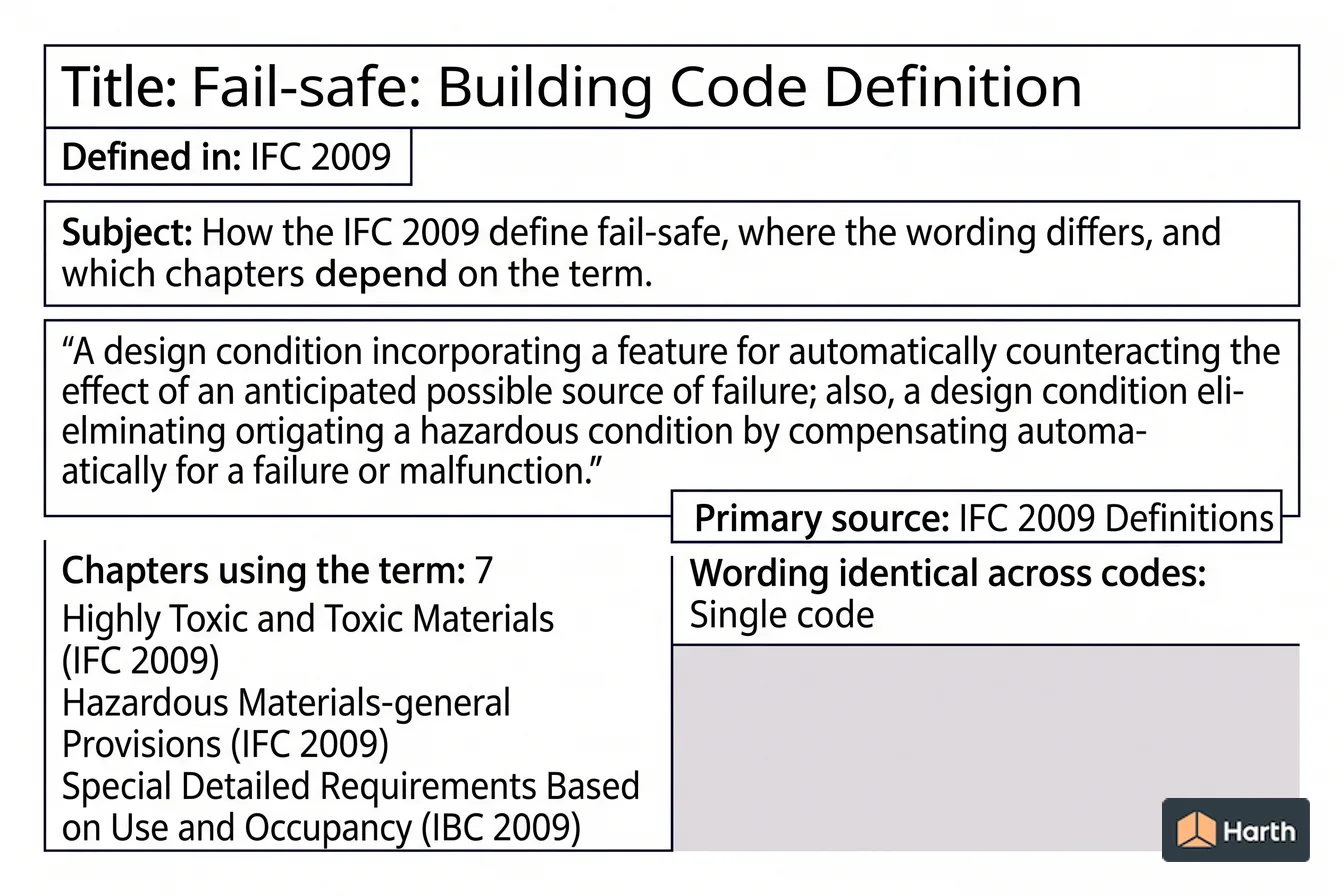
Fail-safe is a defined term in the International Fire Code (IFC) 2009, in Definitions. The code's own words are: “A design condition incorporating a feature for automatically counteracting the effect of an anticipated possible source of failure; also, a design condition eliminating or mitigating a hazardous condition by compensating automatically for a failure or malfunction.” No other I-Code in this corpus defines it, so the IFC 2009 definition is the one to work from. The term is used in 7 chapters of this corpus, most often in Highly Toxic and Toxic Materials (IFC 2009), Hazardous Materials-general Provisions (IFC 2009), Special Detailed Requirements Based on Use and Occupancy (IBC 2009). These pages transcribe the 2009 model text; verify the definition against the edition and amendments your authority having jurisdiction has adopted.
Content and cited inputs reviewed by Scott Barrington, Harth founder and architectural technology specialist · Published 2026-09-07 · Updated 2026-09-07.
What does this term mean?
Fail-safe — IFC 2009, Definitions:
A design condition incorporating a feature for automatically counteracting the effect of an anticipated possible source of failure; also, a design condition eliminating or mitigating a hazardous condition by compensating automatically for a failure or malfunction.
What must be verified before using this guidance?
Fail-safe is defined once in this corpus, in the Definitions chapter of the International Fire Code (IFC) 2009:
A design condition incorporating a feature for automatically counteracting the effect of an anticipated possible source of failure; also, a design condition eliminating or mitigating a hazardous condition by compensating automatically for a failure or malfunction.
Where fail-safe is used in the code
The term appears in 7 chapters of the 2009 I-Codes hosted here. The chapters that lean on it hardest are the ones to read next.
| Chapter | Code | Mentions |
|---|---|---|
| Highly Toxic and Toxic Materials | IFC 2009 | 13 |
| Hazardous Materials-general Provisions | IFC 2009 | 11 |
| Special Detailed Requirements Based on Use and Occupancy | IBC 2009 | 7 |
| Flammable Gases and Flammable Cryogenic Fluids | IFC 2009 | 3 |
| Oxidizers, Oxidizing Gases and Oxidizing Cryogenic Fluids | IFC 2009 | 3 |
| Compressed Gases | IFC 2009 | 2 |
| Definitions | IFC 2009 | 2 |
The term in use
How the code actually writes about fail-safe, quoted from the 2009 text hosted here:
Where failure of an automatic control could result in a dangerous condition or reaction, the automatic control shall be fail-safe.
A manual or automatic fail-safe emergency shutoff valve shall be installed on supply piping at the cylinder or bulk source.
Devices designed to maintain individual compressedgas containers, cylinders or tanks at constant temperature shall be approved and shall be designed to be fail-safe.
Fail-safe: what to open, and in what order
Every row is a document this term depends on. The ICC code library and the ICC adoption maps cover the middle rows.
| Check | Where | Confirmed |
|---|---|---|
| Read the definition in the adopted IFC | Definitions | |
| Re-check the requirement that uses it | Highly Toxic and Toxic Materials (IFC 2009) | |
| Re-check the requirement that uses it | Hazardous Materials-general Provisions (IFC 2009) | |
| Re-check the requirement that uses it | Special Detailed Requirements Based on Use and Occupancy (IBC 2009) | |
| Re-check the requirement that uses it | Flammable Gases and Flammable Cryogenic Fluids (IFC 2009) | |
| Local amendment to any of the above | Jurisdiction's amendment list |
A research aid, not a code determination. The authority having jurisdiction decides which edition and which amendments apply.
Where can you explore related guidance?
- Explore all glossary guidance
- Building: Building Code Definition
- Construction Documents: Building Code Definition
- Registered Design Professional: Building Code Definition
- Dwelling Unit: Building Code Definition
Sources and method
Definitions quoted from the 2009 International Codes as transcribed in this site's building-codes collection, with the source chapter linked for each quotation. Usage counts are computed over the chapters hosted here, one copy per code. The ICC code library publishes the current model text and the ICC adoption maps show which edition a jurisdiction has adopted; those sources control.
Source links
Frequently asked questions
What is the code definition of fail-safe?
The International Fire Code (IFC) 2009 defines it in Definitions as: “A design condition incorporating a feature for automatically counteracting the effect of an anticipated possible source of failure; also, a design condition eliminating or mitigating a hazardous condition by compensating automatically for a failure or malfunction.” The 2009 model text is reproduced here; the definition that binds your project is the one in the edition your jurisdiction has adopted, as amended locally.
Which parts of the code depend on fail-safe?
In this corpus the term is used across 7 chapters, led by Highly Toxic and Toxic Materials in the IFC 2009. Those are the sections whose scope moves if the definition is amended locally, so read them together with Chapter 2 rather than on their own.
What is the definition of a fail-safe?
In the 2009 I-Codes hosted here it is a defined term rather than a description. The IFC 2009 states, in Definitions: “A design condition incorporating a feature for automatically counteracting the effect of an anticipated possible source of failure; also, a design condition eliminating or mitigating a hazardous condition by compensating automatically for a failure or malfunction.” It is defined in IFC 2009. Because it is a defined term, whatever the adopted edition says it means is what every section using it means — so check Chapter 2 of that edition and any local amendment before relying on this wording.
Related pages
- Facing: Building Code Definition
Facing — IRC 2009 definition: The wood structural panel facings that form the two outmost rigid layers of the structural insulated …
- Factored Load: Building Code Definition
Factored Load — IBC 2009 definition: The product ofa nominal load and a load factor.
- Factory-built Chimney: Building Code Definition
Factory-built Chimney — IRC 2009 definition: A listed and labeled chimney composed of factory-made components assembled in the field in accordance with …
- Fallout Area: Building Code Definition
Fallout Area — IFC 2009 definition: The area over which aerial shells are fired.
- False Alarm: Building Code Definition
False Alarm — IFC 2009 definition: The willful and knowing initiation or transmission of a signal, message or other notification of an …
- Fan System Bhp: Building Code Definition
Fan System Bhp — IECC 2009 definition: The sum of the fan brake horsepower of all fans that are required to operate at …