Building Code Glossary
Fumigant: Building Code Definition
How the IFC 2009 define fumigant, where the wording differs, and which chapters depend on the term.
On this page
Last updated September 7, 2026 · Definitions quoted from the 2009 International Codes as transcribed in this site's building-codes collection, with the source chapter linked for each quotation. Usage counts are computed over the chapters hosted here, one copy per code. The [ICC code library](https://codes.iccsafe.org/codes) publishes the current model text and the [ICC adoption maps](https://www.iccsafe.org/advocacy/code-adoption-maps/) show which edition a jurisdiction has adopted; those sources control.
Direct answer
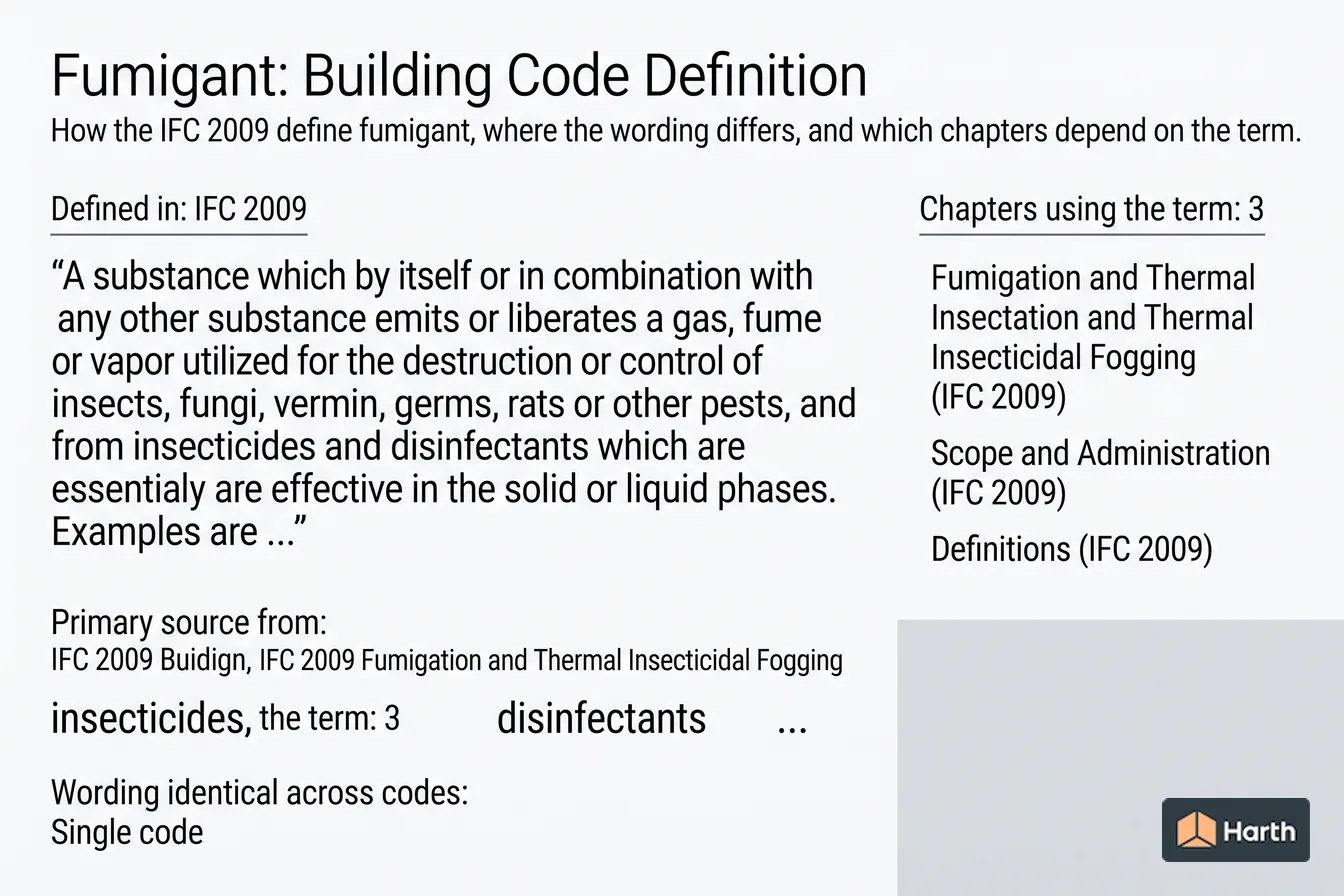
Fumigant is a defined term in the International Fire Code (IFC) 2009, in Fumigation and Thermal Insecticidal Fogging. The code's own words are: “A substance which by itself or in combination with any other substance emits or liberates a gas, fume or vapor utilized for the destruction or control of insects, fungi, vermin, germs, rats or other pests, and shall be distinguished from insecticides and disinfectants which are essentially effective in the solid or liquid phases. Examples are …” No other I-Code in this corpus defines it, so the IFC 2009 definition is the one to work from. The term is used in 3 chapters of this corpus, most often in Fumigation and Thermal Insecticidal Fogging (IFC 2009), Scope and Administration (IFC 2009), Definitions (IFC 2009). These pages transcribe the 2009 model text; verify the definition against the edition and amendments your authority having jurisdiction has adopted.
Content and cited inputs reviewed by Scott Barrington, Harth founder and architectural technology specialist · Published 2026-09-07 · Updated 2026-09-07.
What does this term mean?
Fumigant — IFC 2009, Fumigation and Thermal Insecticidal Fogging:
A substance which by itself or in combination with any other substance emits or liberates a gas, fume or vapor utilized for the destruction or control of insects, fungi, vermin, germs, rats or other pests, and shall be distinguished from insecticides and disinfectants which are essentially effective in the solid or liquid phases. Examples are methyl bromide, ethylene dibromide, hydrogen cyanide, carbon disulfide and sulfuryl fluoride.
What must be verified before using this guidance?
Fumigant is defined once in this corpus, in the Fumigation and Thermal Insecticidal Fogging chapter of the International Fire Code (IFC) 2009:
A substance which by itself or in combination with any other substance emits or liberates a gas, fume or vapor utilized for the destruction or control of insects, fungi, vermin, germs, rats or other pests, and shall be distinguished from insecticides and disinfectants which are essentially effective in the solid or liquid phases. Examples are methyl bromide, ethylene dibromide, hydrogen cyanide, carbon disulfide and sulfuryl fluoride.
Where fumigant is used in the code
The term appears in 3 chapters of the 2009 I-Codes hosted here. The chapters that lean on it hardest are the ones to read next.
| Chapter | Code | Mentions |
|---|---|---|
| Fumigation and Thermal Insecticidal Fogging | IFC 2009 | 8 |
| Scope and Administration | IFC 2009 | 2 |
| Definitions | IFC 2009 | 1 |
The term in use
How the code actually writes about fumigant, quoted from the 2009 text hosted here:
The fire code official and fire chief shall be notified in writing at least 24 hours before the structure is to be closed in connection with the utilization of any toxic or flammable fumigant.
An operational permit is required to operate a business of fumigation or thermal insecticidal fogging and to maintain a room, vault or chamber in which a toxic or flammable fumigant is used.
The terms fumigant is built out of
The definition above leans on 4 other defined terms. Each carries its own code definition, and a local amendment to any of them changes what fumigant covers:
- Control — IRC 2009: A manual or automatic device designed to regulate the gas, air, water or electrical supply to, or operation of, a mechanical system.
- Liquid — IBC 2009: A material that has a melting point that is equal to or less than 68°F (20°C) and a boiling point that is greater than 68°F (20°C) at 14.7 pounds per square inch absolute (psia) (101 kPa).
- Solid — IBC 2009: A material that has a melting point, decomposes or sublimes at a temperature greater than 68°F (20°C).
- Shall — IRC 2009: The term, when used in the code, is construed as mandatory.
Fumigant: what to open, and in what order
Every row is a document this term depends on. The ICC code library and the ICC adoption maps cover the middle rows.
| Check | Where | Confirmed |
|---|---|---|
| Read the definition in the adopted IFC | Fumigation and Thermal Insecticidal Fogging | |
| Re-check the requirement that uses it | Fumigation and Thermal Insecticidal Fogging (IFC 2009) | |
| Re-check the requirement that uses it | Scope and Administration (IFC 2009) | |
| Re-check the requirement that uses it | Definitions (IFC 2009) | |
| Confirm the dependent definition | Control | |
| Confirm the dependent definition | Liquid | |
| Confirm the dependent definition | Solid | |
| Local amendment to any of the above | Jurisdiction's amendment list |
A research aid, not a code determination. The authority having jurisdiction decides which edition and which amendments apply.
Where can you explore related guidance?
- Explore all glossary guidance
- Control: Building Code Definition
- Liquid: Building Code Definition
- Solid: Building Code Definition
Sources and method
Definitions quoted from the 2009 International Codes as transcribed in this site's building-codes collection, with the source chapter linked for each quotation. Usage counts are computed over the chapters hosted here, one copy per code. The ICC code library publishes the current model text and the ICC adoption maps show which edition a jurisdiction has adopted; those sources control.
Source links
Frequently asked questions
What is the code definition of fumigant?
The International Fire Code (IFC) 2009 defines it in Fumigation and Thermal Insecticidal Fogging as: “A substance which by itself or in combination with any other substance emits or liberates a gas, fume or vapor utilized for the destruction or control of insects, fungi, vermin, germs, rats or other pests, and shall be distinguished from insecticides and disinfectants which are essentially effective in the solid or liquid phases. Examples are methyl bromide, ethylene dibromide, hydrogen cyanide, carbon disulfide and sulfuryl fluoride.” The 2009 model text is reproduced here; the definition that binds your project is the one in the edition your jurisdiction has adopted, as amended locally.
Which parts of the code depend on fumigant?
In this corpus the term is used across 3 chapters, led by Fumigation and Thermal Insecticidal Fogging in the IFC 2009. Those are the sections whose scope moves if the definition is amended locally, so read them together with Chapter 2 rather than on their own.
What is the definition of a fumigant?
In the 2009 I-Codes hosted here it is a defined term rather than a description. The IFC 2009 states, in Fumigation and Thermal Insecticidal Fogging: “A substance which by itself or in combination with any other substance emits or liberates a gas, fume or vapor utilized for the destruction or control of insects, fungi, vermin, germs, rats or other pests, and shall be distinguished from insecticides and disinfectants which are essentially effective in the solid or liquid phases. Examples are …” It is defined in IFC 2009. Because it is a defined term, whatever the adopted edition says it means is what every section using it means — so check Chapter 2 of that edition and any local amendment before relying on this wording.
Related pages
- Fuel Gas: Building Code Definition
Fuel Gas — IRC 2009 definition: A natural gas, manufactured gas, liquefiedpetroleum gas or mixtures of these gases.
- Fuel-oil Piping System: Building Code Definition
Fuel-oil Piping System — IMC 2009 definition: A closed piping system that connects a combustible liquid from a source of supply to a …
- Fuel Oil: Building Code Definition
Fuel Oil — IMC 2009 definition: Kerosene or any hydrocarbon oil having a flash point not less than 100°F (38°C).
- Furnace Class A: Building Code Definition
Furnace Class A — IFC 2009 definition: An oven or furnace that has heat utilization equipment operating at approximately atmospheric pressure wherein there …
- Furnace Class D: Building Code Definition
Furnace Class D — IFC 2009 definition: An oven or furnace that operates at temperatures from above ambient to over 5,000°F (2760°C) and …
- Furnace Room: Building Code Definition
Furnace Room — IMC 2009 definition: A room primarily utilized for the installation of fuel-burning, space-heating and water-heating appliances other than boilers …