Building Code Glossary
Liquid: Building Code Definition
How the IBC 2009, IFC 2009 define liquid, where the wording differs, and which chapters depend on the term.
On this page
Last updated September 7, 2026 · Definitions quoted from the 2009 International Codes as transcribed in this site's building-codes collection, with the source chapter linked for each quotation. Usage counts are computed over the chapters hosted here, one copy per code. The [ICC code library](https://codes.iccsafe.org/codes) publishes the current model text and the [ICC adoption maps](https://www.iccsafe.org/advocacy/code-adoption-maps/) show which edition a jurisdiction has adopted; those sources control.
Direct answer
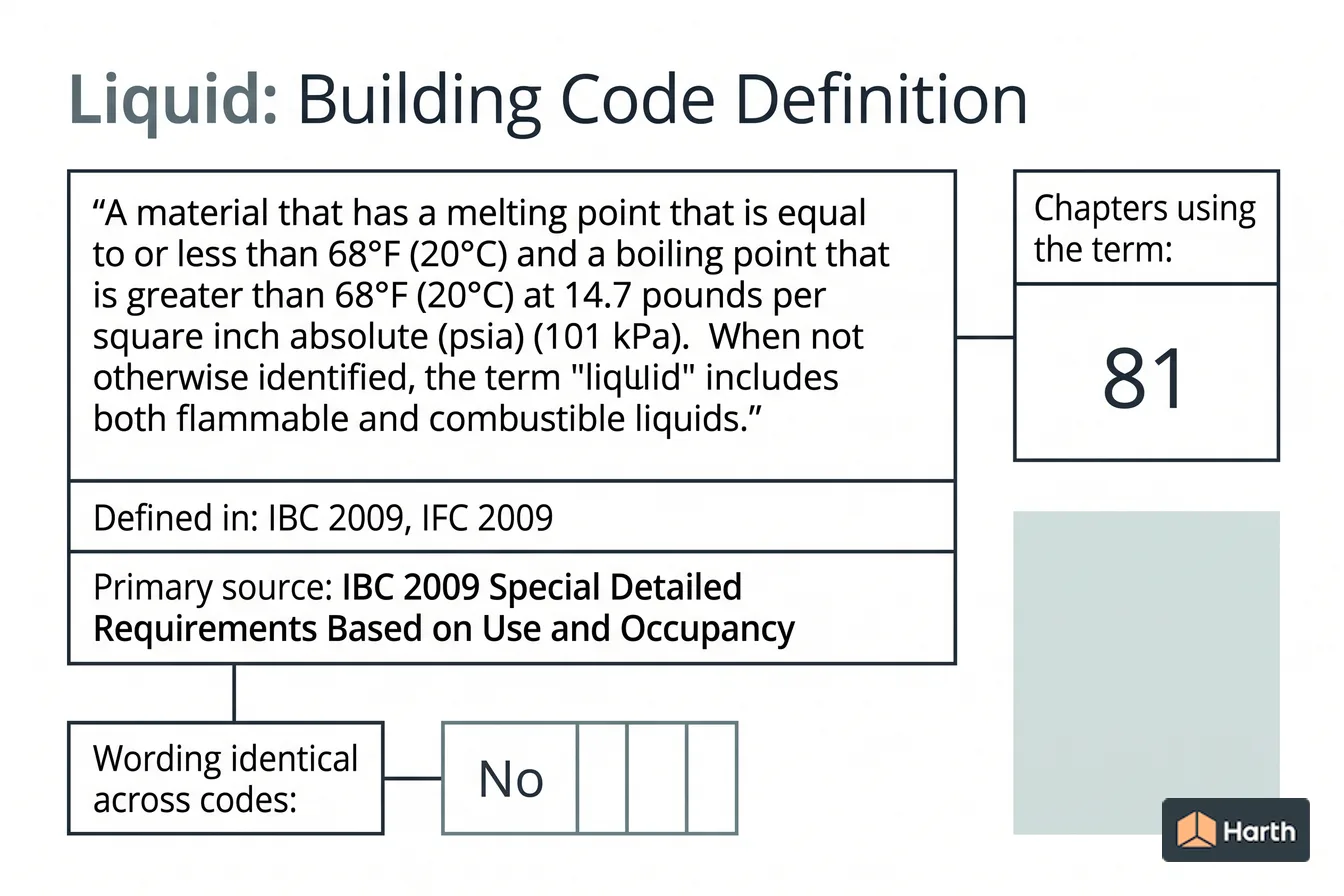
Liquid is a defined term in the International Building Code (IBC) 2009, in Special Detailed Requirements Based on Use and Occupancy. The code's own words are: “A material that has a melting point that is equal to or less than 68°F (20°C) and a boiling point that is greater than 68°F (20°C) at 14.7 pounds per square inch absolute (psia) (101 kPa). When not otherwise identified, the term "liqUid" includes both flammable and combustible liquids.” The IFC 2009 defines the same term with different wording, so the controlling text depends on which code governs the question in front of you — the comparison below sets the versions side by side. The term is used in 81 chapters of this corpus, most often in Flammable and Combustible Liquids (IFC 2009), Hazardous Materials-general Provisions (IFC 2009), Motor Fuel-dispensing Facilities and Repair Garages (IFC 2009). These pages transcribe the 2009 model text; verify the definition against the edition and amendments your authority having jurisdiction has adopted.
Content and cited inputs reviewed by Scott Barrington, Harth founder and architectural technology specialist · Published 2026-09-07 · Updated 2026-09-07.
What does this term mean?
Liquid — IBC 2009, Special Detailed Requirements Based on Use and Occupancy:
A material that has a melting point that is equal to or less than 68°F (20°C) and a boiling point that is greater than 68°F (20°C) at 14.7 pounds per square inch absolute (psia) (101 kPa). When not otherwise identified, the term "liqUid" includes both flammable and combustible liquids.
What must be verified before using this guidance?
Two of the I-Codes in this corpus define Liquid, and the wording is not identical — read the version that governs your question.
| Code | Where it is defined | Definition |
|---|---|---|
| IBC 2009 | Special Detailed Requirements Based on Use and Occupancy | A material that has a melting point that is equal to or less than 68°F (20°C) and a boiling point that is greater than 68°F (20°C) at 14.7 pounds per square inch absolute (psia) (101 kPa). When not otherwise identified, the term "liqUid" includes both flammable and combustible liquids. |
| IFC 2009 | Hazardous Materials-general Provisions | A material having a melting point that is equal to or less than 68°F (20°C) and a boilingpoint which is greater than 68°F (20°C) at 14.7 psia (101 kPa). When not otherwise identified, the term "liqUid" includes both flammable and combustible liquids. |
Where liquid is used in the code
The term appears in 81 chapters of the 2009 I-Codes hosted here. The chapters that lean on it hardest are the ones to read next.
| Chapter | Code | Mentions |
|---|---|---|
| Flammable and Combustible Liquids | IFC 2009 | 1201 |
| Hazardous Materials-general Provisions | IFC 2009 | 233 |
| Motor Fuel-dispensing Facilities and Repair Garages | IFC 2009 | 180 |
| Special Detailed Requirements Based on Use and Occupancy | IBC 2009 | 178 |
| Semiconductor Fabrication Facilities | IFC 2009 | 142 |
| Oxidizers, Oxidizing Gases and Oxidizing Cryogenic Fluids | IFC 2009 | 133 |
| Exhaust Systems | IMC 2009 | 95 |
| Flammable Finishes | IFC 2009 | 80 |
| Highly Toxic and Toxic Materials | IFC 2009 | 74 |
| Use and Occupancy Classification | IBC 2009 | 64 |
| Water-reactive Solids and Liquids | IFC 2009 | 57 |
| Scope and Administration | IFC 2009 | 52 |
69 further chapters mention the term.
The term in use
How the code actually writes about liquid, quoted from the 2009 text hosted here:
Above-ground tanks with connections located below normal liquid level shall be provided with internal or external isolation valves located as close as practical to the shell of the tank.
Where quantities are indicated in pounds and when the weight per gallon of the liquid is not provided to the fire code official, a conversion factor of 10 pounds per gallon (1.2 kg/L) shall be used.
Where liquid delivery to above-ground storage tanks is accomplished by positive-pressure operation, tank vehicles shall be positioned a minimum of 25 feet (7620 mm) from tanks receiving Class I liquids and 15 feet (4572 mm) from tanks receiving Class II and IlIA liquids.
Liquid compared with Flammable Gas
These two are the closest pair in the 2009 I-Codes: about 48 per cent of their defining words are the same. The code states both and compares neither, so the difference is worth naming.
| Wording unique to it | |
|---|---|
| Liquid (IBC 2009) | melting, equal, greater, absolute, when, otherwise, identified, term, liquid, includes, both, flammable |
| Flammable Gas (IBC 2009) | gas, atmosphere, pressure, 68of |
Everything else in the two definitions is shared. If a project turns on which of the two applies, those words are the whole of the test — and a local amendment that edits one of them without editing the other moves the boundary between liquid and flammable gas.
The terms liquid is built out of
The definition above leans on 3 other defined terms. Each carries its own code definition, and a local amendment to any of them changes what liquid covers:
- Combustible Liquids — IMC 2009: Any liquids having a flash point at or above 100°F (38°C), and that are divided into the following classifications:
- Boiling Point — IBC 2009: The temperature at which the vapor pressure of a liquid equals the atmospheric pressure of 14.7 pounds per square inch (psi) (101 kPa) gage or 760 mm of mercury.
- Identified — IRC 2009: (As applied to equipment.) Recognizable as suitable for the specific purpose, function, use, environment, application, etc., where described in a particular code requirement.
Liquid: what to open, and in what order
Every row is a document this term depends on. The ICC code library and the ICC adoption maps cover the middle rows.
| Check | Where | Confirmed |
|---|---|---|
| Read the definition in the adopted IBC | Special Detailed Requirements Based on Use and Occupancy | |
| Read the definition in the adopted IFC | Hazardous Materials-general Provisions | |
| Re-check the requirement that uses it | Flammable and Combustible Liquids (IFC 2009) | |
| Re-check the requirement that uses it | Hazardous Materials-general Provisions (IFC 2009) | |
| Re-check the requirement that uses it | Motor Fuel-dispensing Facilities and Repair Garages (IFC 2009) | |
| Re-check the requirement that uses it | Special Detailed Requirements Based on Use and Occupancy (IBC 2009) | |
| Confirm the dependent definition | Combustible Liquids | |
| Confirm the dependent definition | Boiling Point | |
| Confirm the dependent definition | Identified | |
| Local amendment to any of the above | Jurisdiction's amendment list |
A research aid, not a code determination. The authority having jurisdiction decides which edition and which amendments apply.
Where can you explore related guidance?
- Explore all glossary guidance
- Combustible Liquids: Building Code Definition
- Boiling Point: Building Code Definition
- Identified: Building Code Definition
Sources and method
Definitions quoted from the 2009 International Codes as transcribed in this site's building-codes collection, with the source chapter linked for each quotation. Usage counts are computed over the chapters hosted here, one copy per code. The ICC code library publishes the current model text and the ICC adoption maps show which edition a jurisdiction has adopted; those sources control.
Source links
Frequently asked questions
What is the code definition of liquid?
The International Building Code (IBC) 2009 defines it in Special Detailed Requirements Based on Use and Occupancy as: “A material that has a melting point that is equal to or less than 68°F (20°C) and a boiling point that is greater than 68°F (20°C) at 14.7 pounds per square inch absolute (psia) (101 kPa). When not otherwise identified, the term "liqUid" includes both flammable and combustible liquids.” The 2009 model text is reproduced here; the definition that binds your project is the one in the edition your jurisdiction has adopted, as amended locally.
Which parts of the code depend on liquid?
In this corpus the term is used across 81 chapters, led by Flammable and Combustible Liquids in the IFC 2009. Those are the sections whose scope moves if the definition is amended locally, so read them together with Chapter 2 rather than on their own.
What is the definition of a building code?
Building is a separate defined term. The IBC 2009 defines it as: “Any structure used or intended for supporting or sheltering any use or occupancy.” That is not the same as liquid, which the IBC 2009 defines as “A material that has a melting point that is equal to or less than 68°F (20°C) and a boiling point that is greater than 68°F (20°C) at 14.7 pounds per square inch absolute (psia) (101 kPa). When not otherwise identified …” — read both before applying either, and confirm the wording in the edition your jurisdiction has adopted.
What does Liquid mean?
In the 2009 I-Codes hosted here it is a defined term rather than a description. The IBC 2009 states, in Special Detailed Requirements Based on Use and Occupancy: “A material that has a melting point that is equal to or less than 68°F (20°C) and a boiling point that is greater than 68°F (20°C) at 14.7 pounds per square inch absolute (psia) (101 kPa). When not otherwise identified, the term "liqUid" includes both flammable and combustible liquids.” It is defined in IBC 2009, IFC 2009. Because it is a defined term, whatever the adopted edition says it means is what every section using it means — so check Chapter 2 of that edition and any local amendment before relying on this wording.
Related pages
- Liquid Oxygen Home Care Container: Building Code Definition
Liquid Oxygen Home Care Container — IFC 2009 definition: A container used for liquid oxygen not exceeding 15.8 gallons (60 liters) specifically designed for use …
- Liquid Storage Room: Building Code Definition
Liquid Storage Room — IBC 2009 definition: A room classified as a Group H-3 occupancy used for the storage of flammable or combustible …
- Liquid Storage Warehouse: Building Code Definition
Liquid Storage Warehouse — IFC 2009 definition: A building classified as a Group H-2 or H-3 occupancy used for the storage of flammable …
- Listed: Building Code Definition
Listed — IBC 2009 definition: Equipment, materials, products or services included in a list published by an organization acceptable to the …
- Live Loads: Building Code Definition
Live Loads — IBC 2009 definition: Those loads produced by the use and occupancy of the building or other structure and do …
- Living Space: Building Code Definition
Living Space — IRC 2009 definition: Space within a dwelling unitutilized for living, sleeping, eating, cooking, bathing, washing and sanitation purposes.