Building Code Glossary
Head Joint: Building Code Definition
How the IBC 2009 define head joint, where the wording differs, and which chapters depend on the term.
On this page
Last updated September 7, 2026 · Definitions quoted from the 2009 International Codes as transcribed in this site's building-codes collection, with the source chapter linked for each quotation. Usage counts are computed over the chapters hosted here, one copy per code. The [ICC code library](https://codes.iccsafe.org/codes) publishes the current model text and the [ICC adoption maps](https://www.iccsafe.org/advocacy/code-adoption-maps/) show which edition a jurisdiction has adopted; those sources control.
Direct answer
Head joint is a defined term in the International Building Code (IBC) 2009, in Masonry. The code's own words are: “Vertical mortar joint placed between masonry units within the wythe at the time the masonry units are laid.” No other I-Code in this corpus defines it, so the IBC 2009 definition is the one to work from. The term is used in 4 chapters of this corpus, most often in Wall Construction (IRC 2009), Masonry (IBC 2009), Definitions (IBC 2009). These pages transcribe the 2009 model text; verify the definition against the edition and amendments your authority having jurisdiction has adopted. Record the jurisdiction, the adopted edition, the application date and any local amendment that rewrites the definition before you use it on a live project, because a term redefined by amendment changes every requirement that depends on it.
Content and cited inputs reviewed by Scott Barrington, Harth founder and architectural technology specialist · Published 2026-09-07 · Updated 2026-09-07.
What does this term mean?
Head Joint — IBC 2009, Masonry:
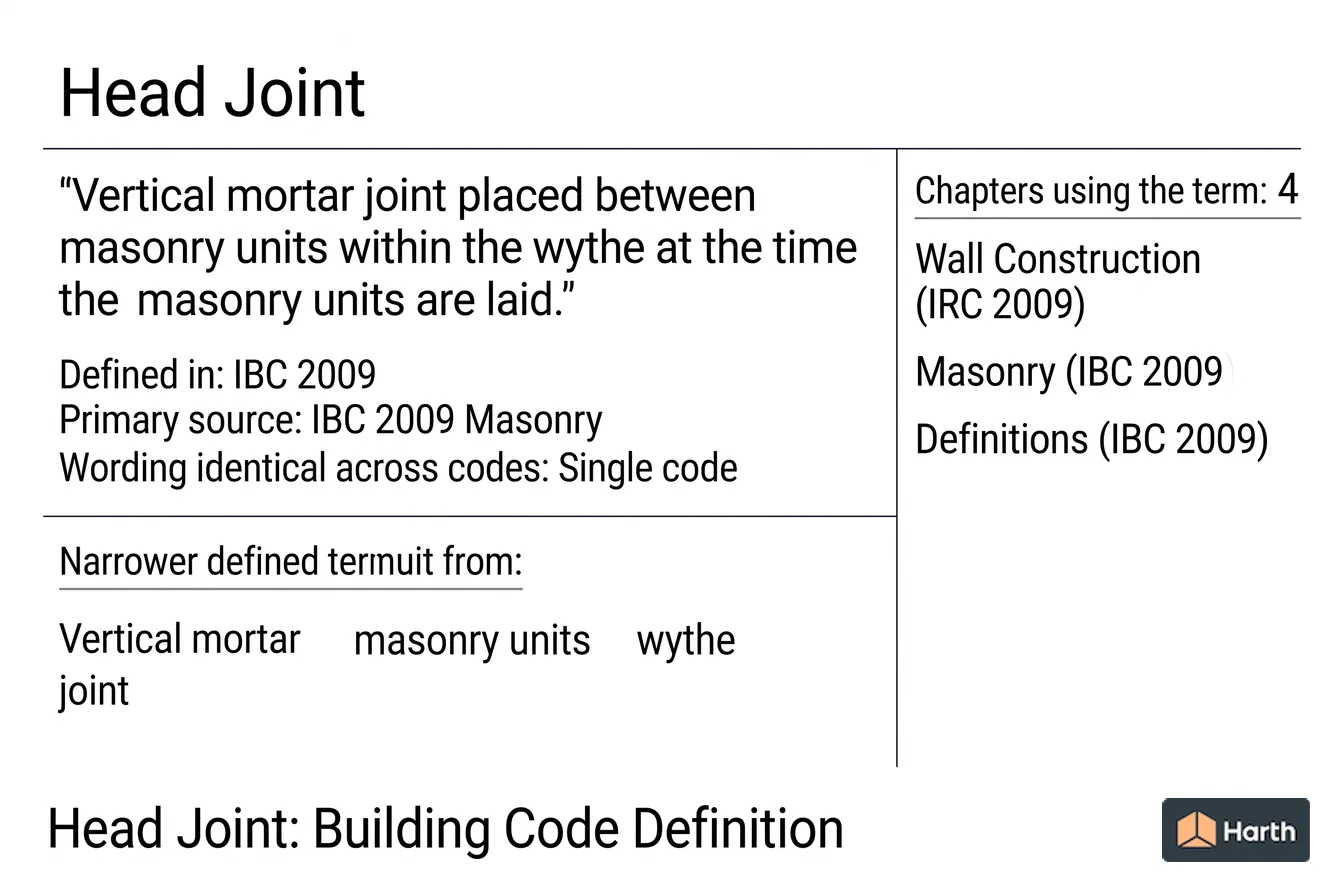
Vertical mortar joint placed between masonry units within the wythe at the time the masonry units are laid.
What must be verified before using this guidance?
Head Joint is defined once in this corpus, in the Masonry chapter of the International Building Code (IBC) 2009:
Vertical mortar joint placed between masonry units within the wythe at the time the masonry units are laid.
Where head joint is used in the code
The term appears in 4 chapters of the 2009 I-Codes hosted here. The chapters that lean on it hardest are the ones to read next.
| Chapter | Code | Mentions |
|---|---|---|
| Wall Construction | IRC 2009 | 5 |
| Masonry | IBC 2009 | 2 |
| Definitions | IBC 2009 | 1 |
| Definitions | IRC 2009 | 1 |
The term in use
How the code actually writes about head joint, quoted from the 2009 text hosted here:
Where unit masonry is laid with less head joint offset than in Section R607.2.1, the minimum area of horizontal reinforcement placed in mortar bed joints or in bond beams spaced not more than 48 inches (1219 mm) apart, shall be 0.0007 times the vertical cross-sectional area of the wall.
The terms head joint is built out of
The definition above leans on 4 other defined terms. Each carries its own code definition, and a local amendment to any of them changes what head joint covers:
- Masonry — IBC 2009: A built-up construction or combination of building units or materials of clay, shale, concrete, glass, gypsum, stone or other approved units bonded together with or without mortar or grout or other accepted methods of joining.
- Mortar — IBC 2009: A plastic mixture of approved cementitious materials, fine aggregates and water used to bond masonry or other structural units.
- Joint — IBC 2009: The linear opening in or between adjacent fire-resistance-rated assemblies that is designed to allow independent movement of the building in any plane caused by thermal, seismic, wind or any other loading.
- Wythe — IBC 2009: Each continuous, vertical section of a wall, one masonry unit in thickness.
Head Joint: what to open, and in what order
Every row is a document this term depends on. The ICC code library and the ICC adoption maps cover the middle rows.
| Check | Where | Confirmed |
|---|---|---|
| Read the definition in the adopted IBC | Masonry | |
| Re-check the requirement that uses it | Wall Construction (IRC 2009) | |
| Re-check the requirement that uses it | Masonry (IBC 2009) | |
| Re-check the requirement that uses it | Definitions (IBC 2009) | |
| Re-check the requirement that uses it | Definitions (IRC 2009) | |
| Confirm the dependent definition | Masonry | |
| Confirm the dependent definition | Mortar | |
| Confirm the dependent definition | Joint | |
| Local amendment to any of the above | Jurisdiction's amendment list |
A research aid, not a code determination. The authority having jurisdiction decides which edition and which amendments apply.
Where can you explore related guidance?
- Explore all glossary guidance
- Masonry: Building Code Definition
- Mortar: Building Code Definition
- Wythe: Building Code Definition
- Joint: Building Code Definition
Sources and method
Definitions quoted from the 2009 International Codes as transcribed in this site's building-codes collection, with the source chapter linked for each quotation. Usage counts are computed over the chapters hosted here, one copy per code. The ICC code library publishes the current model text and the ICC adoption maps show which edition a jurisdiction has adopted; those sources control.
Source links
Frequently asked questions
What is the code definition of head joint?
The International Building Code (IBC) 2009 defines it in Masonry as: “Vertical mortar joint placed between masonry units within the wythe at the time the masonry units are laid.” The 2009 model text is reproduced here; the definition that binds your project is the one in the edition your jurisdiction has adopted, as amended locally.
Which parts of the code depend on head joint?
In this corpus the term is used across 4 chapters, led by Wall Construction in the IRC 2009. Those are the sections whose scope moves if the definition is amended locally, so read them together with Chapter 2 rather than on their own.
What is a head joint?
In the 2009 I-Codes hosted here it is a defined term rather than a description. The IBC 2009 states, in Masonry: “Vertical mortar joint placed between masonry units within the wythe at the time the masonry units are laid.” It is defined in IBC 2009. Because it is a defined term, whatever the adopted edition says it means is what every section using it means — so check Chapter 2 of that edition and any local amendment before relying on this wording.
What is the difference between head joints and bed joints in masonry?
Masonry is a separate defined term. The IBC 2009 defines it as: “A built-up construction or combination of building units or materials of clay, shale, concrete, glass, gypsum, stone or other approved units bonded together with or without mortar or grout or other accepted methods of joining.” That is not the same as head joint, which the IBC 2009 defines as “Vertical mortar joint placed between masonry units within the wythe at the time the masonry units are laid.” — read both before applying either, and confirm the wording in the edition your jurisdiction has adopted.
What is a masonry head joint?
In the 2009 I-Codes hosted here it is a defined term rather than a description. The IBC 2009 states, in Masonry: “Vertical mortar joint placed between masonry units within the wythe at the time the masonry units are laid.” It is defined in IBC 2009. It is not the same as Masonry, which the IBC 2009 defines separately as “A built-up construction or combination of building units or materials of clay, shale, concrete, glass, gypsum, stone or other approved units bonded together with or without mortar or grout or other accepted methods of joining.” Because it is a defined term, whatever the adopted edition says it means is what every section using it means — so check Chapter 2 of that edition and any local amendment before relying on this wording.
Related pages
- Hazardous Location: Building Code Definition
Hazardous Location — IRC 2009 definition: Any location considered to be a fire hazard for flammable vapors, dust, combustible fibers or other …
- Hazardous Materials: Building Code Definition
Hazardous Materials — IBC 2009 definition: Those chemicals or substances that are physical hazards or health hazards as defined and classified in …
- Hazardous Production Material (HPM): Building Code Definition
Hazardous Production Material (HPM) — IBC 2009 definition: A solid, liquid or gas associated with semiconductor manufacturing that has a degree-of-hazard rating in health …
- Health Hazard: Building Code Definition
Health Hazard — IBC 2009 definition: A classification of a chemical for which there is statistically significant evidence that acute or chronic …
- Heat Exchanger: Building Code Definition
Heat Exchanger — IMC 2009 definition: A device that transfers heat from one medium to another.
- Heat Pump: Building Code Definition
Heat Pump — IRC 2009 definition: An appliance having heating or heating/cooling capability and that uses refrigerants to extract heat from air …