Building Code Glossary
Interceptor: Building Code Definition
How the IPC 2009 define interceptor, where the wording differs, and which chapters depend on the term.
On this page
Last updated September 7, 2026 · Definitions quoted from the 2009 International Codes as transcribed in this site's building-codes collection, with the source chapter linked for each quotation. Usage counts are computed over the chapters hosted here, one copy per code. The [ICC code library](https://codes.iccsafe.org/codes) publishes the current model text and the [ICC adoption maps](https://www.iccsafe.org/advocacy/code-adoption-maps/) show which edition a jurisdiction has adopted; those sources control.
Direct answer
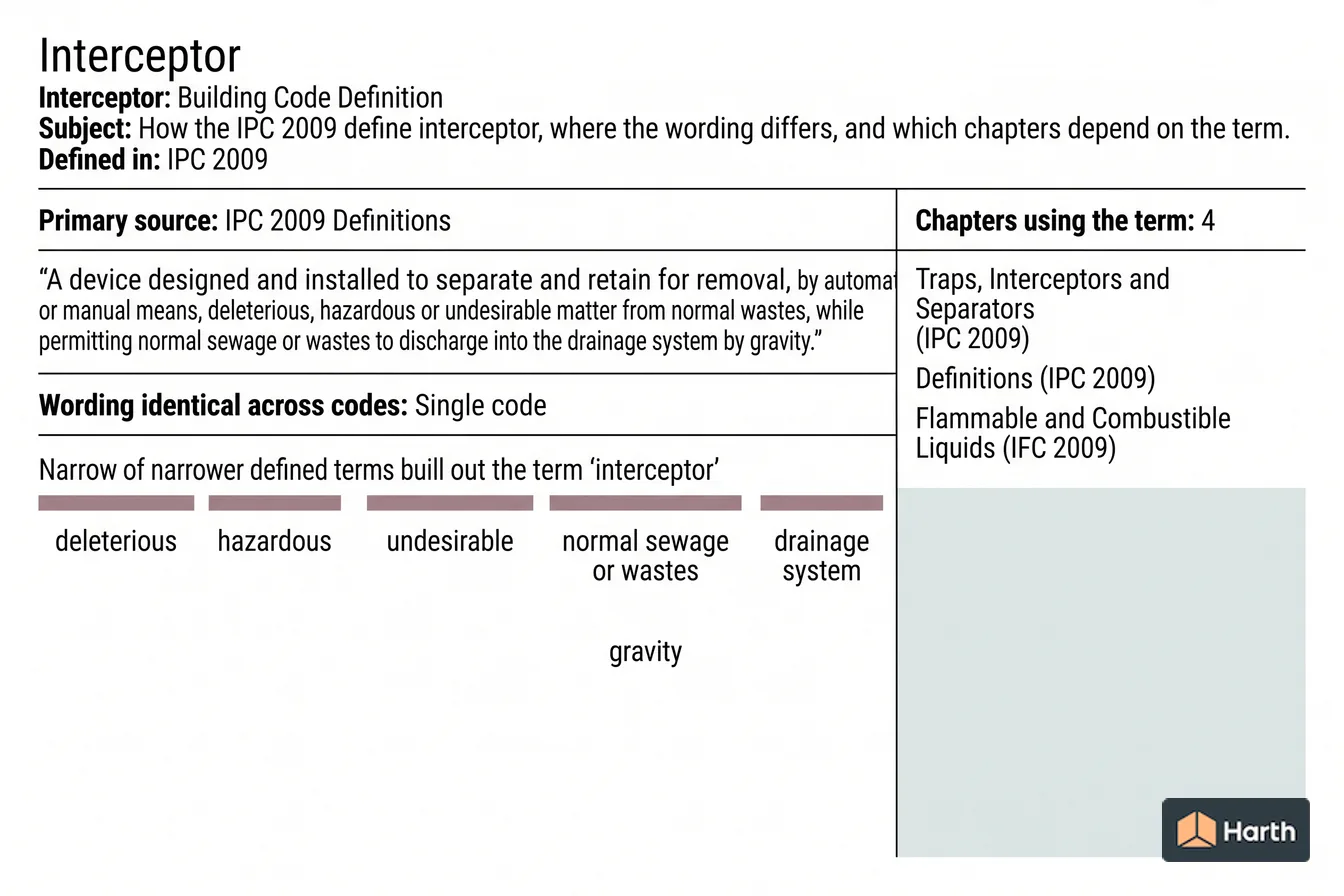
Interceptor is a defined term in the International Plumbing Code (IPC) 2009, in Definitions. The code's own words are: “A device designed and installed to separate and retain for removal, by automatic or manual means, deleterious, hazardous or undesirable matter from normal wastes, while permitting normal sewage or wastes to discharge into the drainage system by gravity.” No other I-Code in this corpus defines it, so the IPC 2009 definition is the one to work from. The term is used in 4 chapters of this corpus, most often in Traps, Interceptors and Separators (IPC 2009), Definitions (IPC 2009), Flammable and Combustible Liquids (IFC 2009). These pages transcribe the 2009 model text; verify the definition against the edition and amendments your authority having jurisdiction has adopted.
Content and cited inputs reviewed by Scott Barrington, Harth founder and architectural technology specialist · Published 2026-09-07 · Updated 2026-09-07.
What does this term mean?
Interceptor — IPC 2009, Definitions:
A device designed and installed to separate and retain for removal, by automatic or manual means, deleterious, hazardous or undesirable matter from normal wastes, while permitting normal sewage or wastes to discharge into the drainage system by gravity.
What must be verified before using this guidance?
Interceptor is defined once in this corpus, in the Definitions chapter of the International Plumbing Code (IPC) 2009:
A device designed and installed to separate and retain for removal, by automatic or manual means, deleterious, hazardous or undesirable matter from normal wastes, while permitting normal sewage or wastes to discharge into the drainage system by gravity.
Where interceptor is used in the code
The term appears in 4 chapters of the 2009 I-Codes hosted here. The chapters that lean on it hardest are the ones to read next.
| Chapter | Code | Mentions |
|---|---|---|
| Traps, Interceptors and Separators | IPC 2009 | 75 |
| Definitions | IPC 2009 | 7 |
| Flammable and Combustible Liquids | IFC 2009 | 5 |
| Vents | IPC 2009 | 2 |
The term in use
How the code actually writes about interceptor, quoted from the 2009 text hosted here:
The size, type and location of each interceptor and of each separator shall be designed and installed in accordance with the manufacturer's instructions and the requirements of this section based on the anticipated conditions of use.
The terms interceptor is built out of
The definition above leans on 5 other defined terms. Each carries its own code definition, and a local amendment to any of them changes what interceptor covers:
- Drainage System — IPC 2009: Piping within a public or private premise that conveys sewage, rainwater or other liquid wastes to a point of disposal.
- Automatic — IBC 2009: As applied to fire protection devices, a device or system providing an emergency function without the necessity for human intervention and activated as a result of a predetermined temperature rise, rate of temperature rise or combustion products.
- System — IFC 2009: An assembly of equipment consisting of a tank, container or containers, appurtenances, pumps, compressors and connecting piping.
- Device — IRC 2009: Aunit of an electrical system that carries or controls electrical energy as it principal function.
- Manual — IECC 2009: Capable of being operated by personal intervention (see "Automatic").
Interceptor: what to open, and in what order
Every row is a document this term depends on. The ICC code library and the ICC adoption maps cover the middle rows.
| Check | Where | Confirmed |
|---|---|---|
| Read the definition in the adopted IPC | Definitions | |
| Re-check the requirement that uses it | Traps, Interceptors and Separators (IPC 2009) | |
| Re-check the requirement that uses it | Definitions (IPC 2009) | |
| Re-check the requirement that uses it | Flammable and Combustible Liquids (IFC 2009) | |
| Re-check the requirement that uses it | Vents (IPC 2009) | |
| Confirm the dependent definition | Drainage System | |
| Confirm the dependent definition | Automatic | |
| Confirm the dependent definition | System | |
| Local amendment to any of the above | Jurisdiction's amendment list |
A research aid, not a code determination. The authority having jurisdiction decides which edition and which amendments apply.
Where can you explore related guidance?
- Explore all glossary guidance
- Drainage System: Building Code Definition
- Automatic: Building Code Definition
- System: Building Code Definition
- Sewage: Building Code Definition
Sources and method
Definitions quoted from the 2009 International Codes as transcribed in this site's building-codes collection, with the source chapter linked for each quotation. Usage counts are computed over the chapters hosted here, one copy per code. The ICC code library publishes the current model text and the ICC adoption maps show which edition a jurisdiction has adopted; those sources control.
Source links
Frequently asked questions
What is the code definition of interceptor?
The International Plumbing Code (IPC) 2009 defines it in Definitions as: “A device designed and installed to separate and retain for removal, by automatic or manual means, deleterious, hazardous or undesirable matter from normal wastes, while permitting normal sewage or wastes to discharge into the drainage system by gravity.” The 2009 model text is reproduced here; the definition that binds your project is the one in the edition your jurisdiction has adopted, as amended locally.
Which parts of the code depend on interceptor?
In this corpus the term is used across 4 chapters, led by Traps, Interceptors and Separators in the IPC 2009. Those are the sections whose scope moves if the definition is amended locally, so read them together with Chapter 2 rather than on their own.
What does interceptor mean?
In the 2009 I-Codes hosted here it is a defined term rather than a description. The IPC 2009 states, in Definitions: “A device designed and installed to separate and retain for removal, by automatic or manual means, deleterious, hazardous or undesirable matter from normal wastes, while permitting normal sewage or wastes to discharge into the drainage system by gravity.” It is defined in IPC 2009. Because it is a defined term, whatever the adopted edition says it means is what every section using it means — so check Chapter 2 of that edition and any local amendment before relying on this wording.
What does ICC stand for in building codes?
Building is a separate defined term. The IBC 2009 defines it as: “Any structure used or intended for supporting or sheltering any use or occupancy.” That is not the same as interceptor, which the IPC 2009 defines as “A device designed and installed to separate and retain for removal, by automatic or manual means, deleterious, hazardous or undesirable matter from normal wastes, while permitting normal sewage or wastes to discharge into the drainage system by gravity.” — read both before applying either, and confirm the wording in the edition your jurisdiction has adopted.
What does IPC mean in plumbing?
Plumbing is a separate defined term. The IRC 2009 defines it as: “For the purpose of this code, plumbing refers to those installations, repairs, maintenance and alterations regulated by Chapters 25 through 33.” That is not the same as interceptor, which the IPC 2009 defines as “A device designed and installed to separate and retain for removal, by automatic or manual means, deleterious, hazardous or undesirable matter from normal wastes, while permitting normal sewage or wastes to discharge into the drainage system by gravity.” — read both before applying either, and confirm the wording in the edition your jurisdiction has adopted.
Related pages
- Initiating Device: Building Code Definition
Initiating Device — IBC 2009 definition: A system component that originates transmission of a change-of-state condition, such as in a smoke detector …
- Inspection Certificate: Building Code Definition
Inspection Certificate — IBC 2009 definition: An identification applied on a product by an approved agency containing the name of the manufacturer …
- Insulating Sheathing: Building Code Definition
Insulating Sheathing — IRC 2009 definition: An insulating board having a minimum thermal resistance of R-2 of the core material.
- Interior Finish: Building Code Definition
Interior Finish — IBC 2009 definition: Interior finish includes interior wall and ceiling finish and interior floor finish.
- Interior Floor Finish: Building Code Definition
Interior Floor Finish — IBC 2009 definition: The exposed floor surfaces of buildings including coverings applied over a finished floor or stair, including …
- Interior Floor-wall Base: Building Code Definition
Interior Floor-wall Base — IBC 2009 definition: Interior floor finish trim used to provide a functional and/or decorative border at the intersection of …