Building Code Glossary
Automatic: Building Code Definition
How the IBC 2009, IRC 2009, IFC 2009, IECC 2009 define automatic, where the wording differs, and which chapters depend on the term.
On this page
Last updated September 7, 2026 · Definitions quoted from the 2009 International Codes as transcribed in this site's building-codes collection, with the source chapter linked for each quotation. Usage counts are computed over the chapters hosted here, one copy per code. The [ICC code library](https://codes.iccsafe.org/codes) publishes the current model text and the [ICC adoption maps](https://www.iccsafe.org/advocacy/code-adoption-maps/) show which edition a jurisdiction has adopted; those sources control.
Direct answer
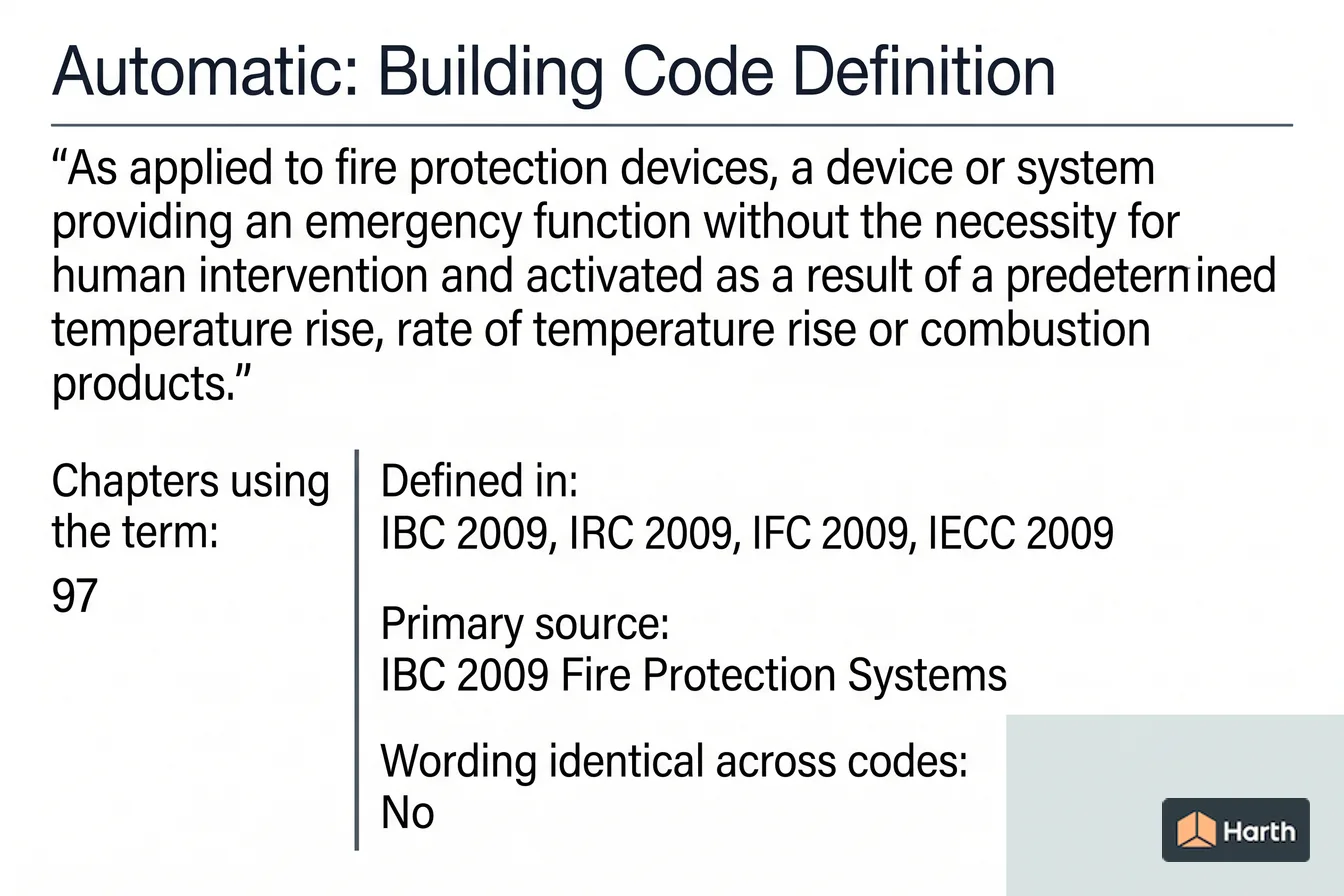
Automatic is a defined term in the International Building Code (IBC) 2009, in Fire Protection Systems. The code's own words are: “As applied to fire protection devices, a device or system providing an emergency function without the necessity for human intervention and activated as a result of a predetermined temperature rise, rate of temperature rise or combustion products.” The IRC 2009, IFC 2009, IECC 2009 define the same term with different wording, so the controlling text depends on which code governs the question in front of you — the comparison below sets the versions side by side. The term is used in 97 chapters of this corpus, most often in Fire Protection Systems (IFC 2009), Fire Protection Systems (IBC 2009), Special Detailed Requirements Based on Use and Occupancy (IBC 2009). These pages transcribe the 2009 model text; verify the definition against the edition and amendments your authority having jurisdiction has adopted.
Content and cited inputs reviewed by Scott Barrington, Harth founder and architectural technology specialist · Published 2026-09-07 · Updated 2026-09-07.
What does this term mean?
Automatic — IBC 2009, Fire Protection Systems:
As applied to fire protection devices, a device or system providing an emergency function without the necessity for human intervention and activated as a result of a predetermined temperature rise, rate of temperature rise or combustion products.
What must be verified before using this guidance?
Four of the I-Codes in this corpus define Automatic, and the wording is not identical — read the version that governs your question.
| Code | Where it is defined | Definition |
|---|---|---|
| IBC 2009 | Fire Protection Systems | As applied to fire protection devices, a device or system providing an emergency function without the necessity for human intervention and activated as a result of a predetermined temperature rise, rate of temperature rise or combustion products. |
| IRC 2009 | Electrical Definitions | Self-acting, operating by its own mechanism when actuated by some impersonal influence, as, for example, a change in current, pressure, temperature or mechanical configuration. |
| IFC 2009 | Fire Protection Systems | As applied to fire protection devices, a device or system providing an emergency function without the necessity for human intervention and activated as a result of a predetermined temperature rise, rate of temperature rise or combustion products. |
| IECC 2009 | Definitions | Self-acting, operating by its own mechanism when actuated by some impersonal influence, as, for example, a change in current strength, pressure, temperature or mechanical configuration (see "Manual"). |
Where automatic is used in the code
The term appears in 97 chapters of the 2009 I-Codes hosted here. The chapters that lean on it hardest are the ones to read next.
| Chapter | Code | Mentions |
|---|---|---|
| Fire Protection Systems | IFC 2009 | 649 |
| Fire Protection Systems | IBC 2009 | 593 |
| Special Detailed Requirements Based on Use and Occupancy | IBC 2009 | 183 |
| Fire and Smoke Protection Features | IBC 2009 | 139 |
| Means of Egress | IFC 2009 | 131 |
| Semiconductor Fabrication Facilities | IFC 2009 | 107 |
| Flammable and Combustible Liquids | IFC 2009 | 103 |
| Means of Egress | IBC 2009 | 101 |
| Commercial Energy Efficiency | IECC 2009 | 101 |
| Interior Finish, Decorative Materials and Furnishings | IFC 2009 | 76 |
| Exhaust Systems | IMC 2009 | 74 |
| Construction Requirements for Existing Buildings | IFC 2009 | 72 |
85 further chapters mention the term.
The term in use
How the code actually writes about automatic, quoted from the 2009 text hosted here:
Such safeguards include, but shall not be limited to, the following: automatic fire detection systems, fire alarm systems, automatic fire-extinguishing systems, standpipe systems, or portable or fixed extinguishers.
Automatic sprinkler systems shall be monitored by an approved supervising station.
Where exit passageways provide a secondary means of egress from a tenant space, doorways to the exit passageway shall be protected by I-hour fire door assemblies that are self- or automatic-closing by smoke detection in accordance with Section 715.4.8.3.
The terms automatic is built out of
The definition above leans on 5 other defined terms. Each carries its own code definition, and a local amendment to any of them changes what automatic covers:
- Combustion Products — IRC 2009: Constituents resulting from the combustion of a fuel with the oxygen of the air, including the inert gases, but excluding excess air.
- Combustion — IRC 2009: In the context of this code, refers to the rapid oxidation of fuel accompanied by the production of heat or heat and light.
- System — IFC 2009: An assembly of equipment consisting of a tank, container or containers, appurtenances, pumps, compressors and connecting piping.
- Device — IRC 2009: Aunit of an electrical system that carries or controls electrical energy as it principal function.
- Manual — IECC 2009: Capable of being operated by personal intervention (see "Automatic").
Automatic: what to open, and in what order
Every row is a document this term depends on. The ICC code library and the ICC adoption maps cover the middle rows.
| Check | Where | Confirmed |
|---|---|---|
| Read the definition in the adopted IBC | Fire Protection Systems | |
| Read the definition in the adopted IRC | Electrical Definitions | |
| Read the definition in the adopted IFC | Fire Protection Systems | |
| Read the definition in the adopted IECC | Definitions | |
| Re-check the requirement that uses it | Fire Protection Systems (IFC 2009) | |
| Re-check the requirement that uses it | Fire Protection Systems (IBC 2009) | |
| Re-check the requirement that uses it | Special Detailed Requirements Based on Use and Occupancy (IBC 2009) | |
| Re-check the requirement that uses it | Fire and Smoke Protection Features (IBC 2009) | |
| Confirm the dependent definition | Combustion Products | |
| Confirm the dependent definition | Combustion | |
| Confirm the dependent definition | System | |
| Local amendment to any of the above | Jurisdiction's amendment list |
A research aid, not a code determination. The authority having jurisdiction decides which edition and which amendments apply.
Where can you explore related guidance?
- Explore all glossary guidance
- Combustion Products: Building Code Definition
- Combustion: Building Code Definition
- System: Building Code Definition
- Manual: Building Code Definition
Sources and method
Definitions quoted from the 2009 International Codes as transcribed in this site's building-codes collection, with the source chapter linked for each quotation. Usage counts are computed over the chapters hosted here, one copy per code. The ICC code library publishes the current model text and the ICC adoption maps show which edition a jurisdiction has adopted; those sources control.
Source links
Frequently asked questions
What is the code definition of automatic?
The International Building Code (IBC) 2009 defines it in Fire Protection Systems as: “As applied to fire protection devices, a device or system providing an emergency function without the necessity for human intervention and activated as a result of a predetermined temperature rise, rate of temperature rise or combustion products.” The 2009 model text is reproduced here; the definition that binds your project is the one in the edition your jurisdiction has adopted, as amended locally.
Do the I-Codes define automatic the same way?
No. IBC 2009, IRC 2009, IFC 2009, IECC 2009 all define the term, but the wording is not identical, and a difference in wording can change which requirements are triggered. The comparison table above sets the versions side by side so you can read the one that governs your question.
Which parts of the code depend on automatic?
In this corpus the term is used across 97 chapters, led by Fire Protection Systems in the IFC 2009. Those are the sections whose scope moves if the definition is amended locally, so read them together with Chapter 2 rather than on their own.
What are the five classifications of building construction?
Building is a separate defined term. The IBC 2009 defines it as: “Any structure used or intended for supporting or sheltering any use or occupancy.” That is not the same as automatic, which the IBC 2009 defines as “As applied to fire protection devices, a device or system providing an emergency function without the necessity for human intervention and activated as a result of a predetermined temperature rise, rate of temperature rise or combustion products.” — read both before applying either, and confirm the wording in the edition your jurisdiction has adopted.
What is automatic programming?
In the 2009 I-Codes hosted here it is a defined term rather than a description. The IBC 2009 states, in Fire Protection Systems: “As applied to fire protection devices, a device or system providing an emergency function without the necessity for human intervention and activated as a result of a predetermined temperature rise, rate of temperature rise or combustion products.” It is defined in IBC 2009, IRC 2009, IFC 2009, IECC 2009. Because it is a defined term, whatever the adopted edition says it means is what every section using it means — so check Chapter 2 of that edition and any local amendment before relying on this wording.
Related pages
- Automatic Fire-extinguishing System: Building Code Definition
Automatic Fire-extinguishing System — IBC 2009 definition: An approved system of devices and equipment which automatically detects a fire and discharges an approvedfire-ext…
- Automatic Smoke Detection System: Building Code Definition
Automatic Smoke Detection System — IBC 2009 definition: A fire alarm system that has initiation devices that utilize smoke detectors for protection of an …
- Automatic Sprinkler System: Building Code Definition
Automatic Sprinkler System — IBC 2009 definition: An automatic sprinkler system, for fire protection purposes, is an integrated system of underground and overhead …
- Average Ambient Sound Level: Building Code Definition
Average Ambient Sound Level — IBC 2009 definition: The root mean square, A-weighted sound pressure level measured over a 24-hour period, or the time …
- Awning: Building Code Definition
Awning — IBC 2009 definition: An architectural projection that provides weather protection, identity or decoration and is wholly supported by the …
- Backflow Preventer, Reduced-pressure-zone Type: Building Code Definition
Backflow Preventer, Reduced-pressure-zone Type — IRC 2009 definition: A backflow-prevention device consisting of two independently acting check valves, internally force loa…