Building Code Glossary
Interlock: Building Code Definition
How the IMC 2009 define interlock, where the wording differs, and which chapters depend on the term.
On this page
Last updated September 7, 2026 · Definitions quoted from the 2009 International Codes as transcribed in this site's building-codes collection, with the source chapter linked for each quotation. Usage counts are computed over the chapters hosted here, one copy per code. The [ICC code library](https://codes.iccsafe.org/codes) publishes the current model text and the [ICC adoption maps](https://www.iccsafe.org/advocacy/code-adoption-maps/) show which edition a jurisdiction has adopted; those sources control.
Direct answer
Interlock is a defined term in the International Mechanical Code (IMC) 2009, in Definitions. The code's own words are: “A device actuated by another device with which it is directly associated, to govern succeeding operations of the same or allied devices. A circuit in which a given action cannot occur until after one or more other actions have taken place.” No other I-Code in this corpus defines it, so the IMC 2009 definition is the one to work from. The term is used in 22 chapters of this corpus, most often in Flammable Finishes (IFC 2009), Motor Fuel-dispensing Facilities and Repair Garages (IFC 2009), Special Detailed Requirements Based on Use and Occupancy (IBC 2009). These pages transcribe the 2009 model text; verify the definition against the edition and amendments your authority having jurisdiction has adopted.
Content and cited inputs reviewed by Scott Barrington, Harth founder and architectural technology specialist · Published 2026-09-07 · Updated 2026-09-07.
What does this term mean?
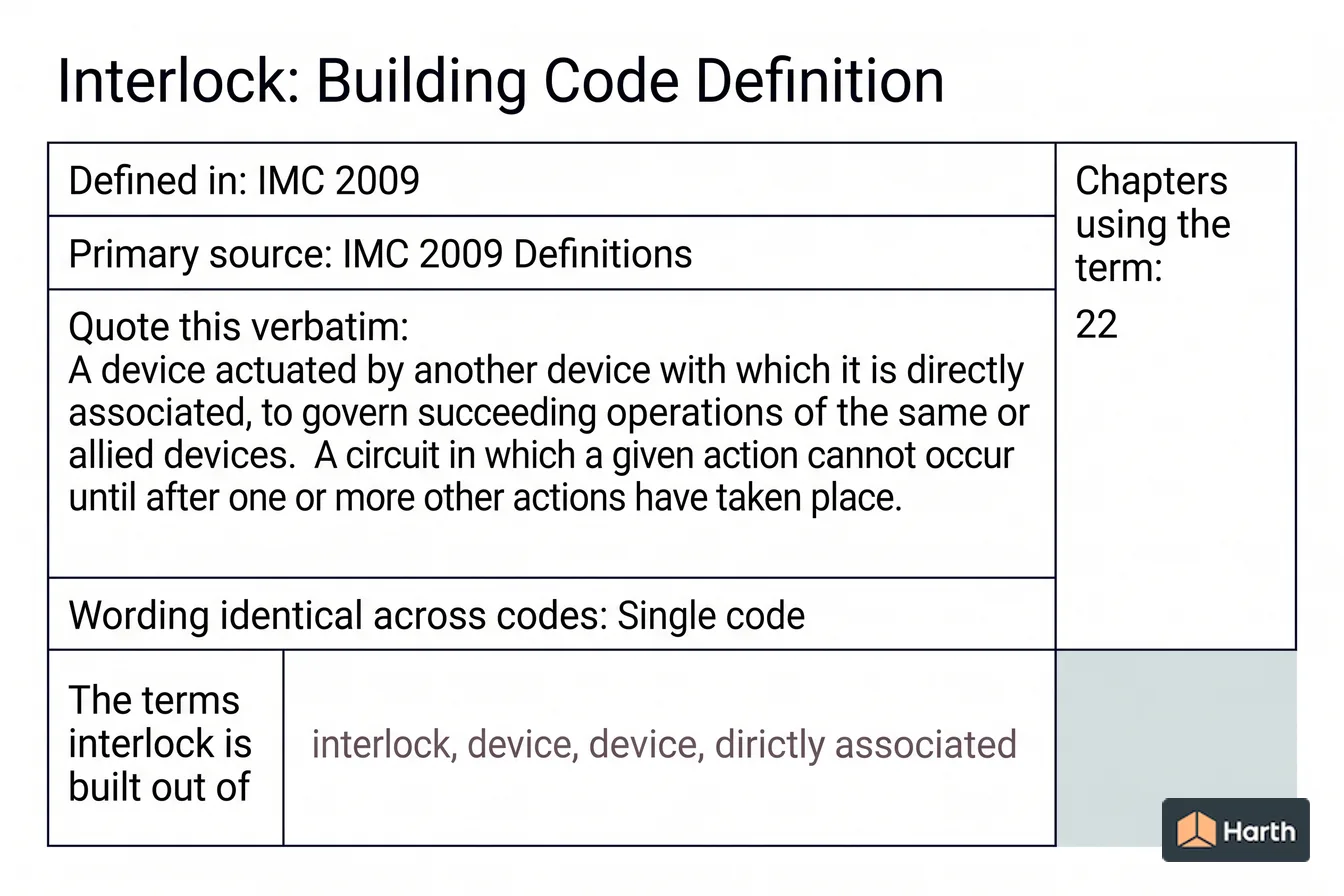
Interlock — IMC 2009, Definitions:
A device actuated by another device with which it is directly associated, to govern succeeding operations of the same or allied devices. A circuit in which a given action cannot occur until after one or more other actions have taken place.
What must be verified before using this guidance?
Interlock is defined once in this corpus, in the Definitions chapter of the International Mechanical Code (IMC) 2009:
A device actuated by another device with which it is directly associated, to govern succeeding operations of the same or allied devices. A circuit in which a given action cannot occur until after one or more other actions have taken place.
Where interlock is used in the code
The term appears in 22 chapters of the 2009 I-Codes hosted here. The chapters that lean on it hardest are the ones to read next.
| Chapter | Code | Mentions |
|---|---|---|
| Flammable Finishes | IFC 2009 | 19 |
| Motor Fuel-dispensing Facilities and Repair Garages | IFC 2009 | 15 |
| Special Detailed Requirements Based on Use and Occupancy | IBC 2009 | 13 |
| Exhaust Systems | IMC 2009 | 7 |
| Fire Protection Systems | IBC 2009 | 6 |
| Flammable Solids | IFC 2009 | 6 |
| Industrial Ovens | IFC 2009 | 5 |
| Fuel Gas | IRC 2009 | 5 |
| Fire Protection Systems | IFC 2009 | 4 |
| Means of Egress | IBC 2009 | 3 |
| Roof Assemblies and Rooftop Structures | IBC 2009 | 3 |
| Explosives and Fireworks | IFC 2009 | 3 |
10 further chapters mention the term.
The term in use
How the code actually writes about interlock, quoted from the 2009 text hosted here:
Where protecting automated spray application operations, automatic fire-extinguishing systems shall be equipped with an approved interlock feature that will, upon discharge of the system, automatically stop the spraying operations and workpiece conveyors into and out of the flammable vapor areas.
The interlock shall be designed to shut down the machine it serves when the dust removal or separator system is not operating properly.
The fan circuit shall be provided with an interlock to prevent heater operation when the fan is not operating.
The terms interlock is built out of
The definition above leans on 1 other defined term. Each carries its own code definition, and a local amendment to any of them changes what interlock covers:
- Device — IRC 2009: Aunit of an electrical system that carries or controls electrical energy as it principal function.
Interlock: what to open, and in what order
Every row is a document this term depends on. The ICC code library and the ICC adoption maps cover the middle rows.
| Check | Where | Confirmed |
|---|---|---|
| Read the definition in the adopted IMC | Definitions | |
| Re-check the requirement that uses it | Flammable Finishes (IFC 2009) | |
| Re-check the requirement that uses it | Motor Fuel-dispensing Facilities and Repair Garages (IFC 2009) | |
| Re-check the requirement that uses it | Special Detailed Requirements Based on Use and Occupancy (IBC 2009) | |
| Re-check the requirement that uses it | Exhaust Systems (IMC 2009) | |
| Confirm the dependent definition | Device | |
| Local amendment to any of the above | Jurisdiction's amendment list |
A research aid, not a code determination. The authority having jurisdiction decides which edition and which amendments apply.
Where can you explore related guidance?
- Explore all glossary guidance
- Device: Building Code Definition
- Building: Building Code Definition
- Construction Documents: Building Code Definition
- Registered Design Professional: Building Code Definition
Sources and method
Definitions quoted from the 2009 International Codes as transcribed in this site's building-codes collection, with the source chapter linked for each quotation. Usage counts are computed over the chapters hosted here, one copy per code. The ICC code library publishes the current model text and the ICC adoption maps show which edition a jurisdiction has adopted; those sources control.
Source links
Frequently asked questions
What is the code definition of interlock?
The International Mechanical Code (IMC) 2009 defines it in Definitions as: “A device actuated by another device with which it is directly associated, to govern succeeding operations of the same or allied devices. A circuit in which a given action cannot occur until after one or more other actions have taken place.” The 2009 model text is reproduced here; the definition that binds your project is the one in the edition your jurisdiction has adopted, as amended locally.
Which parts of the code depend on interlock?
In this corpus the term is used across 22 chapters, led by Flammable Finishes in the IFC 2009. Those are the sections whose scope moves if the definition is amended locally, so read them together with Chapter 2 rather than on their own.
What is considered an interlock?
In the 2009 I-Codes hosted here it is a defined term rather than a description. The IMC 2009 states, in Definitions: “A device actuated by another device with which it is directly associated, to govern succeeding operations of the same or allied devices. A circuit in which a given action cannot occur until after one or more other actions have taken place.” It is defined in IMC 2009. Because it is a defined term, whatever the adopted edition says it means is what every section using it means — so check Chapter 2 of that edition and any local amendment before relying on this wording.
Related pages
- Interior Floor-wall Base: Building Code Definition
Interior Floor-wall Base — IBC 2009 definition: Interior floor finish trim used to provide a functional and/or decorative border at the intersection of …
- Interior Surfaces: Building Code Definition
Interior Surfaces — IBC 2009 definition: Surfaces other than weather-exposed surfaces.
- Interior Wall and Ceiling Finish: Building Code Definition
Interior Wall and Ceiling Finish — IBC 2009 definition: The exposed interior surfaces of buildings, including but not limited to: fixed or movable walls and …
- Irritant: Building Code Definition
Irritant — IFC 2009 definition: A chemical which is not corrosive, but which causes a reversible inflammatory effect on living tissue …
- Isolated: Building Code Definition
Isolated — IRC 2009 definition: (As applied to location.) Not readily accessible to persons unless special means for access are used.
- Joint, Flared: Building Code Definition
Joint, Flared — IRC 2009 definition: A metal-to-metal compression joint in which a conical spread is made on the end of a …