Building Code Glossary
Irritant: Building Code Definition
How the IFC 2009 define irritant, where the wording differs, and which chapters depend on the term.
On this page
Last updated September 7, 2026 · Definitions quoted from the 2009 International Codes as transcribed in this site's building-codes collection, with the source chapter linked for each quotation. Usage counts are computed over the chapters hosted here, one copy per code. The [ICC code library](https://codes.iccsafe.org/codes) publishes the current model text and the [ICC adoption maps](https://www.iccsafe.org/advocacy/code-adoption-maps/) show which edition a jurisdiction has adopted; those sources control.
Direct answer
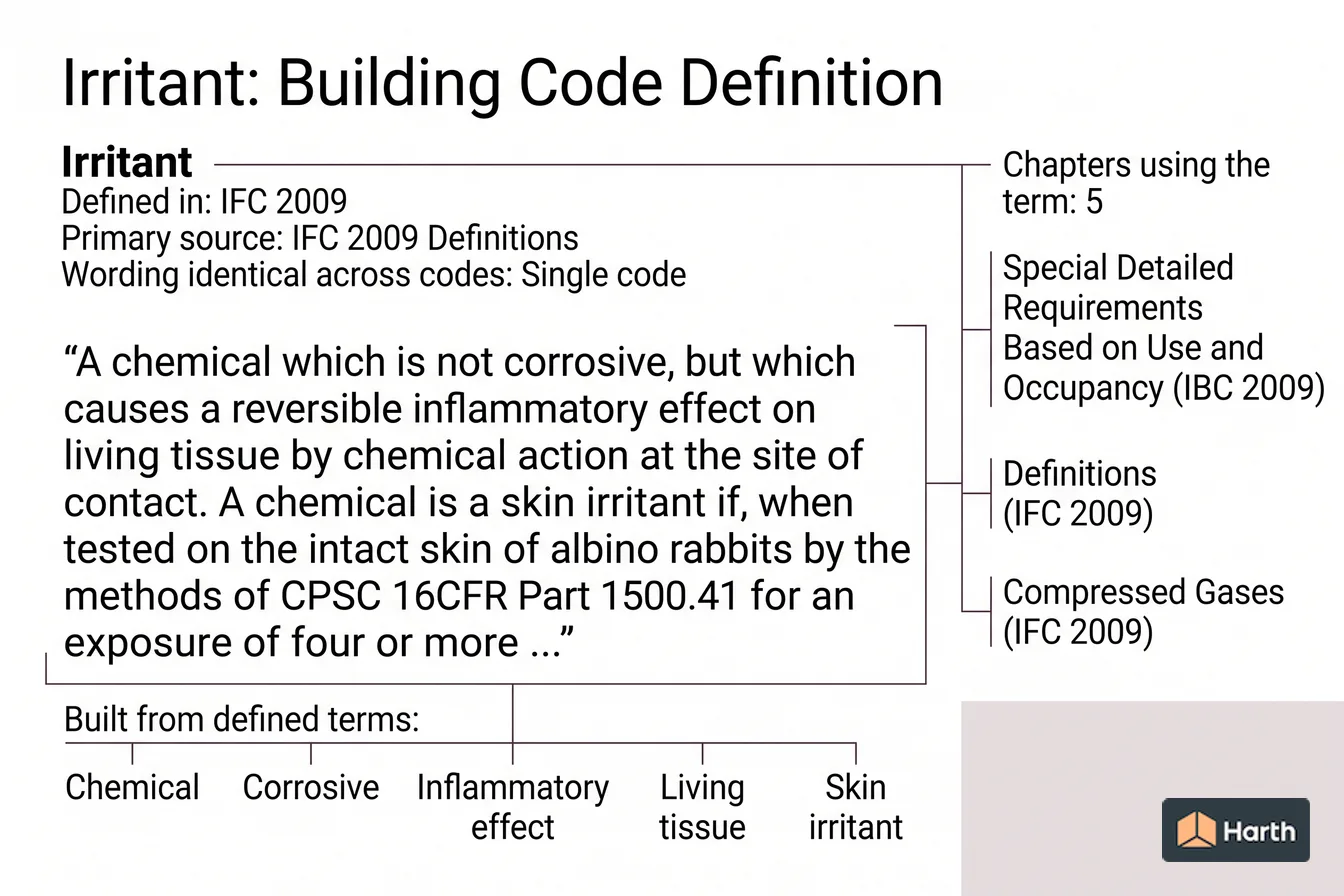
Irritant is a defined term in the International Fire Code (IFC) 2009, in Definitions. The code's own words are: “A chemical which is not corrosive, but which causes a reversible inflammatory effect on living tissue by chemical action at the site of contact. A chemical is a skin irritant if, when tested on the intact skin of albino rabbits by the methods of CPSC 16CFR Part 1500.41 for an exposure of four or more …” No other I-Code in this corpus defines it, so the IFC 2009 definition is the one to work from. The term is used in 5 chapters of this corpus, most often in Special Detailed Requirements Based on Use and Occupancy (IBC 2009), Definitions (IFC 2009), Compressed Gases (IFC 2009). These pages transcribe the 2009 model text; verify the definition against the edition and amendments your authority having jurisdiction has adopted.
Content and cited inputs reviewed by Scott Barrington, Harth founder and architectural technology specialist · Published 2026-09-07 · Updated 2026-09-07.
What does this term mean?
Irritant — IFC 2009, Definitions:
A chemical which is not corrosive, but which causes a reversible inflammatory effect on living tissue by chemical action at the site of contact. A chemical is a skin irritant if, when tested on the intact skin of albino rabbits by the methods of CPSC 16CFR Part 1500.41 for an exposure of four or more hours or by other appropriate techniques, it results in an empirical score of 5 or more. A chemical is classified as an eye irritant if so determined under the procedure listed in CPSC 16CFR Part 1500.42 or other approved techniques.
What must be verified before using this guidance?
Irritant is defined once in this corpus, in the Definitions chapter of the International Fire Code (IFC) 2009:
A chemical which is not corrosive, but which causes a reversible inflammatory effect on living tissue by chemical action at the site of contact. A chemical is a skin irritant if, when tested on the intact skin of albino rabbits by the methods of CPSC 16CFR Part 1500.41 for an exposure of four or more hours or by other appropriate techniques, it results in an empirical score of 5 or more. A chemical is classified as an eye irritant if so determined under the procedure listed in CPSC 16CFR Part 1500.42 or other approved techniques.
Where irritant is used in the code
The term appears in 5 chapters of the 2009 I-Codes hosted here. The chapters that lean on it hardest are the ones to read next.
| Chapter | Code | Mentions |
|---|---|---|
| Special Detailed Requirements Based on Use and Occupancy | IBC 2009 | 3 |
| Definitions | IFC 2009 | 3 |
| Compressed Gases | IFC 2009 | 1 |
| General Requirements | IFC 2009 | 1 |
| Hazardous Materials-general Provisions | IFC 2009 | 1 |
The term in use
How the code actually writes about irritant, quoted from the 2009 text hosted here:
Compressedgases in storage or use not regu1ated by the material-specific provisions of Chapters 6,31,35 and 37 through 44, including asphyxiant, irritant and radioactive gases, shall comply with this section in addition to other requirements of this chapter.
No person shall install and use firearms, sharp or pointed objects, razor wire, explosives, flammable or combustible liquid containers, or dispensers containing highly toxic, toxic, irritant or other hazardous materials in a manner which may passively or actively disable, injure, maim or kill a fire fighter who forcibly enters a building for the purpose of controlling or extinguishing a fire …
The terms irritant is built out of
The definition above leans on 4 other defined terms. Each carries its own code definition, and a local amendment to any of them changes what irritant covers:
- Corrosive — IBC 2009: A chemical that causes visible destruction of, or irreversible alterations in, living tissue by chemical action at the point of contact.
- Approved — IBC 2009: Acceptable to the code official or authority having jurisdiction.
- Chemical — IFC 2009: An element, chemical compound or mixture of elements or compounds or both.
- Listed — IBC 2009: Equipment, materials, products or services included in a list published by an organization acceptable to the code official and concerned with evaluation of products or services that maintains periodic inspection of production of listed equipment or materials or periodic evaluation …
Irritant: what to open, and in what order
Every row is a document this term depends on. The ICC code library and the ICC adoption maps cover the middle rows.
| Check | Where | Confirmed |
|---|---|---|
| Read the definition in the adopted IFC | Definitions | |
| Re-check the requirement that uses it | Special Detailed Requirements Based on Use and Occupancy (IBC 2009) | |
| Re-check the requirement that uses it | Definitions (IFC 2009) | |
| Re-check the requirement that uses it | Compressed Gases (IFC 2009) | |
| Re-check the requirement that uses it | General Requirements (IFC 2009) | |
| Confirm the dependent definition | Corrosive | |
| Confirm the dependent definition | Approved | |
| Confirm the dependent definition | Chemical | |
| Local amendment to any of the above | Jurisdiction's amendment list |
A research aid, not a code determination. The authority having jurisdiction decides which edition and which amendments apply.
Where can you explore related guidance?
- Explore all glossary guidance
- Corrosive: Building Code Definition
- Chemical: Building Code Definition
- Approved: Building Code Definition
- Listed: Building Code Definition
Sources and method
Definitions quoted from the 2009 International Codes as transcribed in this site's building-codes collection, with the source chapter linked for each quotation. Usage counts are computed over the chapters hosted here, one copy per code. The ICC code library publishes the current model text and the ICC adoption maps show which edition a jurisdiction has adopted; those sources control.
Source links
Frequently asked questions
What is the code definition of irritant?
The International Fire Code (IFC) 2009 defines it in Definitions as: “A chemical which is not corrosive, but which causes a reversible inflammatory effect on living tissue by chemical action at the site of contact. A chemical is a skin irritant if, when tested on the intact skin of albino rabbits by the methods of CPSC 16CFR Part 1500.41 for an exposure of four or more hours or by other appropriate techniques, it results in an empirical score of 5 or more. A chemical is classified as an eye irritant if so determined under the procedure listed in CPSC 16CFR Part 1500.42 or other approved techniques.” The 2009 model text is reproduced here; the definition that binds your project is the one in the edition your jurisdiction has adopted, as amended locally.
Which parts of the code depend on irritant?
In this corpus the term is used across 5 chapters, led by Special Detailed Requirements Based on Use and Occupancy in the IBC 2009. Those are the sections whose scope moves if the definition is amended locally, so read them together with Chapter 2 rather than on their own.
What is the definition of a basement in the California building code?
Building is a separate defined term. The IBC 2009 defines it as: “Any structure used or intended for supporting or sheltering any use or occupancy.” That is not the same as irritant, which the IFC 2009 defines as “A chemical which is not corrosive, but which causes a reversible inflammatory effect on living tissue by chemical action at the site of contact. A chemical is a skin irritant if, when tested on the intact skin of albino rabbits …” — read both before applying either, and confirm the wording in the edition your jurisdiction has adopted.
What is an irritant hazard?
In the 2009 I-Codes hosted here it is a defined term rather than a description. The IFC 2009 states, in Definitions: “A chemical which is not corrosive, but which causes a reversible inflammatory effect on living tissue by chemical action at the site of contact. A chemical is a skin irritant if, when tested on the intact skin of albino rabbits by the methods of CPSC 16CFR Part 1500.41 for an exposure of four or more …” It is defined in IFC 2009. Because it is a defined term, whatever the adopted edition says it means is what every section using it means — so check Chapter 2 of that edition and any local amendment before relying on this wording.
Related pages
- Interior Surfaces: Building Code Definition
Interior Surfaces — IBC 2009 definition: Surfaces other than weather-exposed surfaces.
- Interior Wall and Ceiling Finish: Building Code Definition
Interior Wall and Ceiling Finish — IBC 2009 definition: The exposed interior surfaces of buildings, including but not limited to: fixed or movable walls and …
- Interlock: Building Code Definition
Interlock — IMC 2009 definition: A device actuated by another device with which it is directly associated, to govern succeeding operations …
- Isolated: Building Code Definition
Isolated — IRC 2009 definition: (As applied to location.) Not readily accessible to persons unless special means for access are used.
- Joint, Flared: Building Code Definition
Joint, Flared — IRC 2009 definition: A metal-to-metal compression joint in which a conical spread is made on the end of a …
- Joint, Mechanical: Building Code Definition
Joint, Mechanical — IRC 2009 definition: A general form of gas-tight joints obtained by the joining of metal parts through a positive-holding …