Building Code Glossary
Load Effects: Building Code Definition
How the IBC 2009 define load effects, where the wording differs, and which chapters depend on the term.
On this page
Last updated September 7, 2026 · Definitions quoted from the 2009 International Codes as transcribed in this site's building-codes collection, with the source chapter linked for each quotation. Usage counts are computed over the chapters hosted here, one copy per code. The [ICC code library](https://codes.iccsafe.org/codes) publishes the current model text and the [ICC adoption maps](https://www.iccsafe.org/advocacy/code-adoption-maps/) show which edition a jurisdiction has adopted; those sources control.
Direct answer
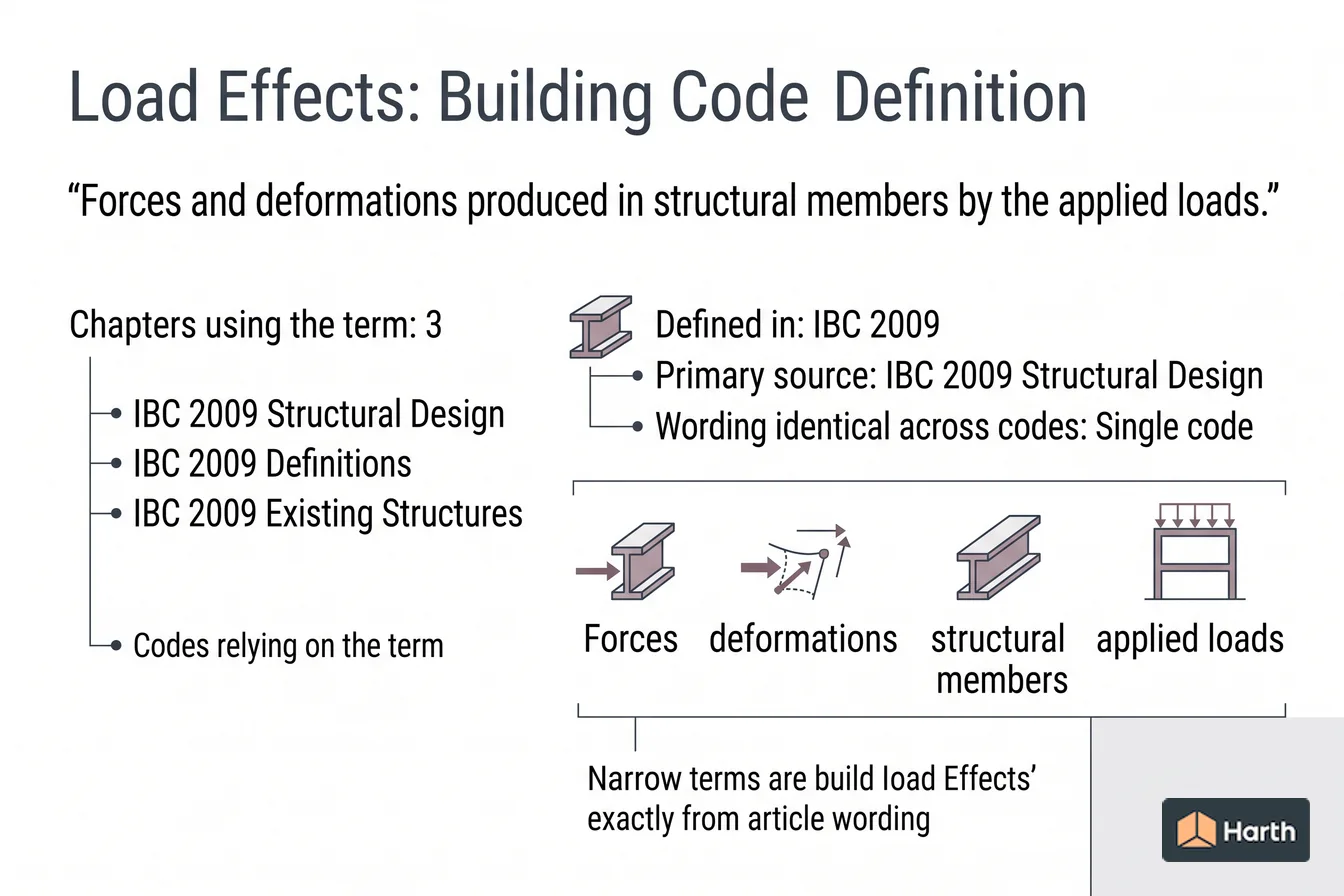
Load effects is a defined term in the International Building Code (IBC) 2009, in Structural Design. The code's own words are: “Forces and deformations produced in structural members by the applied loads.” No other I-Code in this corpus defines it, so the IBC 2009 definition is the one to work from. The term is used in 3 chapters of this corpus, most often in Structural Design (IBC 2009), Definitions (IBC 2009), Existing Structures (IBC 2009). These pages transcribe the 2009 model text; verify the definition against the edition and amendments your authority having jurisdiction has adopted. Record the jurisdiction, the adopted edition, the application date and any local amendment that rewrites the definition before you use it on a live project, because a term redefined by amendment changes every requirement that depends on it.
Content and cited inputs reviewed by Scott Barrington, Harth founder and architectural technology specialist · Published 2026-09-07 · Updated 2026-09-07.
What does this term mean?
Load Effects — IBC 2009, Structural Design:
Forces and deformations produced in structural members by the applied loads.
What must be verified before using this guidance?
Load Effects is defined once in this corpus, in the Structural Design chapter of the International Building Code (IBC) 2009:
Forces and deformations produced in structural members by the applied loads.
Where load effects is used in the code
The term appears in 3 chapters of the 2009 I-Codes hosted here. The chapters that lean on it hardest are the ones to read next.
| Chapter | Code | Mentions |
|---|---|---|
| Structural Design | IBC 2009 | 6 |
| Definitions | IBC 2009 | 1 |
| Existing Structures | IBC 2009 | 1 |
The term in use
How the code actually writes about load effects, quoted from the 2009 text hosted here:
Load effects on structural members and their connections shall be determined by methods of structural analysis that take into account equilibrium, general stability, geometric compatibility and both short-and long-term material properties.
Snow loads shall be considered if the substantial structural damage was caused by or related to snow load effects.
The terms load effects is built out of
The definition above leans on 1 other defined term. Each carries its own code definition, and a local amendment to any of them changes what load effects covers:
- Loads — IBC 2009: Forces or other actions that result from the weight of building materials, occupants and their possessions, environmental effects, differential movement and restrained dimensional changes.
Load Effects: what to open, and in what order
Every row is a document this term depends on. The ICC code library and the ICC adoption maps cover the middle rows.
| Check | Where | Confirmed |
|---|---|---|
| Read the definition in the adopted IBC | Structural Design | |
| Re-check the requirement that uses it | Structural Design (IBC 2009) | |
| Re-check the requirement that uses it | Definitions (IBC 2009) | |
| Re-check the requirement that uses it | Existing Structures (IBC 2009) | |
| Confirm the dependent definition | Loads | |
| Local amendment to any of the above | Jurisdiction's amendment list |
A research aid, not a code determination. The authority having jurisdiction decides which edition and which amendments apply.
Where can you explore related guidance?
- Explore all glossary guidance
- Loads: Building Code Definition
- Design Flood Elevation: Building Code Definition
- Seismic Design Category: Building Code Definition
- Design Flood: Building Code Definition
Sources and method
Definitions quoted from the 2009 International Codes as transcribed in this site's building-codes collection, with the source chapter linked for each quotation. Usage counts are computed over the chapters hosted here, one copy per code. The ICC code library publishes the current model text and the ICC adoption maps show which edition a jurisdiction has adopted; those sources control.
Source links
Frequently asked questions
What is the code definition of load effects?
The International Building Code (IBC) 2009 defines it in Structural Design as: “Forces and deformations produced in structural members by the applied loads.” The 2009 model text is reproduced here; the definition that binds your project is the one in the edition your jurisdiction has adopted, as amended locally.
Which parts of the code depend on load effects?
In this corpus the term is used across 3 chapters, led by Structural Design in the IBC 2009. Those are the sections whose scope moves if the definition is amended locally, so read them together with Chapter 2 rather than on their own.
What are the different types of building loads?
Building is a separate defined term. The IBC 2009 defines it as: “Any structure used or intended for supporting or sheltering any use or occupancy.” That is not the same as load effects, which the IBC 2009 defines as “Forces and deformations produced in structural members by the applied loads.” — read both before applying either, and confirm the wording in the edition your jurisdiction has adopted.
Related pages
- Live Loads: Building Code Definition
Live Loads — IBC 2009 definition: Those loads produced by the use and occupancy of the building or other structure and do …
- Living Space: Building Code Definition
Living Space — IRC 2009 definition: Space within a dwelling unitutilized for living, sleeping, eating, cooking, bathing, washing and sanitation purposes.
- Load and Resistance Factor Design (LRFD): Building Code Definition
Load and Resistance Factor Design (LRFD) — IBC 2009 definition: A method of proportioning structural members and their connections using load and resistance factors such th…
- Load Factor: Building Code Definition
Load Factor — IBC 2009 definition: A factor that accounts for deviations of the actual load from the nominalload, for uncertainties in …
- Loads: Building Code Definition
Loads — IBC 2009 definition: Forces or other actions that result from the weight of building materials, occupants and their possessions …
- Location, Damp: Building Code Definition
Location, Damp — IRC 2009 definition: Location protected from weather and not subject to saturation with water or other liquids but subject …