Building Code Glossary
Physiological Warning Threshold Level: Building Code Definition
How the IBC 2009, IFC 2009 define physiological warning threshold level, where the wording differs, and which chapters depend on the term.
On this page
Last updated September 7, 2026 · Definitions quoted from the 2009 International Codes as transcribed in this site's building-codes collection, with the source chapter linked for each quotation. Usage counts are computed over the chapters hosted here, one copy per code. The [ICC code library](https://codes.iccsafe.org/codes) publishes the current model text and the [ICC adoption maps](https://www.iccsafe.org/advocacy/code-adoption-maps/) show which edition a jurisdiction has adopted; those sources control.
Direct answer
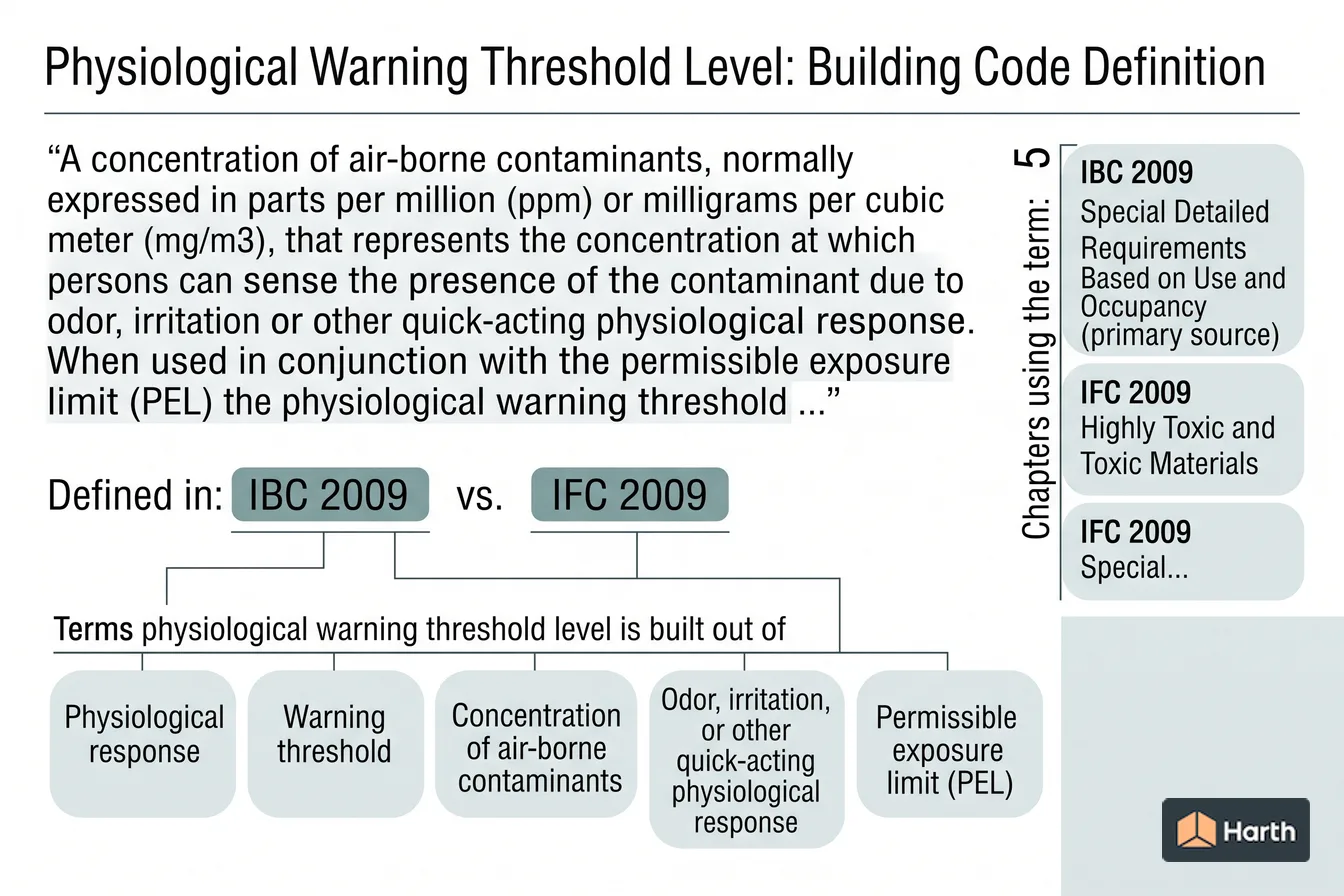
Physiological warning threshold level is a defined term in the International Building Code (IBC) 2009, in Special Detailed Requirements Based on Use and Occupancy. The code's own words are: “A concentration of air-borne contaminants, normally expressed in parts per million (ppm) or milligrams per cubic meter (mg/m3), that represents the concentration at which persons can sense the presence of the contaminant due to odor, irritation or other quick-acting physiological response. When used in conjunction with the permissible exposure limit (PEL) the physiological warning threshold …” The IFC 2009 defines the same term with different wording, so the controlling text depends on which code governs the question in front of you — the comparison below sets the versions side by side. The term is used in 5 chapters of this corpus, most often in Highly Toxic and Toxic Materials (IFC 2009), Special Detailed Requirements Based on Use and Occupancy (IBC 2009), Fire Protection Systems (IBC 2009). These pages transcribe the 2009 model text; verify the definition against the edition and amendments your authority having jurisdiction has adopted.
Content and cited inputs reviewed by Scott Barrington, Harth founder and architectural technology specialist · Published 2026-09-07 · Updated 2026-09-07.
What does this term mean?
Physiological Warning Threshold Level — IBC 2009, Special Detailed Requirements Based on Use and Occupancy:
A concentration of air-borne contaminants, normally expressed in parts per million (ppm) or milligrams per cubic meter (mg/m3), that represents the concentration at which persons can sense the presence of the contaminant due to odor, irritation or other quick-acting physiological response. When used in conjunction with the permissible exposure limit (PEL) the physiological warning threshold levels are those consistent with the classification system used to establish the PEL. See the definition of "Permissible exposure limit (PEL)" in the InternationalFire Code.
What must be verified before using this guidance?
Two of the I-Codes in this corpus define Physiological Warning Threshold Level, and the wording is not identical — read the version that governs your question.
| Code | Where it is defined | Definition |
|---|---|---|
| IBC 2009 | Special Detailed Requirements Based on Use and Occupancy | A concentration of air-borne contaminants, normally expressed in parts per million (ppm) or milligrams per cubic meter (mg/m3), that represents the concentration at which persons can sense the presence of the contaminant due to odor, irritation or other quick-acting physiological response. When used in conjunction with the permissible exposure limit (PEL) the physiological warning threshold levels are those consistent with the classification system used to establish the PEL. See the definition of "Permissible exposure limit (PEL)" in the InternationalFire Code. |
| IFC 2009 | Highly Toxic and Toxic Materials | A concentration of air-borne contaminants, normally expressed in parts per million (ppm) or milligrams per cubic meter (mg/m3), that represents the concentration at which persons can sense the presence ofthe contaminant due to odor, irritation or other quick-acting physiological responses. When used in conjunction with the permissible exposure limit (PEL), the physiological warning threshold levels are those consistent with the classification system used to establish the PEL. See the definition of "Permissible exposure limit (PEL)" in Section 2702. |
Where physiological warning threshold level is used in the code
The term appears in 5 chapters of the 2009 I-Codes hosted here. The chapters that lean on it hardest are the ones to read next.
| Chapter | Code | Mentions |
|---|---|---|
| Highly Toxic and Toxic Materials | IFC 2009 | 5 |
| Special Detailed Requirements Based on Use and Occupancy | IBC 2009 | 4 |
| Fire Protection Systems | IBC 2009 | 2 |
| Definitions | IBC 2009 | 1 |
| Semiconductor Fabrication Facilities | IFC 2009 | 1 |
The term in use
How the code actually writes about physiological warning threshold level, quoted from the 2009 text hosted here:
A continuous gas detection system shall be provided for HPM gases when the physiological warning threshold level of the gas is at a higher level than the accepted permissible exposure limit (PEL) for the gas and for flammable gases in accordance with Sections 1803.13.1 through 1803.13.2.2.
A continuous gas detection system shall be provided for HPM gases when the physiological warning threshold level of the gas is at a higher level than the accepted PEL for the gas and for flammable gases in accordance with Sections 415.8.7.1 and 415.8.7.2.
— IBC 2009, Special Detailed Requirements Based on Use and Occupancy
The terms physiological warning threshold level is built out of
The definition above leans on 2 other defined terms. Each carries its own code definition, and a local amendment to any of them changes what physiological warning threshold level covers:
- System — IFC 2009: An assembly of equipment consisting of a tank, container or containers, appurtenances, pumps, compressors and connecting piping.
- Meter — IRC 2009: The instrument installed to measure the volume of gas delivered through it.
Physiological Warning Threshold Level: what to open, and in what order
Every row is a document this term depends on. The ICC code library and the ICC adoption maps cover the middle rows.
| Check | Where | Confirmed |
|---|---|---|
| Read the definition in the adopted IBC | Special Detailed Requirements Based on Use and Occupancy | |
| Read the definition in the adopted IFC | Highly Toxic and Toxic Materials | |
| Re-check the requirement that uses it | Highly Toxic and Toxic Materials (IFC 2009) | |
| Re-check the requirement that uses it | Special Detailed Requirements Based on Use and Occupancy (IBC 2009) | |
| Re-check the requirement that uses it | Fire Protection Systems (IBC 2009) | |
| Re-check the requirement that uses it | Definitions (IBC 2009) | |
| Confirm the dependent definition | System | |
| Confirm the dependent definition | Meter | |
| Local amendment to any of the above | Jurisdiction's amendment list |
A research aid, not a code determination. The authority having jurisdiction decides which edition and which amendments apply.
Where can you explore related guidance?
Sources and method
Definitions quoted from the 2009 International Codes as transcribed in this site's building-codes collection, with the source chapter linked for each quotation. Usage counts are computed over the chapters hosted here, one copy per code. The ICC code library publishes the current model text and the ICC adoption maps show which edition a jurisdiction has adopted; those sources control.
Source links
Frequently asked questions
What is the code definition of physiological warning threshold level?
The International Building Code (IBC) 2009 defines it in Special Detailed Requirements Based on Use and Occupancy as: “A concentration of air-borne contaminants, normally expressed in parts per million (ppm) or milligrams per cubic meter (mg/m3), that represents the concentration at which persons can sense the presence of the contaminant due to odor, irritation or other quick-acting physiological response. When used in conjunction with the permissible exposure limit (PEL) the physiological warning threshold levels are those consistent with the classification system used to establish the PEL. See the definition of "Permissible exposure limit (PEL)" in the InternationalFire Code.” The 2009 model text is reproduced here; the definition that binds your project is the one in the edition your jurisdiction has adopted, as amended locally.
Which parts of the code depend on physiological warning threshold level?
In this corpus the term is used across 5 chapters, led by Highly Toxic and Toxic Materials in the IFC 2009. Those are the sections whose scope moves if the definition is amended locally, so read them together with Chapter 2 rather than on their own.
What is the definition of a building according to the International Building Code?
Building is a separate defined term. The IBC 2009 defines it as: “Any structure used or intended for supporting or sheltering any use or occupancy.” That is not the same as physiological warning threshold level, which the IBC 2009 defines as “A concentration of air-borne contaminants, normally expressed in parts per million (ppm) or milligrams per cubic meter (mg/m3), that represents the concentration at which persons can sense the presence of the contaminant due to odor, irritation or other quick-acting physiological …” — read both before applying either, and confirm the wording in the edition your jurisdiction has adopted.
Related pages
- Personal Care Service: Building Code Definition
Personal Care Service — IBC 2009 definition: The care of residents who do not require chronic or convalescent medical or nursing care.
- Photoluminescent: Building Code Definition
Photoluminescent — IBC 2009 definition: Having the property of emitting light that continues for a length of time after excitation by …
- Physical Hazard: Building Code Definition
Physical Hazard — IBC 2009 definition: A chemical for which there is evidence that it is a combustible liquid, cryogenic fluid, explosive …
- Pier: Building Code Definition
Pier — IFC 2009 definition: A structure built over the water, supported by pillars or piles, and used as a landing …
- Pilot: Building Code Definition
Pilot — IRC 2009 definition: A small flame that is utilized to ignite the gas at the main burner or burners.
- Piping System: Building Code Definition
Piping System — IRC 2009 definition: All fuel piping, valves and fittings from the outlet of the point ofdeliveryto the outlets of …