Building Code Glossary
Physical Hazard: Building Code Definition
How the IBC 2009, IFC 2009 define physical hazard, where the wording differs, and which chapters depend on the term.
On this page
Last updated September 7, 2026 · Definitions quoted from the 2009 International Codes as transcribed in this site's building-codes collection, with the source chapter linked for each quotation. Usage counts are computed over the chapters hosted here, one copy per code. The [ICC code library](https://codes.iccsafe.org/codes) publishes the current model text and the [ICC adoption maps](https://www.iccsafe.org/advocacy/code-adoption-maps/) show which edition a jurisdiction has adopted; those sources control.
Direct answer
Physical hazard is a defined term in the International Building Code (IBC) 2009, in Use and Occupancy Classification. The code's own words are: “A chemical for which there is evidence that it is a combustible liquid, cryogenic fluid, explosive, flammable (solid, liquid or gas), organic peroxide (solid or liquid), oxidizer (solid or liquid), oxidizing gas, pyrophoric (solid, liquid or gas), unstable (reactive) material (solid, liquid or gas) or water-reactive material (solid or liquid).” The IFC 2009 carries the same definition word for word, so the term means the same thing in each. The term is used in 4 chapters of this corpus, most often in Hazardous Materials-general Provisions (IFC 2009), Use and Occupancy Classification (IBC 2009), Definitions (IFC 2009). These pages transcribe the 2009 model text; verify the definition against the edition and amendments your authority having jurisdiction has adopted.
Content and cited inputs reviewed by Scott Barrington, Harth founder and architectural technology specialist · Published 2026-09-07 · Updated 2026-09-07.
What does this term mean?
Physical Hazard — IBC 2009, Use and Occupancy Classification:
A chemical for which there is evidence that it is a combustible liquid, cryogenic fluid, explosive, flammable (solid, liquid or gas), organic peroxide (solid or liquid), oxidizer (solid or liquid), oxidizing gas, pyrophoric (solid, liquid or gas), unstable (reactive) material (solid, liquid or gas) or water-reactive material (solid or liquid).
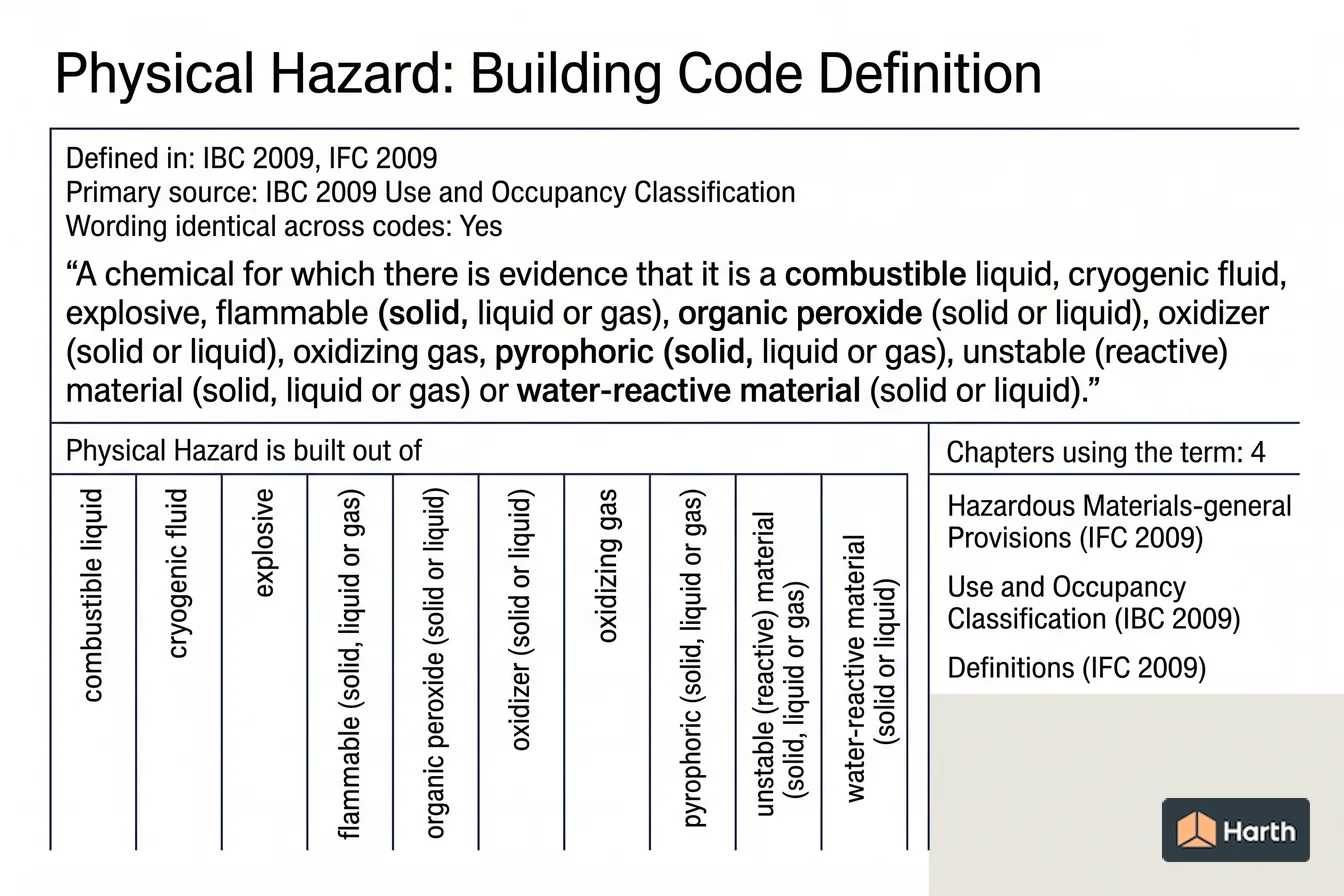
What must be verified before using this guidance?
Two of the I-Codes in this corpus define Physical Hazard, in identical words.
| Code | Where it is defined | Definition |
|---|---|---|
| IBC 2009 | Use and Occupancy Classification | A chemical for which there is evidence that it is a combustible liquid, cryogenic fluid, explosive, flammable (solid, liquid or gas), organic peroxide (solid or liquid), oxidizer (solid or liquid), oxidizing gas, pyrophoric (solid, liquid or gas), unstable (reactive) material (solid, liquid or gas) or water-reactive material (solid or liquid). |
| IFC 2009 | Hazardous Materials-general Provisions | A chemical for which there is evidence that it is a combustible liquid, cryogenic fluid, explosive, flammable (solid, liquid or gas), organic peroxide (solid or liquid), oxidizer (solid or liquid), oxidizing gas, pyrophoric (solid, liquid or gas), unstable (reactive) material (solid, liquid or gas) or water-reactive material (solid or liquid). |
Where physical hazard is used in the code
The term appears in 4 chapters of the 2009 I-Codes hosted here. The chapters that lean on it hardest are the ones to read next.
| Chapter | Code | Mentions |
|---|---|---|
| Hazardous Materials-general Provisions | IFC 2009 | 14 |
| Use and Occupancy Classification | IBC 2009 | 3 |
| Definitions | IFC 2009 | 3 |
| Definitions | IBC 2009 | 1 |
The term in use
How the code actually writes about physical hazard, quoted from the 2009 text hosted here:
A material with a primary classification as a physical hazard can also pose a health hazard.
Buildings and structures containing materials that readily support combustion or that pose a physical hazard shall be classified as Group H-3.
— IBC 2009, Use and Occupancy Classification
The terms physical hazard is built out of
The definition above leans on 5 other defined terms. Each carries its own code definition, and a local amendment to any of them changes what physical hazard covers:
- Unstable (Reactive) Material — IBC 2009: A material, other than an explosive, which in the pure state or as commercially produced, will vigorously polymerize, decompose, condense or become self-reactive and undergo other violent chemical changes, including explosion, when exposed to heat, friction or shock, or in …
- Water-reactive Material — IBC 2009: A material that explodes; violently reacts; produces flammable, toxic or other hazardous gases; or evolves enough heat to cause autoignition or ignition of combustibles upon exposure to water or moisture.
- Combustible Liquid — IBC 2009: A liquid having a closed cup flash point at or above 100°F (38°C).
- Organic Peroxide — IBC 2009: An organic compound that contains the bivalent -0-0- structure and which may be considered to be a structural derivative of hydrogen peroxide where one or both of the hydrogen atoms have been replaced by an organic radical.
- Cryogenic Fluid — IBC 2009: A liquid having a boiling point lower than -150°F (-101°C) at 14.7 pounds per square inch atmosphere (psia) (an absolute pressure of 101 kPa).
Physical Hazard: what to open, and in what order
Every row is a document this term depends on. The ICC code library and the ICC adoption maps cover the middle rows.
| Check | Where | Confirmed |
|---|---|---|
| Read the definition in the adopted IBC | Use and Occupancy Classification | |
| Read the definition in the adopted IFC | Hazardous Materials-general Provisions | |
| Re-check the requirement that uses it | Hazardous Materials-general Provisions (IFC 2009) | |
| Re-check the requirement that uses it | Use and Occupancy Classification (IBC 2009) | |
| Re-check the requirement that uses it | Definitions (IFC 2009) | |
| Re-check the requirement that uses it | Definitions (IBC 2009) | |
| Confirm the dependent definition | Unstable (Reactive) Material | |
| Confirm the dependent definition | Water-reactive Material | |
| Confirm the dependent definition | Combustible Liquid | |
| Local amendment to any of the above | Jurisdiction's amendment list |
A research aid, not a code determination. The authority having jurisdiction decides which edition and which amendments apply.
Where can you explore related guidance?
- Explore all glossary guidance
- Unstable (Reactive) Material: Building Code Definition
- Water-reactive Material: Building Code Definition
- Combustible Liquid: Building Code Definition
- Organic Peroxide: Building Code Definition
Sources and method
Definitions quoted from the 2009 International Codes as transcribed in this site's building-codes collection, with the source chapter linked for each quotation. Usage counts are computed over the chapters hosted here, one copy per code. The ICC code library publishes the current model text and the ICC adoption maps show which edition a jurisdiction has adopted; those sources control.
Source links
Frequently asked questions
What is the code definition of physical hazard?
The International Building Code (IBC) 2009 defines it in Use and Occupancy Classification as: “A chemical for which there is evidence that it is a combustible liquid, cryogenic fluid, explosive, flammable (solid, liquid or gas), organic peroxide (solid or liquid), oxidizer (solid or liquid), oxidizing gas, pyrophoric (solid, liquid or gas), unstable (reactive) material (solid, liquid or gas) or water-reactive material (solid or liquid).” The 2009 model text is reproduced here; the definition that binds your project is the one in the edition your jurisdiction has adopted, as amended locally.
Which parts of the code depend on physical hazard?
In this corpus the term is used across 4 chapters, led by Hazardous Materials-general Provisions in the IFC 2009. Those are the sections whose scope moves if the definition is amended locally, so read them together with Chapter 2 rather than on their own.
What is considered a physical hazard?
In the 2009 I-Codes hosted here it is a defined term rather than a description. The IBC 2009 states, in Use and Occupancy Classification: “A chemical for which there is evidence that it is a combustible liquid, cryogenic fluid, explosive, flammable (solid, liquid or gas), organic peroxide (solid or liquid), oxidizer (solid or liquid), oxidizing gas, pyrophoric (solid, liquid or gas), unstable (reactive) material (solid, liquid or gas) or water-reactive material (solid or liquid).” It is defined in IBC 2009, IFC 2009. Because it is a defined term, whatever the adopted edition says it means is what every section using it means — so check Chapter 2 of that edition and any local amendment before relying on this wording.
Related pages
- Person: Building Code Definition
Person — IBC 2009 definition: An individual, heirs, executors, administrators or assigns, and also includes a firm, partnership or corporation, its …
- Personal Care Service: Building Code Definition
Personal Care Service — IBC 2009 definition: The care of residents who do not require chronic or convalescent medical or nursing care.
- Photoluminescent: Building Code Definition
Photoluminescent — IBC 2009 definition: Having the property of emitting light that continues for a length of time after excitation by …
- Physiological Warning Threshold Level: Building Code Definition
Physiological Warning Threshold Level — IBC 2009 definition: A concentration of air-borne contaminants, normally expressed in parts per million (ppm) or milligrams per cubic …
- Pier: Building Code Definition
Pier — IFC 2009 definition: A structure built over the water, supported by pillars or piles, and used as a landing …
- Pilot: Building Code Definition
Pilot — IRC 2009 definition: A small flame that is utilized to ignite the gas at the main burner or burners.