Building Code Glossary
Unstable (Reactive) Material: Building Code Definition
How the IBC 2009, IFC 2009 define unstable (reactive) material, where the wording differs, and which chapters depend on the term.
On this page
Last updated September 7, 2026 · Definitions quoted from the 2009 International Codes as transcribed in this site's building-codes collection, with the source chapter linked for each quotation. Usage counts are computed over the chapters hosted here, one copy per code. The [ICC code library](https://codes.iccsafe.org/codes) publishes the current model text and the [ICC adoption maps](https://www.iccsafe.org/advocacy/code-adoption-maps/) show which edition a jurisdiction has adopted; those sources control.
Direct answer
Unstable (reactive) material is a defined term in the International Building Code (IBC) 2009, in Use and Occupancy Classification. The code's own words are: “A material, other than an explosive, which in the pure state or as commercially produced, will vigorously polymerize, decompose, condense or become self-reactive and undergo other violent chemical changes, including explosion, when exposed to heat, friction or shock, or in the absence of an inhibitor, or in the presence of contaminants, or in contact with …” The IFC 2009 carries the same definition word for word, so the term means the same thing in each. The term is used in 7 chapters of this corpus, most often in Unstable (reactive) Materials (IFC 2009), Definitions (IFC 2009), Use and Occupancy Classification (IBC 2009). These pages transcribe the 2009 model text; verify the definition against the edition and amendments your authority having jurisdiction has adopted.
Content and cited inputs reviewed by Scott Barrington, Harth founder and architectural technology specialist · Published 2026-09-07 · Updated 2026-09-07.
What does this term mean?
Unstable (Reactive) Material — IBC 2009, Use and Occupancy Classification:
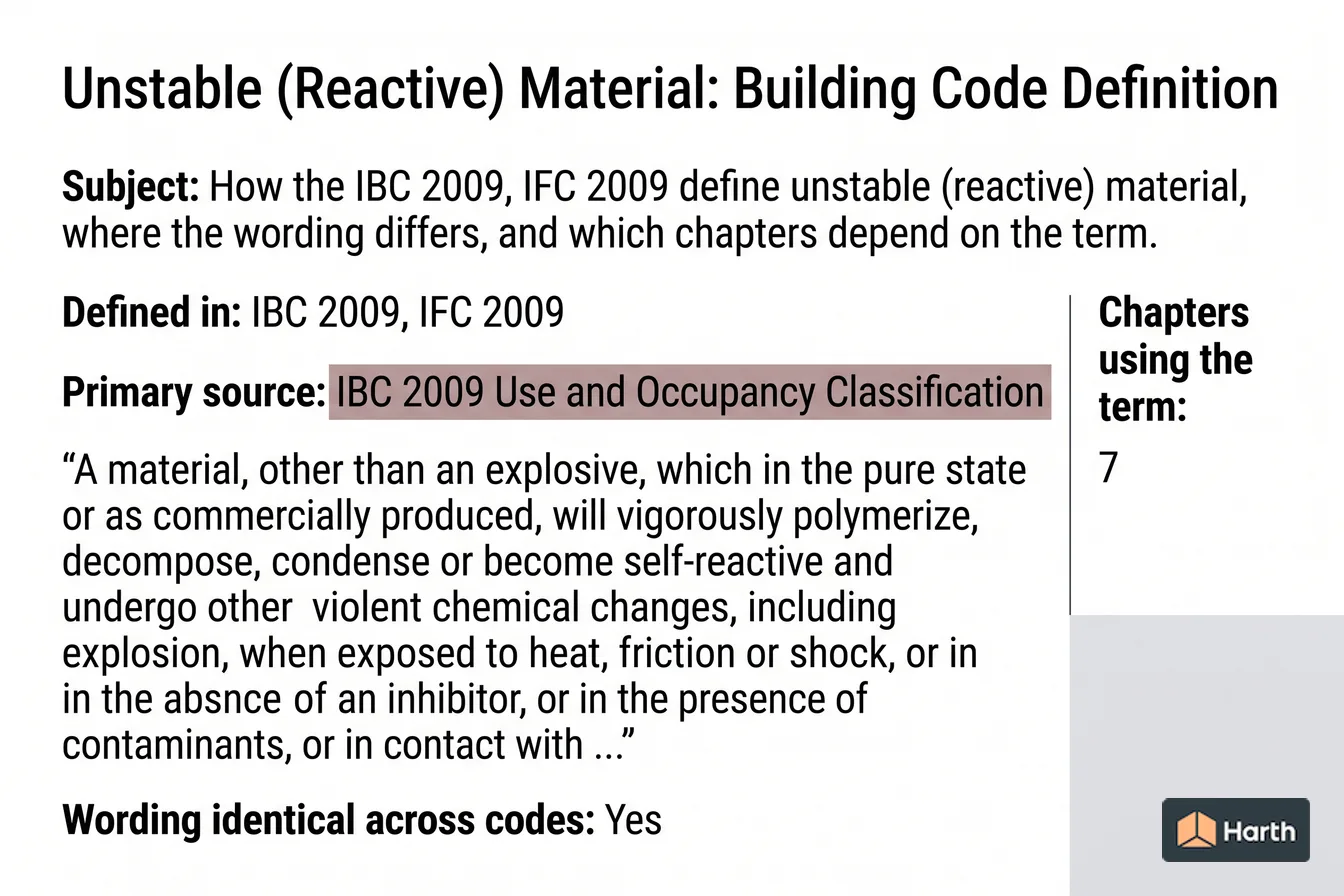
A material, other than an explosive, which in the pure state or as commercially produced, will vigorously polymerize, decompose, condense or become self-reactive and undergo other violent chemical changes, including explosion, when exposed to heat, friction or shock, or in the absence of an inhibitor, or in the presence of contaminants, or in contact with incompatible materials. Unstable (reactive) materials are subdivided as follows:
What must be verified before using this guidance?
Two of the I-Codes in this corpus define Unstable (Reactive) Material, in identical words.
| Code | Where it is defined | Definition |
|---|---|---|
| IBC 2009 | Use and Occupancy Classification | A material, other than an explosive, which in the pure state or as commercially produced, will vigorously polymerize, decompose, condense or become self-reactive and undergo other violent chemical changes, including explosion, when exposed to heat, friction or shock, or in the absence of an inhibitor, or in the presence of contaminants, or in contact with incompatible materials. Unstable (reactive) materials are subdivided as follows: |
| IFC 2009 | Unstable (reactive) Materials | A material, other than an explosive, which in the pure state or as commercially produced, will vigorously polymerize, decompose, condense or become self-reactive and undergo other violent chemical changes, including explosion, when exposed to heat, friction or shock, or in the absence of an inhibitor, or in the presence of contaminants, or in contact with incompatible materials. Unstable (reactive) materials are subdivided as follows: |
Where unstable (reactive) material is used in the code
The term appears in 7 chapters of the 2009 I-Codes hosted here. The chapters that lean on it hardest are the ones to read next.
| Chapter | Code | Mentions |
|---|---|---|
| Unstable (reactive) Materials | IFC 2009 | 61 |
| Definitions | IFC 2009 | 10 |
| Use and Occupancy Classification | IBC 2009 | 9 |
| Special Detailed Requirements Based on Use and Occupancy | IBC 2009 | 4 |
| Flammable Finishes | IFC 2009 | 2 |
| Definitions | IBC 2009 | 1 |
| Hazardous Materials-general Provisions | IFC 2009 | 1 |
The term in use
How the code actually writes about unstable (reactive) material, quoted from the 2009 text hosted here:
Outdoor storage of Class 4 or 3 (detonable) unstable (reactive) material shall be in accordance with Table 3304.5.2(2).
The terms unstable (reactive) material is built out of
The definition above leans on 5 other defined terms. Each carries its own code definition, and a local amendment to any of them changes what unstable (reactive) material covers:
- Incompatible Materials — IBC 2009: Materials that, when mixed, have the potential to react in a manner that generates heat, fumes, gases or byproducts which are hazardous to life or property.
- Explosive — IBC 2009: A chemical compound, mixture or device, the primary or common purpose of which is to function by explosion.
- Explosion — IBC 2009: An effect produced by the sudden violent expansion of gases, which may be accompanied by a shock wave or disruption, or both, of enclosing materials or structures.
- Chemical — IFC 2009: An element, chemical compound or mixture of elements or compounds or both.
- Exposed — IRC 2009: (As applied to live parts.) Capable of being inadvertently touched or approached nearer than a safe distance by a person.
Unstable (Reactive) Material: what to open, and in what order
Every row is a document this term depends on. The ICC code library and the ICC adoption maps cover the middle rows.
| Check | Where | Confirmed |
|---|---|---|
| Read the definition in the adopted IBC | Use and Occupancy Classification | |
| Read the definition in the adopted IFC | Unstable (reactive) Materials | |
| Re-check the requirement that uses it | Unstable (reactive) Materials (IFC 2009) | |
| Re-check the requirement that uses it | Definitions (IFC 2009) | |
| Re-check the requirement that uses it | Use and Occupancy Classification (IBC 2009) | |
| Re-check the requirement that uses it | Special Detailed Requirements Based on Use and Occupancy (IBC 2009) | |
| Confirm the dependent definition | Incompatible Materials | |
| Confirm the dependent definition | Explosive | |
| Confirm the dependent definition | Explosion | |
| Local amendment to any of the above | Jurisdiction's amendment list |
A research aid, not a code determination. The authority having jurisdiction decides which edition and which amendments apply.
Where can you explore related guidance?
- Explore all glossary guidance
- Incompatible Materials: Building Code Definition
- Explosive: Building Code Definition
- Explosion: Building Code Definition
- Chemical: Building Code Definition
Sources and method
Definitions quoted from the 2009 International Codes as transcribed in this site's building-codes collection, with the source chapter linked for each quotation. Usage counts are computed over the chapters hosted here, one copy per code. The ICC code library publishes the current model text and the ICC adoption maps show which edition a jurisdiction has adopted; those sources control.
Source links
Frequently asked questions
What is the code definition of unstable (reactive) material?
The International Building Code (IBC) 2009 defines it in Use and Occupancy Classification as: “A material, other than an explosive, which in the pure state or as commercially produced, will vigorously polymerize, decompose, condense or become self-reactive and undergo other violent chemical changes, including explosion, when exposed to heat, friction or shock, or in the absence of an inhibitor, or in the presence of contaminants, or in contact with incompatible materials. Unstable (reactive) materials are subdivided as follows:” The 2009 model text is reproduced here; the definition that binds your project is the one in the edition your jurisdiction has adopted, as amended locally.
Which parts of the code depend on unstable (reactive) material?
In this corpus the term is used across 7 chapters, led by Unstable (reactive) Materials in the IFC 2009. Those are the sections whose scope moves if the definition is amended locally, so read them together with Chapter 2 rather than on their own.
Related pages
- Ungrounded: Building Code Definition
Ungrounded — IRC 2009 definition: Not connected to ground or to a conductive body that extends the ground connection.
- Unit Heater: Building Code Definition
Unit Heater — IMC 2009 definition: A self-contained appliance of the fan type, designed for the delivery of warm air directly into …
- Unit Skylight: Building Code Definition
Unit Skylight — IRC 2009 definition: A factory assembled, glazed fenestration unit, containing one panel of glazing material, that allows for natural …
- Unvented Room Heater: Building Code Definition
Unvented Room Heater — IRC 2009 definition: An unvented heating appliance designed for stationary installation and utilized to provide comfort heating.
- Unwanted Fire: Building Code Definition
Unwanted Fire — IFC 2009 definition: A fire not used for cooking, heating or recreational purposes or one not incidental to the …
- Use (Material): Building Code Definition
Use (Material) — IBC 2009 definition: Placing a material into action, including solids, liquids and gases.