Building Code Glossary
Concealed Location: Building Code Definition
How the IRC 2009, IMC 2009 define concealed location, where the wording differs, and which chapters depend on the term.
On this page
Last updated September 7, 2026 · Definitions quoted from the 2009 International Codes as transcribed in this site's building-codes collection, with the source chapter linked for each quotation. Usage counts are computed over the chapters hosted here, one copy per code. The [ICC code library](https://codes.iccsafe.org/codes) publishes the current model text and the [ICC adoption maps](https://www.iccsafe.org/advocacy/code-adoption-maps/) show which edition a jurisdiction has adopted; those sources control.
Direct answer
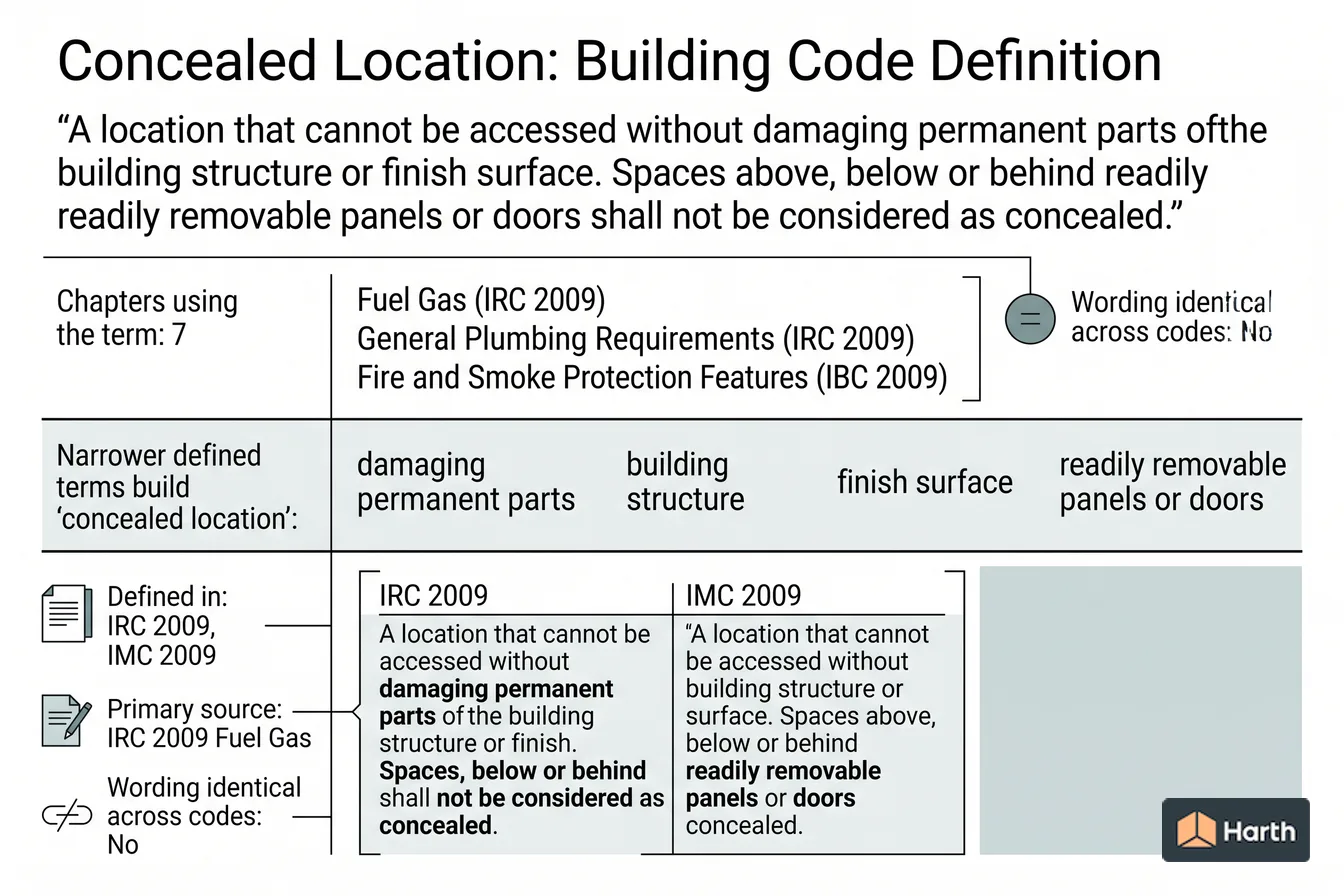
Concealed location is a defined term in the International Residential Code (IRC) 2009, in Fuel Gas. The code's own words are: “A location that cannot be accessed without damaging permanent parts ofthe building structure or finish surface. Spaces above, below or behind readily removable panels or doors shall not be considered as concealed.” The IMC 2009 defines the same term with different wording, so the controlling text depends on which code governs the question in front of you — the comparison below sets the versions side by side. The term is used in 7 chapters of this corpus, most often in Fuel Gas (IRC 2009), General Plumbing Requirements (IRC 2009), Fire and Smoke Protection Features (IBC 2009). These pages transcribe the 2009 model text; verify the definition against the edition and amendments your authority having jurisdiction has adopted.
Content and cited inputs reviewed by Scott Barrington, Harth founder and architectural technology specialist · Published 2026-09-07 · Updated 2026-09-07.
What does this term mean?
Concealed Location — IRC 2009, Fuel Gas:
A location that cannot be accessed without damaging permanent parts ofthe building structure or finish surface. Spaces above, below or behind readily removable panels or doors shall not be considered as concealed.
What must be verified before using this guidance?
Two of the I-Codes in this corpus define Concealed Location, and the wording is not identical — read the version that governs your question.
| Code | Where it is defined | Definition |
|---|---|---|
| IRC 2009 | Fuel Gas | A location that cannot be accessed without damaging permanent parts ofthe building structure or finish surface. Spaces above, below or behind readily removable panels or doors shall not be considered as concealed. |
| IMC 2009 | Definitions | A location that cannot be accessed without damaging permanent parts of the building structure or finish surface. Spaces above, below or behind readily removable panels or doors shall not be considered as concealed. |
Where concealed location is used in the code
The term appears in 7 chapters of the 2009 I-Codes hosted here. The chapters that lean on it hardest are the ones to read next.
| Chapter | Code | Mentions |
|---|---|---|
| Fuel Gas | IRC 2009 | 10 |
| General Plumbing Requirements | IRC 2009 | 2 |
| Fire and Smoke Protection Features | IBC 2009 | 1 |
| Definitions | IMC 2009 | 1 |
| General Regulations | IMC 2009 | 1 |
| General Regulations | IPC 2009 | 1 |
| General Mechanical System Requirements | IRC 2009 | 1 |
The terms concealed location is built out of
The definition above leans on 4 other defined terms. Each carries its own code definition, and a local amendment to any of them changes what concealed location covers:
- Concealed — IRC 2009: Rendered inaccessible by the structure or finish of the building.
- Structure — IPC 2009: That which is built or constructed or a portion thereof.
- Building — IBC 2009: Any structure used or intended for supporting or sheltering any use or occupancy.
- Shall — IRC 2009: The term, when used in the code, is construed as mandatory.
Concealed Location: what to open, and in what order
Every row is a document this term depends on. The ICC code library and the ICC adoption maps cover the middle rows.
| Check | Where | Confirmed |
|---|---|---|
| Read the definition in the adopted IRC | Fuel Gas | |
| Read the definition in the adopted IMC | Definitions | |
| Re-check the requirement that uses it | Fuel Gas (IRC 2009) | |
| Re-check the requirement that uses it | General Plumbing Requirements (IRC 2009) | |
| Re-check the requirement that uses it | Fire and Smoke Protection Features (IBC 2009) | |
| Re-check the requirement that uses it | Definitions (IMC 2009) | |
| Confirm the dependent definition | Concealed | |
| Confirm the dependent definition | Structure | |
| Confirm the dependent definition | Building | |
| Local amendment to any of the above | Jurisdiction's amendment list |
A research aid, not a code determination. The authority having jurisdiction decides which edition and which amendments apply.
Where can you explore related guidance?
- Explore all glossary guidance
- Structure: Building Code Definition
- Concealed: Building Code Definition
- Building: Building Code Definition
Sources and method
Definitions quoted from the 2009 International Codes as transcribed in this site's building-codes collection, with the source chapter linked for each quotation. Usage counts are computed over the chapters hosted here, one copy per code. The ICC code library publishes the current model text and the ICC adoption maps show which edition a jurisdiction has adopted; those sources control.
Source links
Frequently asked questions
What is the code definition of concealed location?
The International Residential Code (IRC) 2009 defines it in Fuel Gas as: “A location that cannot be accessed without damaging permanent parts ofthe building structure or finish surface. Spaces above, below or behind readily removable panels or doors shall not be considered as concealed.” The 2009 model text is reproduced here; the definition that binds your project is the one in the edition your jurisdiction has adopted, as amended locally.
Which parts of the code depend on concealed location?
In this corpus the term is used across 7 chapters, led by Fuel Gas in the IRC 2009. Those are the sections whose scope moves if the definition is amended locally, so read them together with Chapter 2 rather than on their own.
What is an IRC dwelling?
Dwelling is a separate defined term. The IBC 2009 defines it as: “A building that contains one or two dwelling units used, intended or designed to be used, rented, leased, let or hired out to be occupied for living purposes.” That is not the same as concealed location, which the IRC 2009 defines as “A location that cannot be accessed without damaging permanent parts ofthe building structure or finish surface. Spaces above, below or behind readily removable panels or doors shall not be considered as concealed.” — read both before applying either, and confirm the wording in the edition your jurisdiction has adopted.
Related pages
- Compressive Strength OF Masonry: Building Code Definition
Compressive Strength OF Masonry — IBC 2009 definition: Maximum compressive force resisted per unit of net cross-sectional area of masonry, determined by the testing …
- Compressor: Building Code Definition
Compressor — IMC 2009 definition: A specific machine, with or without accessories, for compressing a gas.
- Concealed Fouling Surface: Building Code Definition
Concealed Fouling Surface — IPC 2009 definition: Any surface of a plumbing fixture which is not readily visible and is not scoured or …
- Concealed Piping: Building Code Definition
Concealed Piping — IRC 2009 definition: Piping that is located in a concealed location (see “Concealed location”).
- Concealed: Building Code Definition
Concealed — IRC 2009 definition: Rendered inaccessible by the structure or finish of the building.
- Concrete, Cellular: Building Code Definition
Concrete, Cellular — IBC 2009 definition: A lightweight insulating concrete made by mixing a preformed foam with portland cement slurry and having …