Building Code Glossary
Heat Trap: Building Code Definition
How the IECC 2009 define heat trap, where the wording differs, and which chapters depend on the term.
On this page
Last updated September 7, 2026 · Definitions quoted from the 2009 International Codes as transcribed in this site's building-codes collection, with the source chapter linked for each quotation. Usage counts are computed over the chapters hosted here, one copy per code. The [ICC code library](https://codes.iccsafe.org/codes) publishes the current model text and the [ICC adoption maps](https://www.iccsafe.org/advocacy/code-adoption-maps/) show which edition a jurisdiction has adopted; those sources control.
Direct answer
Heat trap is a defined term in the International Energy Conservation Code (IECC) 2009, in Definitions. The code's own words are: “An arrangement of piping and fittings, such as elbows, or a commercially available heat trap that prevents thermosyphoning of hot water during standby periods.” No other I-Code in this corpus defines it, so the IECC 2009 definition is the one to work from. The term is used in 3 chapters of this corpus, most often in Commercial Energy Efficiency (IECC 2009), Fire Protection Systems (IBC 2009), Definitions (IECC 2009). These pages transcribe the 2009 model text; verify the definition against the edition and amendments your authority having jurisdiction has adopted. Record the jurisdiction, the adopted edition, the application date and any local amendment that rewrites the definition before you use it on a live project, because a term redefined by amendment changes every requirement that depends on it.
Content and cited inputs reviewed by Scott Barrington, Harth founder and architectural technology specialist · Published 2026-09-07 · Updated 2026-09-07.
What does this term mean?
Heat Trap — IECC 2009, Definitions:
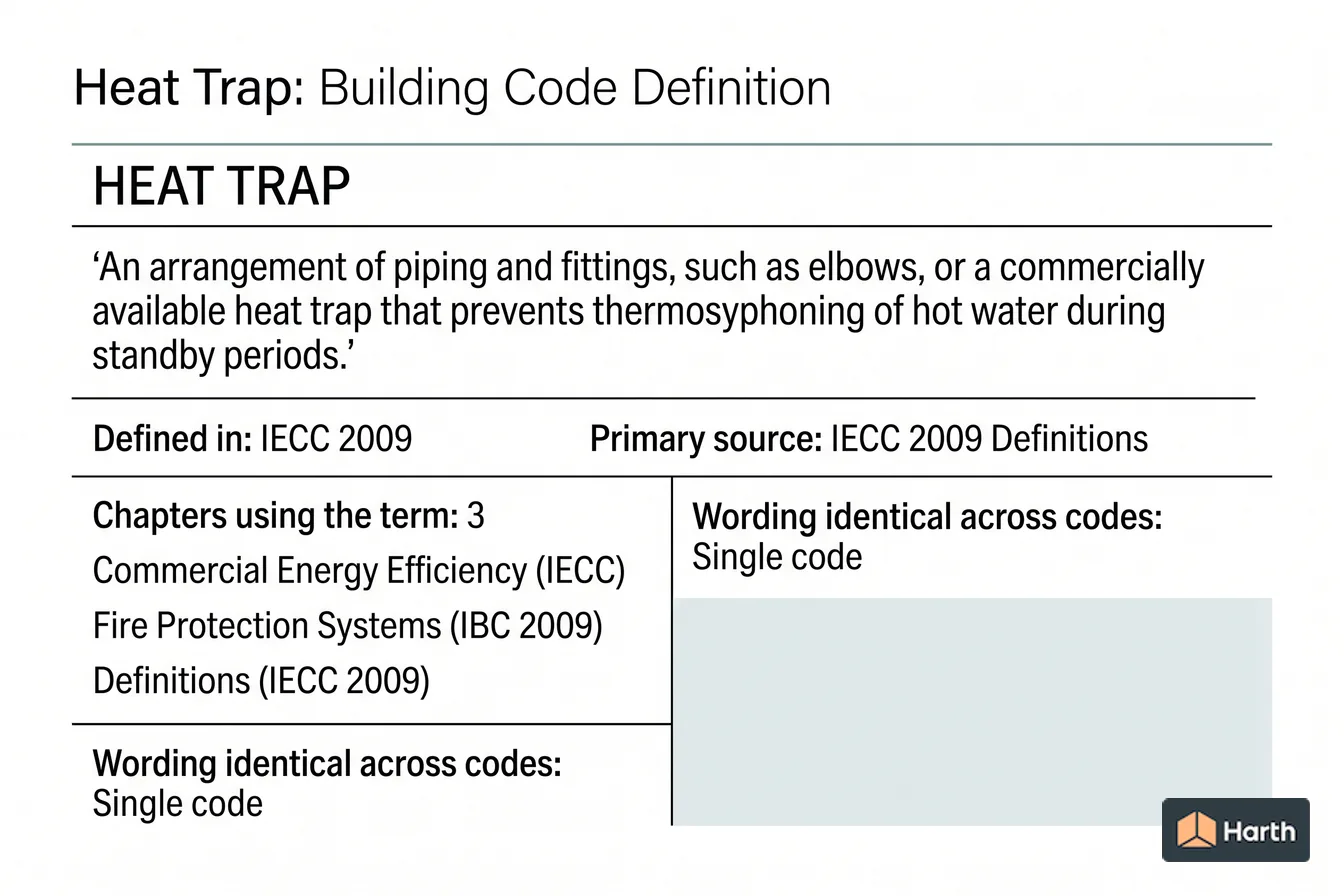
An arrangement of piping and fittings, such as elbows, or a commercially available heat trap that prevents thermosyphoning of hot water during standby periods.
What must be verified before using this guidance?
Heat Trap is defined once in this corpus, in the Definitions chapter of the International Energy Conservation Code (IECC) 2009:
An arrangement of piping and fittings, such as elbows, or a commercially available heat trap that prevents thermosyphoning of hot water during standby periods.
Where heat trap is used in the code
The term appears in 3 chapters of the 2009 I-Codes hosted here. The chapters that lean on it hardest are the ones to read next.
| Chapter | Code | Mentions |
|---|---|---|
| Commercial Energy Efficiency | IECC 2009 | 4 |
| Fire Protection Systems | IBC 2009 | 3 |
| Definitions | IECC 2009 | 2 |
The term in use
How the code actually writes about heat trap, quoted from the 2009 text hosted here:
into the vestibule to serve as a smoke and heat trap and to provide an upward-moving air column.
— IBC 2009, Fire Protection Systems
The terms heat trap is built out of
The definition above leans on 2 other defined terms. Each carries its own code definition, and a local amendment to any of them changes what heat trap covers:
- Hot Water — IRC 2009: Water at a temperature greater than or equal to 110° P (43°C).
- Piping — IRC 2009: Where used in this code, “piping” refers to either pipe or tubing, or both.
Heat Trap: what to open, and in what order
Every row is a document this term depends on. The ICC code library and the ICC adoption maps cover the middle rows.
| Check | Where | Confirmed |
|---|---|---|
| Read the definition in the adopted IECC | Definitions | |
| Re-check the requirement that uses it | Commercial Energy Efficiency (IECC 2009) | |
| Re-check the requirement that uses it | Fire Protection Systems (IBC 2009) | |
| Re-check the requirement that uses it | Definitions (IECC 2009) | |
| Confirm the dependent definition | Hot Water | |
| Confirm the dependent definition | Piping | |
| Local amendment to any of the above | Jurisdiction's amendment list |
A research aid, not a code determination. The authority having jurisdiction decides which edition and which amendments apply.
Where can you explore related guidance?
Sources and method
Definitions quoted from the 2009 International Codes as transcribed in this site's building-codes collection, with the source chapter linked for each quotation. Usage counts are computed over the chapters hosted here, one copy per code. The ICC code library publishes the current model text and the ICC adoption maps show which edition a jurisdiction has adopted; those sources control.
Source links
Frequently asked questions
What is the code definition of heat trap?
The International Energy Conservation Code (IECC) 2009 defines it in Definitions as: “An arrangement of piping and fittings, such as elbows, or a commercially available heat trap that prevents thermosyphoning of hot water during standby periods.” The 2009 model text is reproduced here; the definition that binds your project is the one in the edition your jurisdiction has adopted, as amended locally.
Which parts of the code depend on heat trap?
In this corpus the term is used across 3 chapters, led by Commercial Energy Efficiency in the IECC 2009. Those are the sections whose scope moves if the definition is amended locally, so read them together with Chapter 2 rather than on their own.
What is a heat trap?
In the 2009 I-Codes hosted here it is a defined term rather than a description. The IECC 2009 states, in Definitions: “An arrangement of piping and fittings, such as elbows, or a commercially available heat trap that prevents thermosyphoning of hot water during standby periods.” It is defined in IECC 2009. Because it is a defined term, whatever the adopted edition says it means is what every section using it means — so check Chapter 2 of that edition and any local amendment before relying on this wording.
Related pages
- Heat Exchanger: Building Code Definition
Heat Exchanger — IMC 2009 definition: A device that transfers heat from one medium to another.
- Heat Pump: Building Code Definition
Heat Pump — IRC 2009 definition: An appliance having heating or heating/cooling capability and that uses refrigerants to extract heat from air …
- Heat Transfer Liquid: Building Code Definition
Heat Transfer Liquid — IMC 2009 definition: The operating or thermal storage liquid in a mechanical system, including water or other liquid base …
- Heated Slab: Building Code Definition
Heated Slab — IECC 2009 definition: Slab-on-grade construction in which the heating elements, hydronic tubing, or hot air distribution system is in …
- Heavy-duty Cooking Appliance: Building Code Definition
Heavy-duty Cooking Appliance — IMC 2009 definition: Heavy-duty cooking appliances include electric under-fired broilers, electric chain (conveyor) broilers, gas under-fired…
- Height, Building: Building Code Definition
Height, Building — IBC 2009 definition: The vertical distance from grade plane to the average height of the highest roof surface.