Building Code Glossary
Hot Water: Building Code Definition
How the IRC 2009, IPC 2009 define hot water, where the wording differs, and which chapters depend on the term.
On this page
Last updated September 7, 2026 · Definitions quoted from the 2009 International Codes as transcribed in this site's building-codes collection, with the source chapter linked for each quotation. Usage counts are computed over the chapters hosted here, one copy per code. The [ICC code library](https://codes.iccsafe.org/codes) publishes the current model text and the [ICC adoption maps](https://www.iccsafe.org/advocacy/code-adoption-maps/) show which edition a jurisdiction has adopted; those sources control.
Direct answer
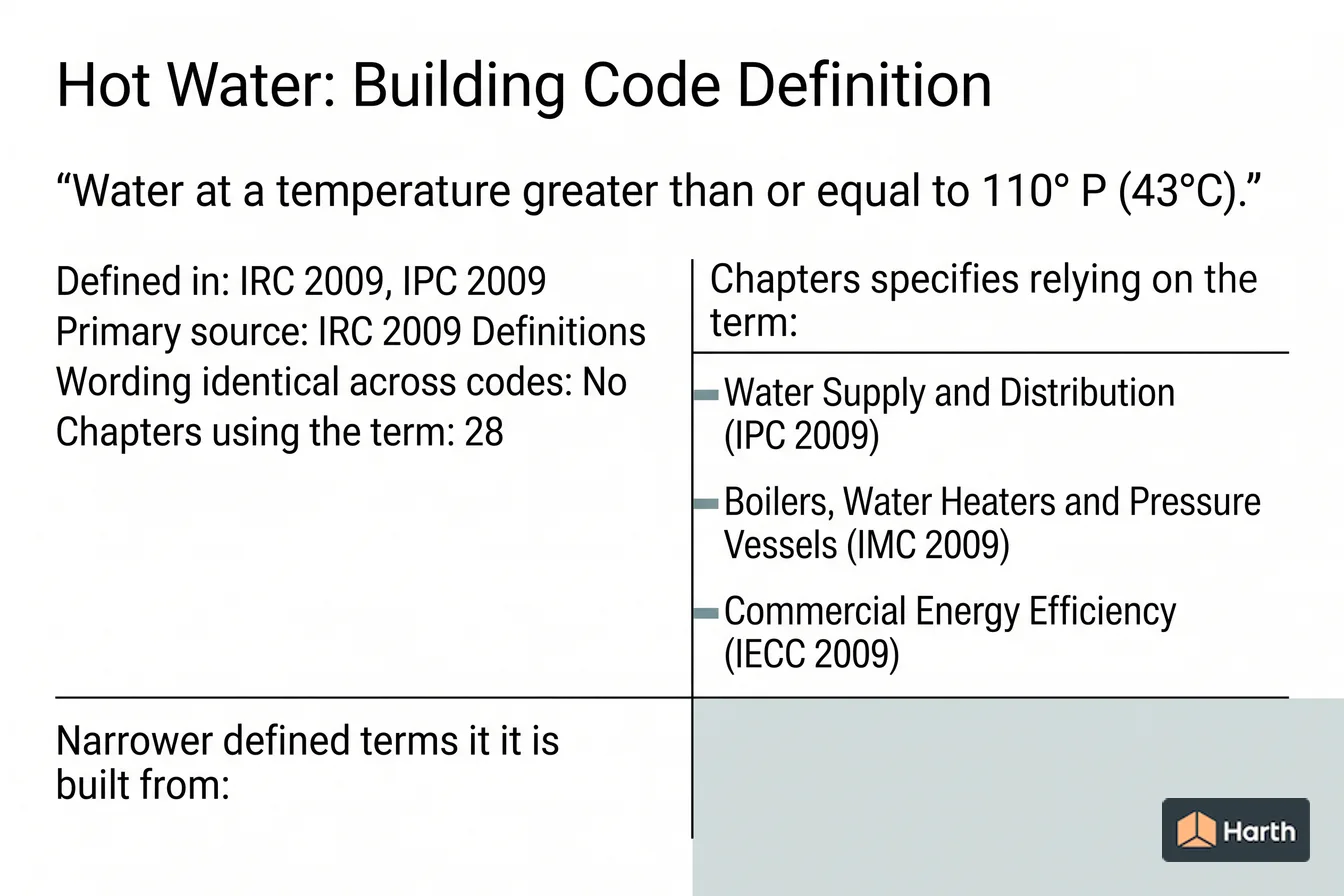
Hot water is a defined term in the International Residential Code (IRC) 2009, in Definitions. The code's own words are: “Water at a temperature greater than or equal to 110° P (43°C).” The IPC 2009 defines the same term with different wording, so the controlling text depends on which code governs the question in front of you — the comparison below sets the versions side by side. The term is used in 28 chapters of this corpus, most often in Water Supply and Distribution (IPC 2009), Boilers, Water Heaters and Pressure Vessels (IMC 2009), Commercial Energy Efficiency (IECC 2009). These pages transcribe the 2009 model text; verify the definition against the edition and amendments your authority having jurisdiction has adopted.
Content and cited inputs reviewed by Harth team · Published 2026-09-07 · Updated 2026-09-07.
What does this term mean?
Hot Water — IRC 2009, Definitions:
Water at a temperature greater than or equal to 110° P (43°C).
What must be verified before using this guidance?
Two of the I-Codes in this corpus define Hot Water, and the wording is not identical — read the version that governs your question.
| Code | Where it is defined | Definition |
|---|---|---|
| IRC 2009 | Definitions | Water at a temperature greater than or equal to 110° P (43°C). |
| IPC 2009 | Definitions | Water at a temperature greater than or equal to 110°F (43°C). |
Where hot water is used in the code
The term appears in 28 chapters of the 2009 I-Codes hosted here. The chapters that lean on it hardest are the ones to read next.
| Chapter | Code | Mentions |
|---|---|---|
| Water Supply and Distribution | IPC 2009 | 37 |
| Boilers, Water Heaters and Pressure Vessels | IMC 2009 | 18 |
| Commercial Energy Efficiency | IECC 2009 | 14 |
| Fuel Gas | IRC 2009 | 14 |
| Water Heaters | IPC 2009 | 13 |
| Boilers and Water Heaters | IRC 2009 | 11 |
| Water Heaters | IRC 2009 | 10 |
| Flammable and Combustible Liquids | IFC 2009 | 5 |
| Hydronic Piping | IMC 2009 | 5 |
| Solar Systems | IMC 2009 | 4 |
| Energy Efficiency | IRC 2009 | 4 |
| Plumbing Administration | IRC 2009 | 4 |
16 further chapters mention the term.
The term in use
How the code actually writes about hot water, quoted from the 2009 text hosted here:
Hot water and cold water manifolds installed with gridded or parallel connected individual distribution lines to each fixture or fixture fitting shall be designed in accordance with Sections 604.10.1 through 604.10.3.
Potable water heaters and hot water storage tanks shall be listed and labeled and installed in accordance with the manufacturer's installation instructions, the International Plumbing Code and this code.
Hydronic systems that use a common return system for both hot water and chilled water are prohibited.
Hot Water: what to open, and in what order
Every row is a document this term depends on. The ICC code library and the ICC adoption maps cover the middle rows.
| Check | Where | Confirmed |
|---|---|---|
| Read the definition in the adopted IRC | Definitions | |
| Read the definition in the adopted IPC | Definitions | |
| Re-check the requirement that uses it | Water Supply and Distribution (IPC 2009) | |
| Re-check the requirement that uses it | Boilers, Water Heaters and Pressure Vessels (IMC 2009) | |
| Re-check the requirement that uses it | Commercial Energy Efficiency (IECC 2009) | |
| Re-check the requirement that uses it | Fuel Gas (IRC 2009) | |
| Local amendment to any of the above | Jurisdiction's amendment list |
A research aid, not a code determination. The authority having jurisdiction decides which edition and which amendments apply.
Where can you explore related guidance?
- Explore all glossary guidance
- Building: Building Code Definition
- Construction Documents: Building Code Definition
- Registered Design Professional: Building Code Definition
- Dwelling Unit: Building Code Definition
Sources and method
Definitions quoted from the 2009 International Codes as transcribed in this site's building-codes collection, with the source chapter linked for each quotation. Usage counts are computed over the chapters hosted here, one copy per code. The ICC code library publishes the current model text and the ICC adoption maps show which edition a jurisdiction has adopted; those sources control.
Source links
Frequently asked questions
What is the code definition of hot water?
The International Residential Code (IRC) 2009 defines it in Definitions as: “Water at a temperature greater than or equal to 110° P (43°C).” The 2009 model text is reproduced here; the definition that binds your project is the one in the edition your jurisdiction has adopted, as amended locally.
Which parts of the code depend on hot water?
In this corpus the term is used across 28 chapters, led by Water Supply and Distribution in the IPC 2009. Those are the sections whose scope moves if the definition is amended locally, so read them together with Chapter 2 rather than on their own.
What is the code for hot water temperature?
In the 2009 I-Codes hosted here it is a defined term rather than a description. The IRC 2009 states, in Definitions: “Water at a temperature greater than or equal to 110° P (43°C).” It is defined in IRC 2009, IPC 2009. Because it is a defined term, whatever the adopted edition says it means is what every section using it means — so check Chapter 2 of that edition and any local amendment before relying on this wording.
Related pages
- Height, Building: Building Code Definition
Height, Building — IBC 2009 definition: The vertical distance from grade plane to the average height of the highest roof surface.
- Highly Toxic: Building Code Definition
Highly Toxic — IBC 2009 definition: A material which produces a lethal dose or lethal concentration that falls within any of the …
- Hood: Building Code Definition
Hood — IFC 2009 definition: An air-intake device used to capture by entrapment, impingement, adhesion or similar means, grease and similar …
- Ignition Source: Building Code Definition
Ignition Source — IRC 2009 definition: A flame, spark or hot surface capable of igniting flammable vapors or fumes.
- Inert Gas: Building Code Definition
Inert Gas — IBC 2009 definition: A gas that is capable of reacting with other materials only under abnormal conditions such as …
- Interior Finish: Building Code Definition
Interior Finish — IBC 2009 definition: Interior finish includes interior wall and ceiling finish and interior floor finish.