Building Code Glossary
Hood: Building Code Definition
How the IFC 2009, IMC 2009 define hood, where the wording differs, and which chapters depend on the term.
On this page
Last updated September 7, 2026 · Definitions quoted from the 2009 International Codes as transcribed in this site's building-codes collection, with the source chapter linked for each quotation. Usage counts are computed over the chapters hosted here, one copy per code. The [ICC code library](https://codes.iccsafe.org/codes) publishes the current model text and the [ICC adoption maps](https://www.iccsafe.org/advocacy/code-adoption-maps/) show which edition a jurisdiction has adopted; those sources control.
Direct answer
Hood is a defined term in the International Fire Code (IFC) 2009, in Building Services and Systems. The code's own words are: “An air-intake device used to capture by entrapment, impingement, adhesion or similar means, grease and similar contaminants before they enter a duct system.” The IMC 2009 defines the same term with different wording, so the controlling text depends on which code governs the question in front of you — the comparison below sets the versions side by side. The term is used in 30 chapters of this corpus, most often in Exhaust Systems (IMC 2009), Fuel Gas (IRC 2009), Definitions (IMC 2009). These pages transcribe the 2009 model text; verify the definition against the edition and amendments your authority having jurisdiction has adopted.
Content and cited inputs reviewed by Scott Barrington, Harth founder and architectural technology specialist · Published 2026-09-07 · Updated 2026-09-07.
What does this term mean?
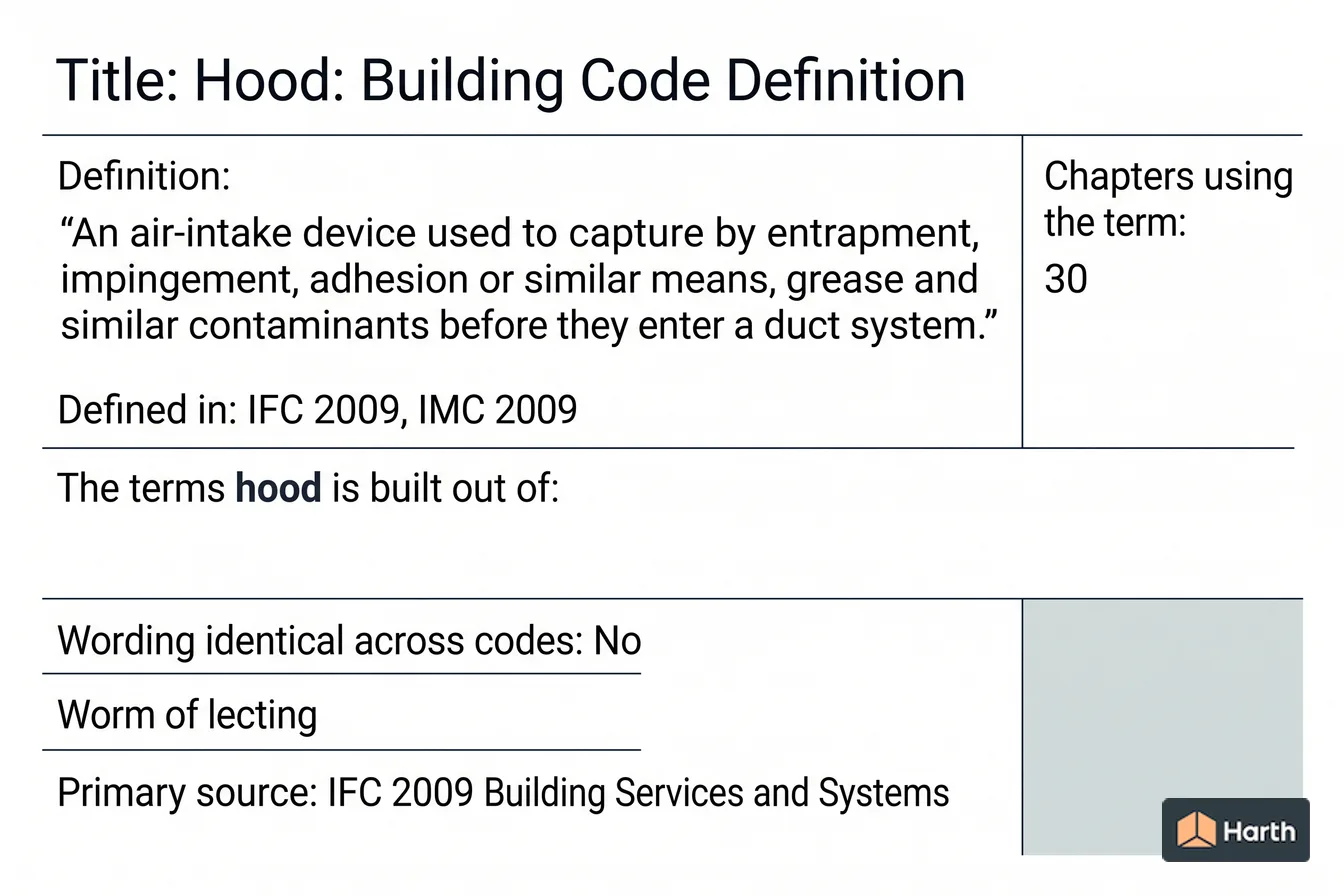
Hood — IFC 2009, Building Services and Systems:
An air-intake device used to capture by entrapment, impingement, adhesion or similar means, grease and similar contaminants before they enter a duct system.
What must be verified before using this guidance?
Two of the I-Codes in this corpus define Hood, and the wording is not identical — read the version that governs your question.
| Code | Where it is defined | Definition |
|---|---|---|
| IFC 2009 | Building Services and Systems | An air-intake device used to capture by entrapment, impingement, adhesion or similar means, grease and similar contaminants before they enter a duct system. |
| IMC 2009 | Definitions | An air intake device used to capture by entrapment, impingement, adhesion or similar means, grease, moisture, heat and similar contaminants before they enter a duct system. |
Where hood is used in the code
The term appears in 30 chapters of the 2009 I-Codes hosted here. The chapters that lean on it hardest are the ones to read next.
| Chapter | Code | Mentions |
|---|---|---|
| Exhaust Systems | IMC 2009 | 267 |
| Fuel Gas | IRC 2009 | 233 |
| Definitions | IMC 2009 | 56 |
| Exhaust Systems | IRC 2009 | 23 |
| Building Services and Systems | IFC 2009 | 22 |
| Fire Protection Systems | IFC 2009 | 18 |
| Fire Protection Systems | IBC 2009 | 14 |
| Commercial Energy Efficiency | IECC 2009 | 12 |
| Definitions | IRC 2009 | 9 |
| Highly Toxic and Toxic Materials | IFC 2009 | 8 |
| Chimneys and Vents | IRC 2009 | 6 |
| Flammable Finishes | IFC 2009 | 5 |
18 further chapters mention the term.
The term in use
How the code actually writes about hood, quoted from the 2009 text hosted here:
Exhaust hood systems capable of exhausting in excess of 400 cfm (0.19 m3/s) shall be provided with makeup air at a rate approximately equal to the exhaust air rate.
Where used, a drafthoodor a barometric draft regulator shall be installed in the same room or enclosure as the applianceserved so as to prevent any difference in pressure between the hood or regulator and the combustion air supply.
The duct serving the hood shall have a smooth interior surface, shall be air tight and shall be equipped with a backdraft damper.
The terms hood is built out of
The definition above leans on 3 other defined terms. Each carries its own code definition, and a local amendment to any of them changes what hood covers:
- Duct System — IRC 2009: A continuous passageway for the transmission of air which, in addition to ducts, includes duct fittings, dampers, plenums, fans and accessory air-handling equipment and appliances.
- System — IFC 2009: An assembly of equipment consisting of a tank, container or containers, appurtenances, pumps, compressors and connecting piping.
- Device — IRC 2009: Aunit of an electrical system that carries or controls electrical energy as it principal function.
Hood: what to open, and in what order
Every row is a document this term depends on. The ICC code library and the ICC adoption maps cover the middle rows.
| Check | Where | Confirmed |
|---|---|---|
| Read the definition in the adopted IFC | Building Services and Systems | |
| Read the definition in the adopted IMC | Definitions | |
| Re-check the requirement that uses it | Exhaust Systems (IMC 2009) | |
| Re-check the requirement that uses it | Fuel Gas (IRC 2009) | |
| Re-check the requirement that uses it | Definitions (IMC 2009) | |
| Re-check the requirement that uses it | Exhaust Systems (IRC 2009) | |
| Confirm the dependent definition | Duct System | |
| Confirm the dependent definition | System | |
| Confirm the dependent definition | Device | |
| Local amendment to any of the above | Jurisdiction's amendment list |
A research aid, not a code determination. The authority having jurisdiction decides which edition and which amendments apply.
Where can you explore related guidance?
- Explore all glossary guidance
- Duct System: Building Code Definition
- System: Building Code Definition
- Device: Building Code Definition
Sources and method
Definitions quoted from the 2009 International Codes as transcribed in this site's building-codes collection, with the source chapter linked for each quotation. Usage counts are computed over the chapters hosted here, one copy per code. The ICC code library publishes the current model text and the ICC adoption maps show which edition a jurisdiction has adopted; those sources control.
Source links
Frequently asked questions
What is the code definition of hood?
The International Fire Code (IFC) 2009 defines it in Building Services and Systems as: “An air-intake device used to capture by entrapment, impingement, adhesion or similar means, grease and similar contaminants before they enter a duct system.” The 2009 model text is reproduced here; the definition that binds your project is the one in the edition your jurisdiction has adopted, as amended locally.
Do the I-Codes define hood the same way?
No. IFC 2009, IMC 2009 all define the term, but the wording is not identical, and a difference in wording can change which requirements are triggered. The comparison table above sets the versions side by side so you can read the one that governs your question.
Which parts of the code depend on hood?
In this corpus the term is used across 30 chapters, led by Exhaust Systems in the IMC 2009. Those are the sections whose scope moves if the definition is amended locally, so read them together with Chapter 2 rather than on their own.
What are the hood requirements for a commercial kitchen?
In the 2009 I-Codes hosted here it is a defined term rather than a description. The IFC 2009 states, in Building Services and Systems: “An air-intake device used to capture by entrapment, impingement, adhesion or similar means, grease and similar contaminants before they enter a duct system.” It is defined in IFC 2009, IMC 2009. It is not the same as Kitchen, which the IRC 2009 defines separately as “Kitchen shall mean an area used, or designated to be used, for the preparation of food.” Because it is a defined term, whatever the adopted edition says it means is what every section using it means — so check Chapter 2 of that edition and any local amendment before relying on this wording.
What does "hood" slang mean?
In the 2009 I-Codes hosted here it is a defined term rather than a description. The IFC 2009 states, in Building Services and Systems: “An air-intake device used to capture by entrapment, impingement, adhesion or similar means, grease and similar contaminants before they enter a duct system.” It is defined in IFC 2009, IMC 2009. Because it is a defined term, whatever the adopted edition says it means is what every section using it means — so check Chapter 2 of that edition and any local amendment before relying on this wording.
Related pages
- Highway: Building Code Definition
Highway — IFC 2009 definition: A public street, public alley or public road.
- Hill: Building Code Definition
Hill — IRC 2009 definition: With respect to topographic wind effects, a land surface characterized by strong relief in any horizontal …
- Historic Buildings: Building Code Definition
Historic Buildings — IBC 2009 definition: Buildings that are listed in or eligible for listing in the National Register of Historic Places …
- Horizontal Assembly: Building Code Definition
Horizontal Assembly — IBC 2009 definition: A fire-resistance-rated floor or roof assembly of materials designed to restrict the spread of fire in …
- Horizontal Branch Drain: Building Code Definition
Horizontal Branch Drain — IPC 2009 definition: A drainage branch pipe extending laterally from a soil or waste stack or bUilding drain, with …
- Horizontal Pipe: Building Code Definition
Horizontal Pipe — IRC 2009 definition: Any pipe or fitting that makes an angle of less than 45 degrees (0.79 rad) with …