Solar & Daylight Data
Sun Path: Darwin, Australia
Sunrise, sunset, day length and sun bearings for Darwin, Australia in local clock time, month by month.
On this page
Last updated September 25, 2026 · Location: GeoNames point -12.4611, 130.8418 ([GeoNames AU dump](https://download.geonames.org/export/dump/AU.zip), CC BY 4.0, ID 2073124); time zone Australia/Darwin from the same GeoNames record. Sun positions, sunrise and sunset calculated by Harth with [NOAA's solar calculator equations](https://gml.noaa.gov/grad/solcalc/calcdetails.html), including standard atmospheric refraction, for a sea-level horizon.
Direct answer
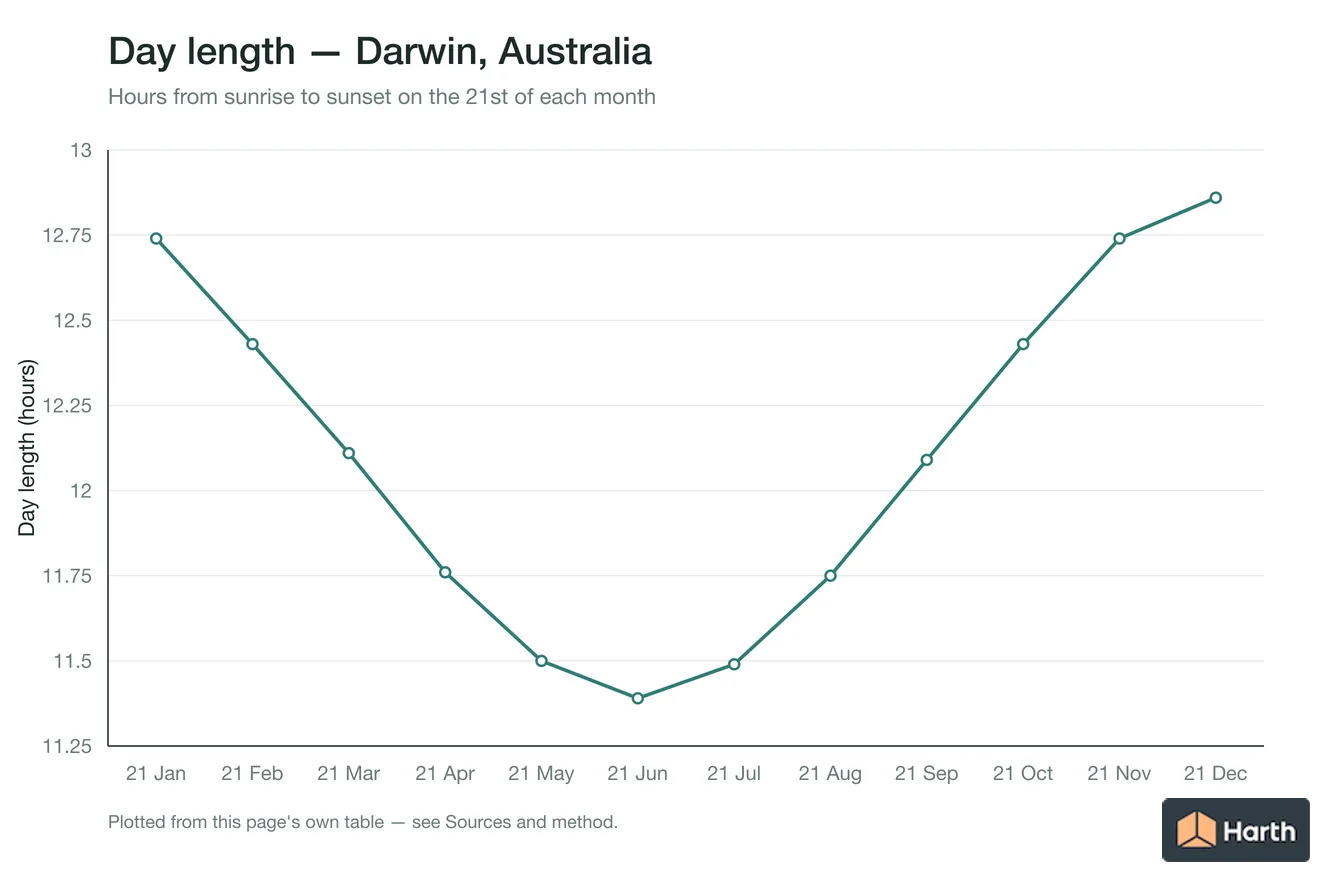
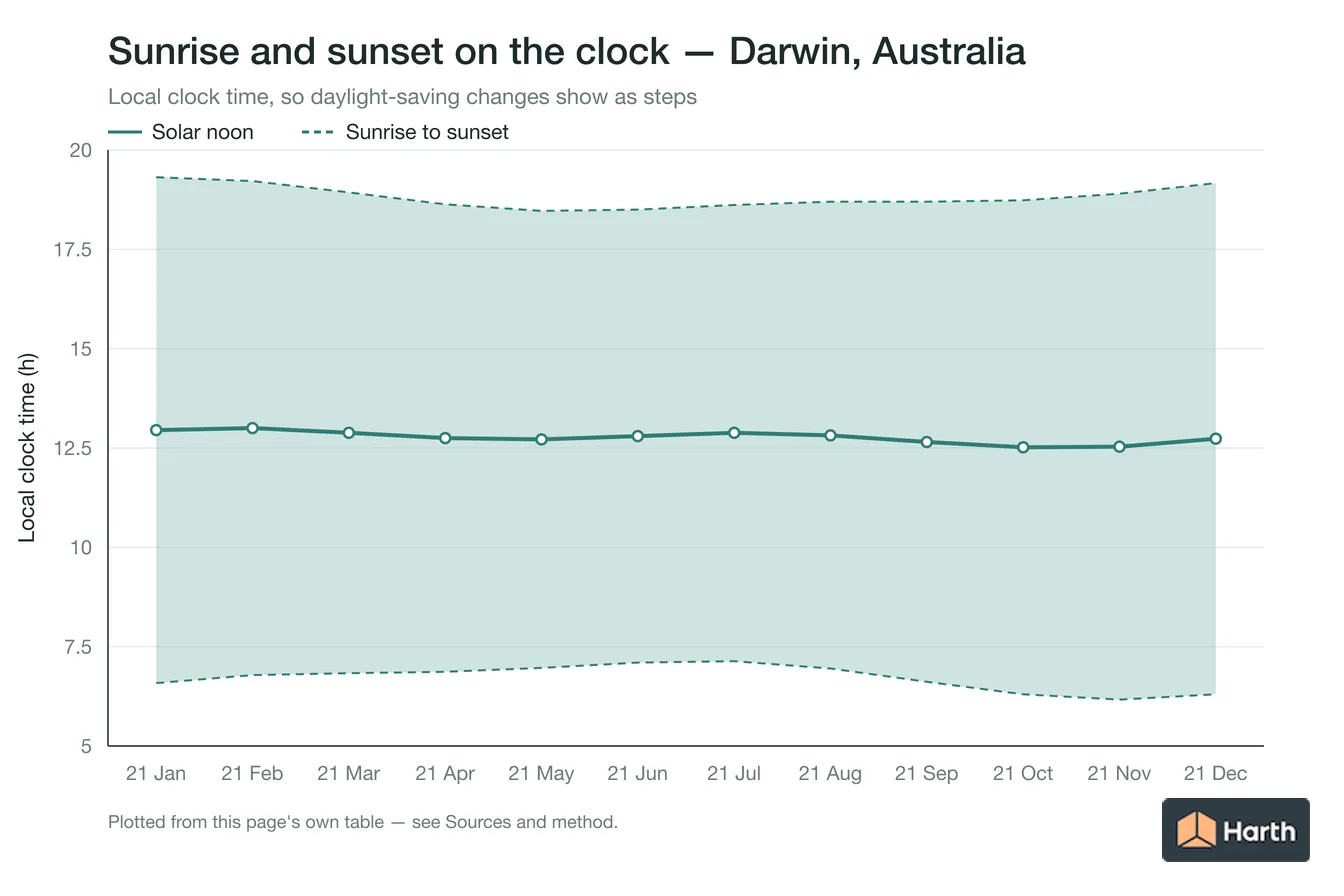
In Darwin, the shortest day (21 June) has 11 h 24 min of daylight, from sunrise at 07:06 to sunset at 18:30 ACST, and the longest (22 December) has 12 h 52 min, from 06:19 to 19:10 ACST. The noon sun climbs from 54.1° to 90.0° above the horizon over the year. Sunrise moves between 66° (ENE) and 114° (ESE) and sunset between 246° (WSW) and 294° (WNW). The earliest sunrise is 06:10 on 20 November and the latest sunset is 19:19 on 23 January, which are not the solstice dates. Darwin keeps ACST (UTC+9:30) all year, with no daylight saving. Times are local clock time from NOAA's solar equations for the city-centre GeoNames point at a sea-level horizon.
Content and cited inputs reviewed by Harth team · Published 2026-08-26 · Updated 2026-09-25.
When does the sun rise and set in Darwin each month?
Times are local clock time on the 21st of each month in 2026, including daylight saving where it applies. Bearings are clockwise from true north.
| Date | Sunrise | Solar noon | Sunset | Day length | Noon altitude | Sunrise bearing | Sunset bearing | Clock |
|---|---|---|---|---|---|---|---|---|
| 21 January | 06:35 | 12:57 | 19:19 | 12.74 h | 82.5° | 111° (ESE) | 249° (WSW) | ACST |
| 21 February | 06:47 | 13:00 | 19:13 | 12.43 h | 88.1° | 101° (E) | 259° (W) | ACST |
| 21 March | 06:50 | 12:53 | 18:56 | 12.11 h | 77.3° | 90° (E) | 270° (W) | ACST |
| 21 April | 06:52 | 12:45 | 18:38 | 11.76 h | 65.7° | 78° (ENE) | 282° (WNW) | ACST |
| 21 May | 06:58 | 12:43 | 18:28 | 11.50 h | 57.4° | 70° (ENE) | 291° (WNW) | ACST |
| 21 June | 07:06 | 12:48 | 18:30 | 11.39 h | 54.1° | 66° (ENE) | 294° (WNW) | ACST |
| 21 July | 07:08 | 12:53 | 18:37 | 11.49 h | 57.1° | 69° (ENE) | 291° (WNW) | ACST |
| 21 August | 06:57 | 12:49 | 18:42 | 11.75 h | 65.4° | 78° (ENE) | 282° (WNW) | ACST |
| 21 September | 06:37 | 12:39 | 18:42 | 12.09 h | 76.8° | 89° (E) | 270° (W) | ACST |
| 21 October | 06:18 | 12:31 | 18:44 | 12.43 h | 88.2° | 101° (E) | 259° (W) | ACST |
| 21 November | 06:10 | 12:32 | 18:54 | 12.74 h | 82.6° | 111° (ESE) | 249° (WSW) | ACST |
| 21 December | 06:18 | 12:44 | 19:10 | 12.86 h | 79.0° | 114° (ESE) | 246° (WSW) | ACST |
How the sun moves over Darwin through the year
At -12.46° latitude the sunrise point swings 48° along the horizon over the year, from 66° (ENE) to 114° (ESE), and sunset moves between 246° (WSW) and 294° (WNW). On the shortest day the noon sun is 54.1° above the northern horizon; on 26 October it reaches 90.0°.
Solar noon falls at 12:31–13:00 on the clock through the year, because Darwin sits 11.7° of longitude from its time zone's reference meridian and the equation of time shifts noon by up to 16 minutes. Use the clock times in the table, not 12:00, when you set up a sun study.
Key sun dates for Darwin in 2026
- Shortest day: 21 June, 11 h 24 min (sunrise 07:06, sunset 18:30 ACST).
- Longest day: 22 December, 12 h 52 min (sunrise 06:19, sunset 19:10 ACST).
- Earliest sunrise: 06:10 ACST on 20 November. Latest sunset: 19:19 ACST on 23 January.
- Highest noon sun: 90.0° on 26 October; lowest: 54.1° on 21 June.
- Clocks: Darwin keeps ACST (UTC+9:30) all year, with no daylight saving.
- Sun overhead: the noon sun passes directly overhead on about 16 February and 26 October; between those dates it is on the southern side of the sky at noon.
How these times were calculated
Harth computed each value with NOAA's solar-position equations for the GeoNames point -12.4611, 130.8418, using the standard 90.833° zenith for sunrise and sunset (refraction plus the sun's radius) and the Australia/Darwin time zone. Hills, buildings and elevation move the sunrise and sunset you actually see by a few minutes; use surveyed site coordinates and a horizon survey for a specific building.
Where can you explore related guidance?
- Explore all solar data guidance
- Sun Path: Cairns, Australia
- Sun Path: Townsville, Australia
- Sun Path: Mackay, Australia
- Sun Path: Rockhampton, Australia
- All solar & daylight data guidance for Australia
- Climate Design Data: Darwin, Australia
- House Construction Cost Planning: Darwin, Australia
- Office Construction Cost Planning: Darwin, Australia
- Retail Construction Cost Planning: Darwin, Australia
Sources and method
Location: GeoNames point -12.4611, 130.8418 (GeoNames AU dump, CC BY 4.0, ID 2073124); time zone Australia/Darwin from the same GeoNames record. Sun positions, sunrise and sunset calculated by Harth with NOAA's solar calculator equations, including standard atmospheric refraction, for a sea-level horizon.
Source links
Frequently asked questions
What time is sunrise and sunset in Darwin on the longest day?
On 22 December 2026 the sun rises in Darwin at 06:19 and sets at 19:10 ACST, giving 12 h 52 min of daylight.
Which direction does the sun rise and set in Darwin?
Sunrise in Darwin moves between 66° (ENE) and 114° (ESE) over the year, and sunset between 246° (WSW) and 294° (WNW). Only near the equinoxes does the sun rise due east and set due west.
Does Darwin use daylight saving time?
Darwin keeps ACST (UTC+9:30) all year, with no daylight saving.
When is the sun directly overhead in Darwin?
The noon sun is directly overhead in Darwin on about 16 February and 26 October 2026. Between those dates it is south of overhead at noon, so the south-facing facade gets direct midday sun.
Related pages
- Sun Path: Cork, Ireland
Sun path for Cork, Ireland: solar-noon altitude 61.5° June, 38.1° equinox, 14.7° December; 7.5–16.5 h daylight; 12-month geometry table.
- Sun Path: Cotabato, Philippines
Sun path for Cotabato, Philippines: solar-noon altitude 73.8° June, 82.8° equinox, 59.3° December; 11.6–12.4 h daylight; 12-month geometry table.
- Sun Path: Coventry, UK
Sun path for Coventry, UK: solar-noon altitude 61.0° June, 37.6° equinox, 14.2° December; 7.4–16.6 h daylight; 12-month geometry table.
- Sun Path: Davao, Philippines
Sun path for Davao, Philippines: solar-noon altitude 73.6° June, 82.9° equinox, 59.5° December; 11.6–12.4 h daylight; 12-month geometry table.
- Sun Path: Delhi, India
Sun path for Delhi, India: solar-noon altitude 84.8° June, 61.3° equinox, 37.9° December; 10.2–13.8 h daylight; 12-month geometry table.
- Sun Path: Derby, UK
Sun path for Derby, UK: solar-noon altitude 60.5° June, 37.1° equinox, 13.6° December; 7.3–16.7 h daylight; 12-month geometry table.