Solar & Daylight Data
Sun Path: Pune, India
How to research sun path for a specific site in Pune — the controlling authority, source documents, and checks to run before you rely on a number.
On this page
Last updated August 31, 2026 · Location data from the [GeoNames IN dump](https://download.geonames.org/export/dump/IN.zip) (CC BY 4.0, snapshot 2026-08-31, GeoNames ID 1259229). Regulatory starting point: [Bureau of Indian Standards and the applicable state or urban local body](https://www.services.bis.gov.in/php/BIS_2.0/bisconnect/knowyourstandards/Indian_standards/isdetails/). Figures are illustrative — verify against the current locally adopted edition for the site. Solar-method context: [NOAA Solar Calculation Details](https://gml.noaa.gov/grad/solcalc/calcdetails.html); the Harth monthly table uses a simpler declination and geometric-daylight approximation whose stated limitations must be retained.
Direct answer
For Pune at 18.5196, 73.8554, the declination-only solar-noon altitude is approximately 85.1° at the June solstice, 71.5° at an equinox and 48.0° at the December solstice. Refine these geometry checks with the project date, civil time, facade azimuth, terrain and local horizon. The reproducible location record is GeoNames ID 1259229 in administrative area 16, at 18.5196, 73.8554; replace it with the surveyed parcel point before relying on the result. As a transparent geometry check, declination-only solar-noon altitude is about 85.1° at the June solstice, 71.5° at an equinox and 48.0° at the December solstice. Representative 21st-day geometry ranges from about 10.9 hours in December to 13.1 hours in June; this excludes atmospheric refraction, terrain and obstruction effects. The cited national authority is a discovery starting point; current local documents and a named qualified reviewer control project use of this sun path record.
Content and cited inputs reviewed by Harth team · Published 2026-08-26 · Updated 2026-08-31.
What must be verified for Pune?
Pune is represented here at approximately 18.5196, 73.8554 for discovery and workflow planning. A project address, parcel, elevation, exposure, authority, and submission date must replace that city-centre reference before design use.
How should sun path be established?
- Fix the surveyed site and local time basis.
- Select an authoritative weather source or a named solar-position algorithm.
- Record period, percentile or scenario and units.
- Test sensitivity to elevation, exposure, urban form and horizon.
- Save the source file, retrieval date and checker in the model record.
| Input | Project-specific evidence | QA question |
|---|---|---|
| Site | surveyed coordinates, elevation and horizon | Does the point represent the building? |
| Weather/solar method | named dataset, algorithm, period and time basis | Are station, time zone and units explicit? |
| Design scenario | current and future scenario agreed by the team | Is an average being mistaken for an extreme? |
| Compliance | adopted local document and edition | Was applicability confirmed with the authority? |
What are the limits of this worksheet?
This sun-path-workflow page is a project-starting worksheet, not a design value or approval. The controlling authority and qualified professionals for the Pune site remain authoritative.
Pune monthly solar geometry check for sun path
| Representative date | Declination | Solar-noon altitude | Geometric daylight |
|---|---|---|---|
| 21 January | -20.14° | 51.3° | 11.1 h |
| 21 February | -11.23° | 60.3° | 11.5 h |
| 21 March | -0.40° | 71.1° | 12.0 h |
| 21 April | +11.58° | 83.1° | 12.5 h |
| 21 May | +20.14° | 88.4° | 12.9 h |
| 21 June | +23.45° | 85.1° | 13.1 h |
| 21 July | +20.44° | 88.1° | 13.0 h |
| 21 August | +11.75° | 83.2° | 12.5 h |
| 21 September | -0.20° | 71.3° | 12.0 h |
| 21 October | -11.75° | 59.7° | 11.5 h |
| 21 November | -20.44° | 51.0° | 11.0 h |
| 21 December | -23.45° | 48.0° | 10.9 h |
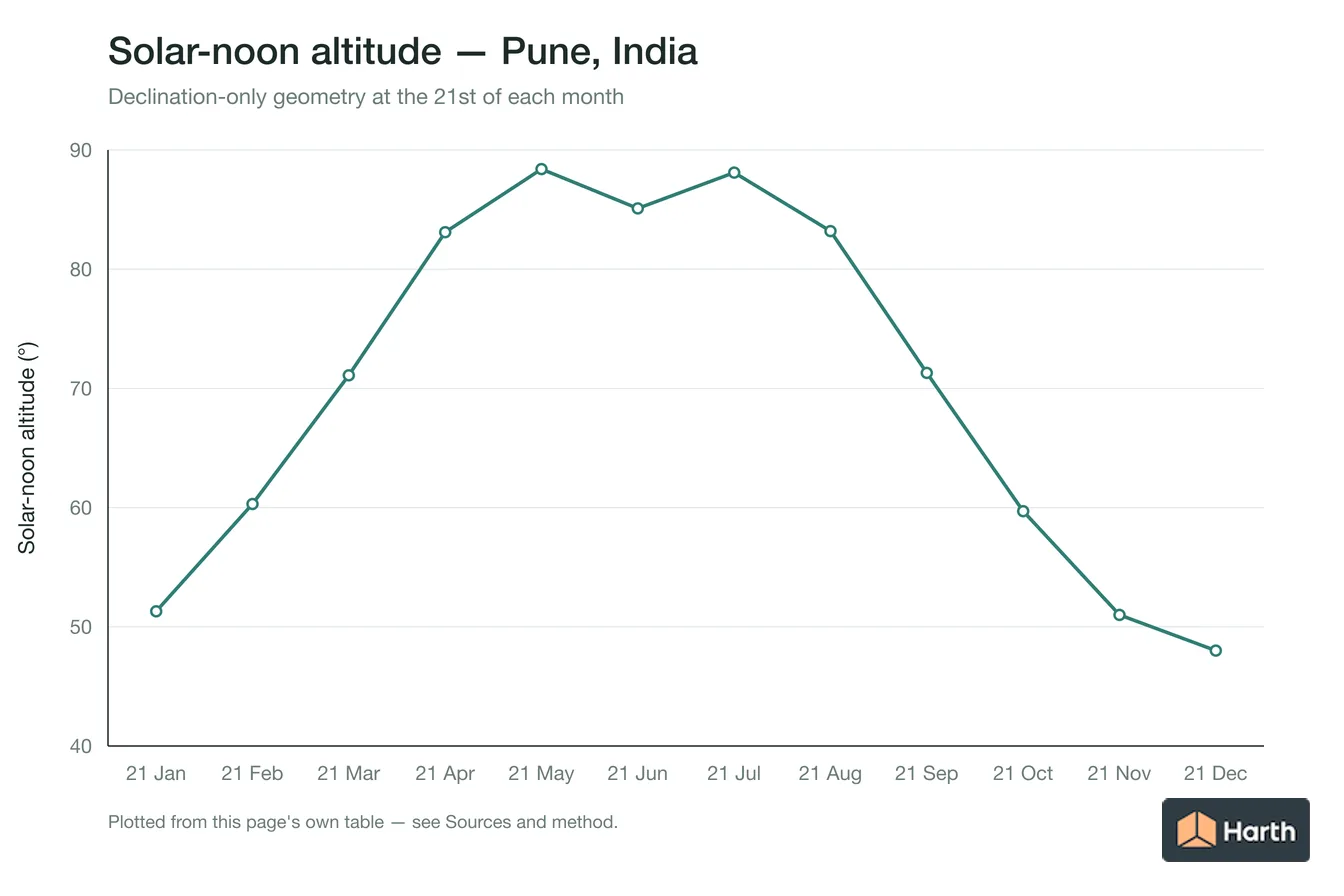
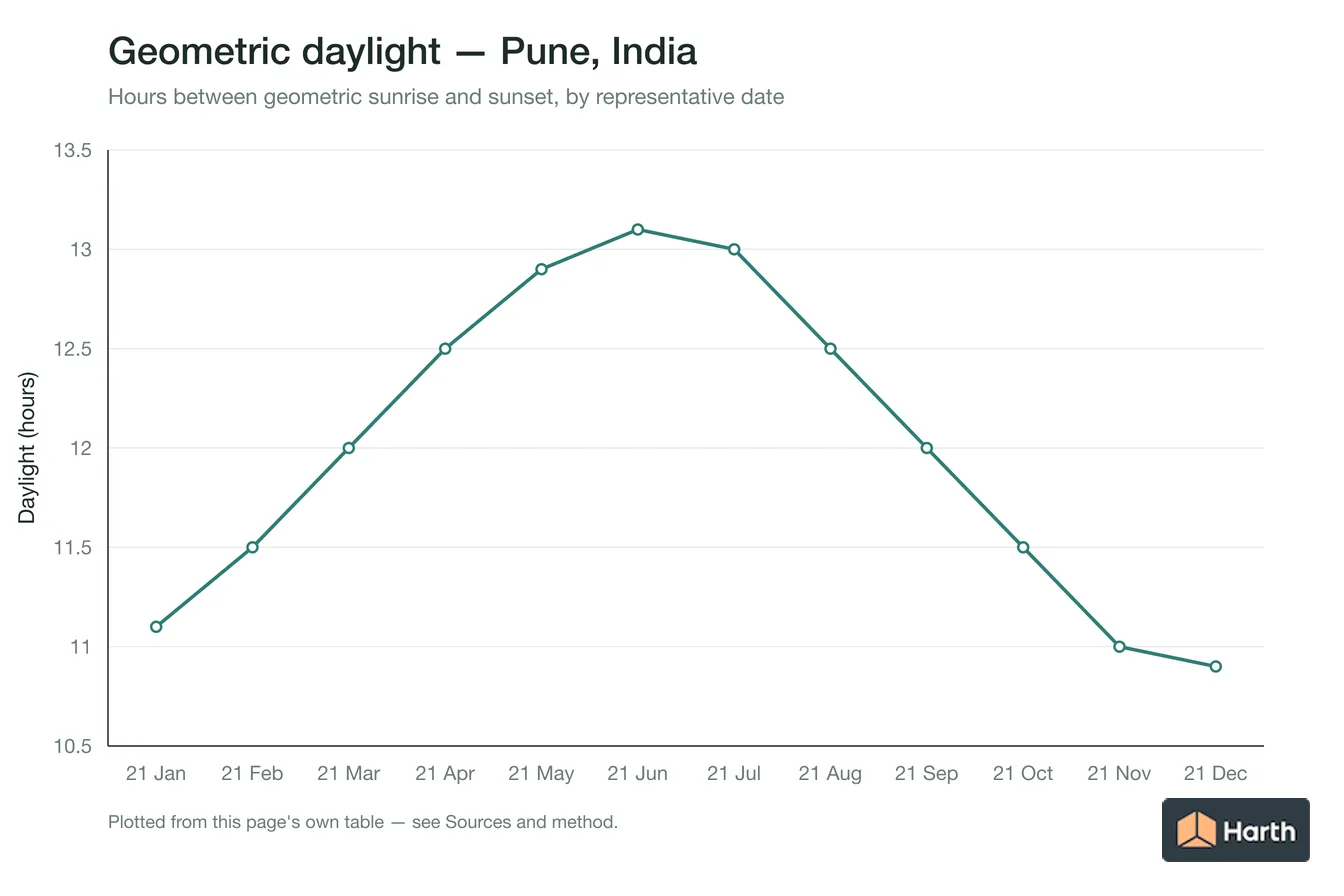
Month-by-month geometry interpretation
- 21 January: approximate solar-noon altitude 51.3° (zenith angle 38.7°) and 11.1 hours of geometric daylight. That is 0.2 hours longer than the preceding representative date in this annual sequence.
- 21 February: approximate solar-noon altitude 60.3° (zenith angle 29.7°) and 11.5 hours of geometric daylight. That is 0.4 hours longer than the preceding representative date in this annual sequence.
- 21 March: approximate solar-noon altitude 71.1° (zenith angle 18.9°) and 12.0 hours of geometric daylight. That is 0.5 hours longer than the preceding representative date in this annual sequence.
- 21 April: approximate solar-noon altitude 83.1° (zenith angle 6.9°) and 12.5 hours of geometric daylight. That is 0.5 hours longer than the preceding representative date in this annual sequence.
- 21 May: approximate solar-noon altitude 88.4° (zenith angle 1.6°) and 12.9 hours of geometric daylight. That is 0.4 hours longer than the preceding representative date in this annual sequence.
- 21 June: approximate solar-noon altitude 85.1° (zenith angle 4.9°) and 13.1 hours of geometric daylight. That is 0.2 hours longer than the preceding representative date in this annual sequence.
- 21 July: approximate solar-noon altitude 88.1° (zenith angle 1.9°) and 13.0 hours of geometric daylight. That is 0.2 hours shorter than the preceding representative date in this annual sequence.
- 21 August: approximate solar-noon altitude 83.2° (zenith angle 6.8°) and 12.5 hours of geometric daylight. That is 0.4 hours shorter than the preceding representative date in this annual sequence.
- 21 September: approximate solar-noon altitude 71.3° (zenith angle 18.7°) and 12.0 hours of geometric daylight. That is 0.5 hours shorter than the preceding representative date in this annual sequence.
- 21 October: approximate solar-noon altitude 59.7° (zenith angle 30.3°) and 11.5 hours of geometric daylight. That is 0.5 hours shorter than the preceding representative date in this annual sequence.
- 21 November: approximate solar-noon altitude 51.0° (zenith angle 39.0°) and 11.0 hours of geometric daylight. That is 0.4 hours shorter than the preceding representative date in this annual sequence.
- 21 December: approximate solar-noon altitude 48.0° (zenith angle 42.0°) and 10.9 hours of geometric daylight. That is 0.2 hours shorter than the preceding representative date in this annual sequence.
Harth calculation for latitude 18.5196°: Cooper declination approximation, 90° - |latitude - declination| at solar noon, and centre-to-centre sunrise hour angle. See NOAA's solar calculation details for fuller method context. This screening table excludes equation-of-time/civil-time conversion, atmospheric refraction, terrain, facade azimuth and obstructions; it is not an hourly shading result.
Where can you explore related guidance?
- Explore all solar data guidance
- Sun Path: Kalyān, India
- Sun Path: Mumbai, India
- Sun Path: Virār, India
- All solar & daylight data guidance for India
- Climate Design Data: Pune, India
- House Construction Cost Planning: Pune, India
- Office Construction Cost Planning: Pune, India
- Retail Construction Cost Planning: Pune, India
Sources and method
Location data from the GeoNames IN dump (CC BY 4.0, snapshot 2026-08-31, GeoNames ID 1259229). Regulatory starting point: Bureau of Indian Standards and the applicable state or urban local body. Figures are illustrative — verify against the current locally adopted edition for the site. Solar-method context: NOAA Solar Calculation Details; the Harth monthly table uses a simpler declination and geometric-daylight approximation whose stated limitations must be retained.
Source links
Frequently asked questions
What does the sun path record for Pune establish?
The sun path record for Pune establishes a reproducible discovery point at 18.5196, 73.8554 (GeoNames ID 1259229, administrative area 16) and a India source path. It does not establish a final project value, approval or parcel decision.
What must be replaced before using this sun path workflow for a project in Pune?
For the sun path record in Pune, replace the 18.5196, 73.8554 city reference with the surveyed site or parcel, identify the competent local authority, and verify the current documents under National Building Code of India plus state and urban-local-body rules. Record the edition, retrieval date, units, assumptions and named checker before relying on the result.
Related pages
- Sun Path: Preston, UK
Sun path for Preston, UK: solar-noon altitude 59.7° June, 36.2° equinox, 12.8° December; 7.2–16.8 h daylight; 12-month geometry table.
- Sun Path: Pretoria, South Africa
Sun path for Pretoria, South Africa: solar-noon altitude 40.8° June, 64.3° equinox, 87.7° December; 10.4–13.6 h daylight; 12-month geometry table.
- Sun Path: Pukekohe East, New Zealand
Sun path for Pukekohe East, New Zealand: solar-noon altitude 29.4° June, 52.8° equinox, 76.2° December; 9.4–14.6 h daylight; 12-month geometry table.
- Sun Path: Québec, Canada
Sun path for Québec, Canada: solar-noon altitude 66.6° June, 43.2° equinox, 19.8° December; 8.3–15.7 h daylight; 12-month geometry table.
- Sun Path: Quezon City, Philippines
Sun path for Quezon City, Philippines: solar-noon altitude 81.2° June, 75.4° equinox, 51.9° December; 11.1–12.9 h daylight; 12-month geometry table.
- Sun Path: Rājkot, India
Sun path for Rājkot, India: solar-noon altitude 88.9° June, 67.7° equinox, 44.3° December; 10.6–13.4 h daylight; 12-month geometry table.