US Building Code Adoption by State
Alabama Building Code: Which Editions Are Adopted
Which I-Code editions Alabama is recorded as adopting, what the record does not cover, and how to confirm the edition governing a project.
On this page
Last updated September 7, 2026 · Adopted editions transcribed from the [ICC Master I-Code Adoption Chart (January 2024)](https://www.iccsafe.org/wp-content/uploads/Master-I-Code-Adoption-Chart-1.pdf), reproduced with the chart's own legend so an “X” is not mistaken for a statewide adoption. ICC notes that not all jurisdictions report their adoptions and publishes updates at [iccsafe.org/adoptions](https://www.iccsafe.org/adoptions). The current edition, its effective date and the state amendments are published by [Alabama Division of Construction Management](https://dcm.alabama.gov/bldg_code.aspx), which controls.
Direct answer
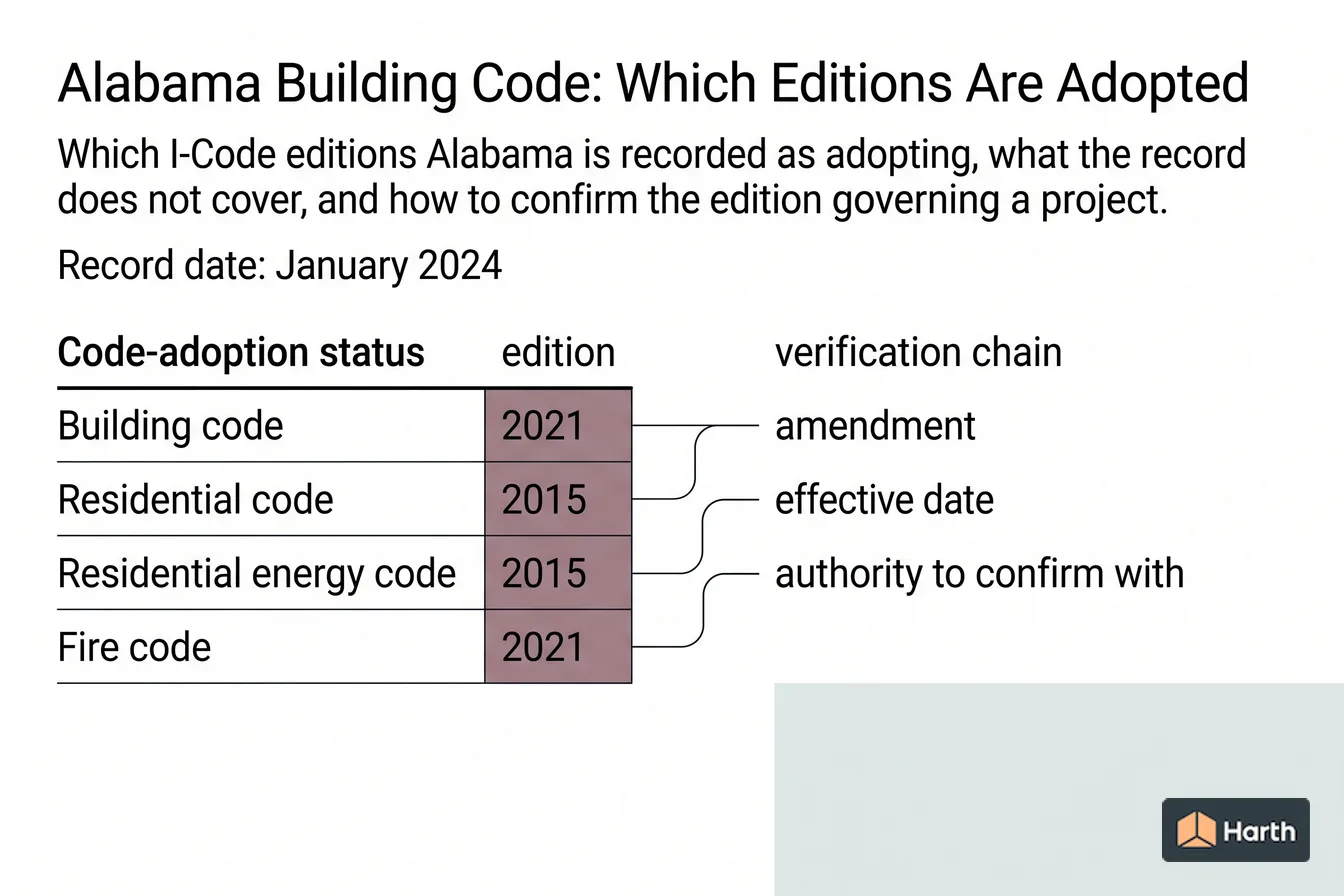
Alabama's adopted code editions, as recorded in the ICC Master I-Code Adoption Chart (January 2024): 2021 IBC, 2015 IRC, 2015 IECC and 2021 IFC. The chart gives an edition year for 9 of the 17 I-Codes it tracks in Alabama; the remainder are either adopted only by individual agencies, replaced by a state-written code, or not adopted at all. A chart entry is not an effective date and it is not the amended text. ICC records adoptions as jurisdictions report them, so a state that moved edition after January 2024 will still show the older year here. Confirm both the edition and its effective date at Alabama Division of Construction Management, then read the state amendments, because an amended definition or table changes the requirement even when the edition matches.
Content and cited inputs reviewed by Scott Barrington, Harth founder and architectural technology specialist · Published 2026-09-07 · Updated 2026-09-07.
What must be verified before using this guidance?
Every I-Code the ICC Master I-Code Adoption Chart (January 2024) tracks, as it records Alabama:
| Code | Recorded adoption |
|---|---|
| International Building Code (IBC) | 2021 |
| International Residential Code (IRC) | 2015 |
| International Fire Code (IFC) | 2021 |
| International Mechanical Code (IMC) | 2021 |
| International Plumbing Code (IPC) | 2021 |
| International Private Sewage Disposal Code (IPSDC) | Some jurisdictions only |
| International Fuel Gas Code (IFGC) | 2021 |
| International Green Construction Code (IgCC) | Not adopted |
| International Energy Conservation Code — Residential (IECC-R) | 2015 |
| International Energy Conservation Code — Commercial (IECC-C) | 2015 |
| International Property Maintenance Code (IPMC) | Some jurisdictions only |
| International Existing Building Code (IEBC) | 2021 |
| International Swimming Pool and Spa Code (ISPSC) | Some jurisdictions only |
| ICC Performance Code (ICCPC) | Some jurisdictions only |
| International Wildland-Urban Interface Code (IWUIC) | Some jurisdictions only |
| International Zoning Code (IZC) | Some jurisdictions only |
| ICC 700 National Green Building Standard (ICC 700) | Not adopted |
Alabama has a recorded edition year for 9 of the 17 codes: 2021 for the building, fire, mechanical, plumbing, fuel gas and existing buildings codes; 2015 for the residential, residential energy and commercial energy codes. The private sewage, property maintenance, swimming pool and spa, performance, wildland-urban interface and zoning codes appear as adopted by individual state or local agencies rather than as a statewide standard, so whether they apply depends on the permit jurisdiction for the project address. No adoption at all is recorded for the green construction and green building standard codes.
Source: ICC Master I-Code Adoption Chart (January 2024).
How Alabama compares with its neighbours
| State | Building (IBC) | Residential (IRC) | Residential energy (IECC-R) |
|---|---|---|---|
| Alabama | 2021 | 2015 | 2015 |
| Georgia | 2018 | 2018 | 2015 |
| Mississippi | 2018 | 2018 | 2018 |
| Tennessee | 2012 | 2018 | 2009 |
| Florida | 2021 | 2021 | 2021 |
Georgia, Mississippi and Tennessee differ from Alabama on the building code alone. A practice working across that border is working to two editions, whatever the office standard says.
Where Alabama sits in the national record
Of the 50 states and the District of Columbia, 18 are recorded on the 2021 IBC, 0 on a later edition, 26 on an earlier one, and 7 with no statewide IBC edition at all. Alabama is at or ahead of the national middle on the building code, so the risk runs the other way: work arriving from a slower-moving state may be drawn to an older edition.
The building code and the residential energy code are on different editions here — 2021 against 2015. 18 states show the same split, which is why the energy code is worth confirming as a separate question rather than assuming it moved with the building code.
Across all 17 codes the chart tracks, Alabama has a recorded edition for 9, which ranks it 12th of 51. A low count is not a gap in regulation — it usually means the state legislates through its own documents, or leaves the discipline to local adoption.
What the chart does and does not tell you
The chart's own legend matters more than the numbers:
- An edition year means one or more state or local agencies adopted that edition. It does not mean every building in the state is designed to it.
- “Some jurisdictions only” is the chart's
X: the code is in use somewhere in the state but is not the standard for all buildings. - “Not adopted” is a blank cell — no state or local jurisdiction reported adopting that code.
- “State-written code” means the state publishes its own document in place of the model edition, so the model text is a reference, not the law.
ICC states plainly that not every jurisdiction notifies it of an adoption, and this chart is dated January 2024. Treat it as the starting point for a search, never as the answer.
How to confirm the edition that governs a Alabama project
- Open Alabama Division of Construction Management and find the currently adopted code list with its effective date.
- Check whether the permit authority for the project address is the state or a local programme with its own adoption.
- Read the state amendments alongside the model edition — an amended table or definition changes the requirement even when the edition matches.
- Record the permit application date. A code change usually applies from an effective date, and applications filed before it are normally reviewed under the previous edition.
- Get the answer in writing from the authority having jurisdiction before it drives a design decision.
This site also hosts a transcription of the 2009 model code chapters as adopted in Alabama at /building-codes/us-states/alabama. That is a historical reference for the 2009 editions and is not Alabama's current code basis.
Alabama code-basis worksheet
Fill this in once per project and keep it with the drawing set. Every row is a question a plan reviewer can ask, and the answer changes with the address and the application date, not with the state.
| Item | Project entry |
|---|---|
| Project address and permit jurisdiction | |
| State programme or local programme as AHJ | |
| Building / residential edition and effective date | |
| Energy code edition (or state-written code) | |
| Fire, mechanical, plumbing and fuel-gas editions | |
| Accessibility standard and edition | |
| State amendments consulted (citation) | |
| Local amendments consulted (citation) | |
| Permit application date and vesting rule | |
| Written AHJ confirmation (date, name) |
This worksheet records a determination; it does not make one. The authority having jurisdiction decides which edition and which amendments apply.
Where can you explore related guidance?
- Explore all code adoption guidance
- Georgia Building Code: Which Editions Are Adopted
- Mississippi Building Code: Which Editions Are Adopted
- Tennessee Building Code: Which Editions Are Adopted
- Florida Building Code: Which Editions Are Adopted
Sources and method
Adopted editions transcribed from the ICC Master I-Code Adoption Chart (January 2024), reproduced with the chart's own legend so an “X” is not mistaken for a statewide adoption. ICC notes that not all jurisdictions report their adoptions and publishes updates at iccsafe.org/adoptions. The current edition, its effective date and the state amendments are published by Alabama Division of Construction Management, which controls.
Source links
Frequently asked questions
Which building code edition does Alabama use?
The ICC Master I-Code Adoption Chart (January 2024) records Alabama on the 2021 International Building Code. That is the edition ICC was told about; the effective date, the amendments and any newer adoption live with Alabama Division of Construction Management, which is the source to check before relying on it.
Why does this page not simply state today's code?
Because the underlying record is dated. The ICC Master I-Code Adoption Chart (January 2024) is the most complete cross-state source available, and ICC notes that not every jurisdiction reports its adoptions. Publishing it with its date attached and sending you to Alabama Division of Construction Management is honest; publishing an undated “current edition” would not be.
Related pages
- Alaska Building Code: Which Editions Are Adopted
Alaska adopted code editions from the ICC January 2024 chart: 2021 IBC, Some jurisdictions only IRC — with the state source to confirm against.
- Arizona Building Code: Which Editions Are Adopted
Arizona: No statewide building code; every city and county adopts its own. Checked 2026-09-08 against the state source, with the cross-state ICC record for comparison.
- Arkansas Building Code: Which Editions Are Adopted
Arkansas adopted code editions from the ICC January 2024 chart: 2021 IBC, 2021 IRC — with the state source to confirm against.
- California Building Code: Which Editions Are Adopted
California adopted code editions from the ICC January 2024 chart: 2021 IBC, 2021 IRC — with the state source to confirm against.
- Colorado Building Code: Which Editions Are Adopted
Colorado building code: No statewide building code; local jurisdictions adopt, with a state-mandated energy-code floor. Checked 2026-09-08 against the state source.
- Connecticut Building Code: Which Editions Are Adopted
Connecticut: 2022 Connecticut State Building Code, effective 1 October 2022. Checked 2026-09-08 against the state source, with the cross-state ICC record for comparison.