On this page
Austin Building Codes (2026): Adopted Editions, Amendments & Dates
Austin enforces the 2024 IBC, IRC and IECC with local amendments, effective July 10, 2025. Current editions, key amendments, adoption history and FAQs.
Direct answer
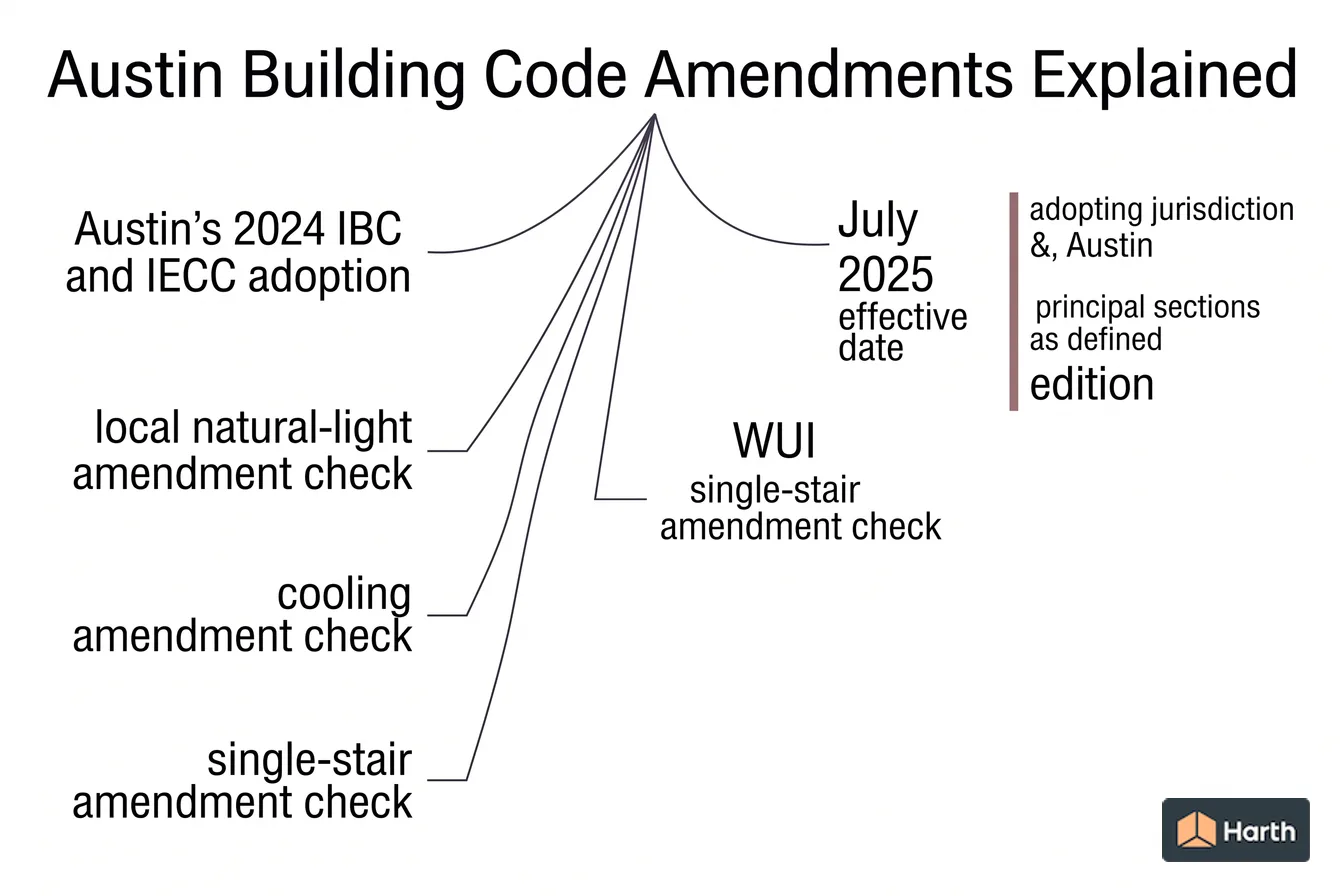
Austin enforces the 2024 International Codes with local amendments, effective July 10, 2025: the 2024 IBC, IRC, IECC, IEBC, IFC, IPMC, ISPSC and IWUIC, plus the 2024 Uniform Mechanical and Uniform Plumbing Codes. The electrical code is the 2023 NEC until the 2026 NEC takes effect on September 1, 2026. Austin's amendments live in City Code Chapter 25-12 (Technical Codes) and must be read alongside the model code. The largest local departures are a cooling standard for habitable rooms, a single-stair option for small apartment buildings and an expanded wildland-urban interface area.
Codes in force in Austin
| Discipline | Code in force | Effective | Austin note |
|---|---|---|---|
| Commercial building | 2024 IBC | July 10, 2025 | Local amendments in Chapter 25-12 |
| Residential (one- and two-family, townhouses) | 2024 IRC | July 10, 2025 | Confirm the project qualifies for the IRC |
| Energy | 2024 IECC | July 10, 2025 | Austin Energy testing, commissioning, solar-ready and EV-readiness deliverables apply |
| Existing buildings | 2024 IEBC | July 10, 2025 | Alterations, additions and change of occupancy |
| Fire | 2024 IFC | July 10, 2025 | Read with Austin Fire amendments |
| Property maintenance | 2024 IPMC | July 10, 2025 | Carries the cooling and electrical-service rules below |
| Pools and spas | 2024 ISPSC | July 10, 2025 | APSP 7 and 15 compliance documentation |
| Wildland-urban interface | 2024 IWUIC | July 10, 2025 | Applies in mapped WUI proximity zones |
| Mechanical | 2024 UMC | July 10, 2025 | Austin uses the IAPMO code, not the IMC |
| Plumbing | 2024 UPC | July 10, 2025 | Austin uses the IAPMO code, not the IPC |
| Electrical | 2023 NEC, then 2026 NEC | 2026 NEC from Sept. 1, 2026 | Check which edition applies to your permit date |
| Flood hazard areas | Chapter 25-12, Article 3 | — | No change in the 2025 cycle |
Source: Austin Development Services, Building Technical Codes, which links the adopted local amendment for each code.
Because Texas cities adopt and amend the editions they enforce, Austin's codes can differ from those of Houston, Dallas or San Antonio. See Texas building code adoption for the statewide picture.
Austin amendments to check early in design
- Cooling in habitable rooms (IPMC 603.7). Owners must provide and maintain refrigerated air able to hold each habitable room at least 15 °F below the outdoor temperature and never above 85 °F, measured 3 ft above the floor. It is a defense if at least one habitable room is at 85 °F when it is over 110 °F outside. The requirement sits in the property maintenance code, so it applies to existing buildings too (Council backup for the 2024 IPMC amendments).
- Minimum electrical service (IPMC 604.2). Dwelling units need a three-wire, 120/240 V single-phase service rated at least 100 A (same source).
- Single-stair apartment buildings. A local amendment allows one exit stair in a narrowly defined apartment building of no more than five stories and no more than four dwelling units per floor, subject to the full amended conditions. Model the stair core against the adopted text before fixing the plan.
- Wildland-urban interface. The 2025 cycle expanded the mapped WUI area and Proximity Zone C. Sites in a proximity zone follow the 2024 IWUIC, Austin's amendments and the city's WUI construction guide.
- Natural light. Austin keeps local natural-light provisions that can drive room depth and facade openings.
- Energy deliverables. Commercial projects plan for renewable-energy, solar-ready, EV-readiness and commissioning requirements. Austin publishes a commissioning summary template, a renewable-energy systems guide and EV-readiness guides on the Building Technical Codes page.
Use the adopted ordinance text, not a redline marked "proposed". Austin's document system still indexes draft 2024 adoption files next to the final ones.
Austin code adoption history
A building has to be maintained to the standards in force when it was built. Austin identifies those standards from the effective date of the adopting ordinance and the "in date" on the plan-review folder, or on the building permit if there is no plan-review folder.
| Code | 2015 cycle (effective) | 2021 cycle (effective) | 2024 cycle (effective) |
|---|---|---|---|
| Building (IBC) | Jan. 1, 2018 | Sept. 1, 2021 (Ord. 20210603-059) | July 10, 2025 |
| Residential (IRC) | July 5, 2017 | Sept. 1, 2021 (Ord. 20210603-054) | July 10, 2025 |
| Energy (IECC) | Sept. 1, 2016 | Sept. 1, 2021 (Ord. 20210603-055) | July 10, 2025 |
| Fire (IFC) | Jan. 7, 2018 | Sept. 1, 2021 (Ord. 20210603-056) | July 10, 2025 |
| Property maintenance (IPMC) | Apr. 1, 2018 | Sept. 1, 2021 (Ord. 20210603-060) | July 10, 2025 |
| Plumbing (UPC) | Sept. 6, 2017 | Sept. 1, 2021 (Ord. 20210603-057) | July 10, 2025 |
| Mechanical (UMC) | Sept. 6, 2017 | Sept. 1, 2021 (Ord. 20210603-058) | July 10, 2025 |
Austin first adopted the IWUIC effective January 1, 2021 (Ord. 20200409-040). Electrical code: the 2017 NEC took effect January 1, 2018, the 2020 NEC on September 1, 2020, and the 2026 NEC takes effect on September 1, 2026. Earlier dates come from the city's historic code adoption dates record.
Austin permit-start checklist
- Confirm that the address is inside Austin's building-code jurisdiction, and identify any extraterritorial jurisdiction or Travis County layer.
- Record the application date and the edition in force for each discipline on that date.
- Download the final Chapter 25-12 amendment for each code that applies.
- Search the Code Interpretation Library for the sections you rely on.
- Check the WUI map when the site may fall in a proximity zone.
- Add Austin Energy testing, commissioning, solar-ready and EV documents to the permit deliverables list.
- Check zoning separately: use, height, setbacks and compatibility come from the Land Development Code, not the technical codes. Start with zoning in Austin.
Amendment log template
| Code / section | Model requirement | Austin amendment or interpretation | Drawing/spec response | Source date |
|---|---|---|---|---|
| — | — | — | — | — |
| — | — | — | — | — |
| — | — | — | — | — |
To work through an Austin project with this guide loaded, use Add to Harth agent at the top of the page. It opens the Harth agent with this page as context.
Frequently asked questions
What building code does Austin use in 2026?
Austin uses the 2024 International Building Code with local amendments, effective July 10, 2025. The same cycle adopted the 2024 IRC, IECC, IEBC, IFC, IPMC, ISPSC and IWUIC, plus the 2024 UMC and UPC. Electrical work follows the 2023 NEC until the 2026 NEC takes effect on September 1, 2026.
When did Austin's current building codes go into effect?
On July 10, 2025. They replaced the 2021 codes, which had been in force since September 1, 2021. Which code applies to a project depends on its application date, so record that date on the code sheet.
Which version of the IRC does Austin use?
The 2024 International Residential Code with Austin amendments, effective July 10, 2025. Before that, Austin used the 2021 IRC from September 1, 2021 and the 2015 IRC from July 5, 2017.
Which energy code applies in Austin?
The 2024 IECC with Austin amendments, effective July 10, 2025. Austin Energy's testing, commissioning, renewable-energy, solar-ready and EV-readiness requirements are part of compliance, so plan for those submittals as well.
Does Austin require air conditioning?
Yes. Austin's amendment to IPMC Section 603.7 requires owners to provide and maintain refrigerated air that keeps each habitable room at least 15 °F below the outdoor temperature and no warmer than 85 °F.
Does Austin allow single-stair apartment buildings?
Yes, within limits. Austin's 2024 amendments allow a single exit stair in apartment buildings of no more than five stories with no more than four dwelling units per floor, subject to the full conditions in the adopted amendment.
Which code applies to an older Austin building?
The code in force when it was built. Austin determines this from the effective date of the adopting ordinance and the "in date" on the plan-review folder or building permit. Alterations to existing buildings are reviewed under the current IEBC.
Related Austin design data
- Zoning in Austin, TX: district families and illustrative standards
- Climate design data for Austin, TX: design temperatures and climate zone
- Sun path and solar angles for Austin, TX: shading and daylight inputs
- City building-code amendments: Denver, Seattle and other city guides
Scope and sources
Harth prepared this guide from the Austin Development Services adoption records and the amendment documents linked above. It summarizes which codes apply and when; it does not reproduce the controlling code, give a legal opinion or confirm which edition governs a particular address. Where this page and an official publication disagree, the official publication and the authority having jurisdiction control.
Authored and prepared by Harth from the linked agency records. Review scope: adoption status and source paths verified; project-specific applicability and local interpretation require AHJ confirmation.