Solar & Daylight Data
Sun Path & Solar Angles for Austin, TX
Calculated solar-noon angles and a first-pass fixed-shading worksheet for Austin, TX, using transparent solar geometry rather than an unexplained chart.
On this page
Last updated August 17, 2026 · Original calculation using latitude 30.2672° N and declinations +23.44°, 0°, and -23.44°. Formula: altitude = 90° - |latitude - declination|. Time zone: America/Chicago. Verify occupied-hour positions with the NOAA Solar Calculator; values omit refraction, equation of time, terrain, obstructions, and facade azimuth.
Direct answer
Calculated solar-noon angles and a first-pass fixed-shading worksheet for Austin, TX, using transparent solar geometry rather than an unexplained chart. A key reference is latitude: 30.2672° N; check the cited source, edition, units, and applicability before using it for design, compliance, procurement, or approval. Latitude is 30.2672° N; Austin, TX. June solstice noon is 83.2°; south at solar noon. Equinox noon is 59.7°; geometric solar noon. Projection ratio = 1 / tan(solar altitude). Multiply the ratio by the vertical distance the noon shadow must cover. Use this only as a hand check before a full-year study. Read the values with the cited source, edition or observation period, units and applicability; replace illustrative inputs with current project evidence before design, procurement or approval use.
Content and cited inputs reviewed by Harth team · Published 2026-08-17 · Updated 2026-08-17.
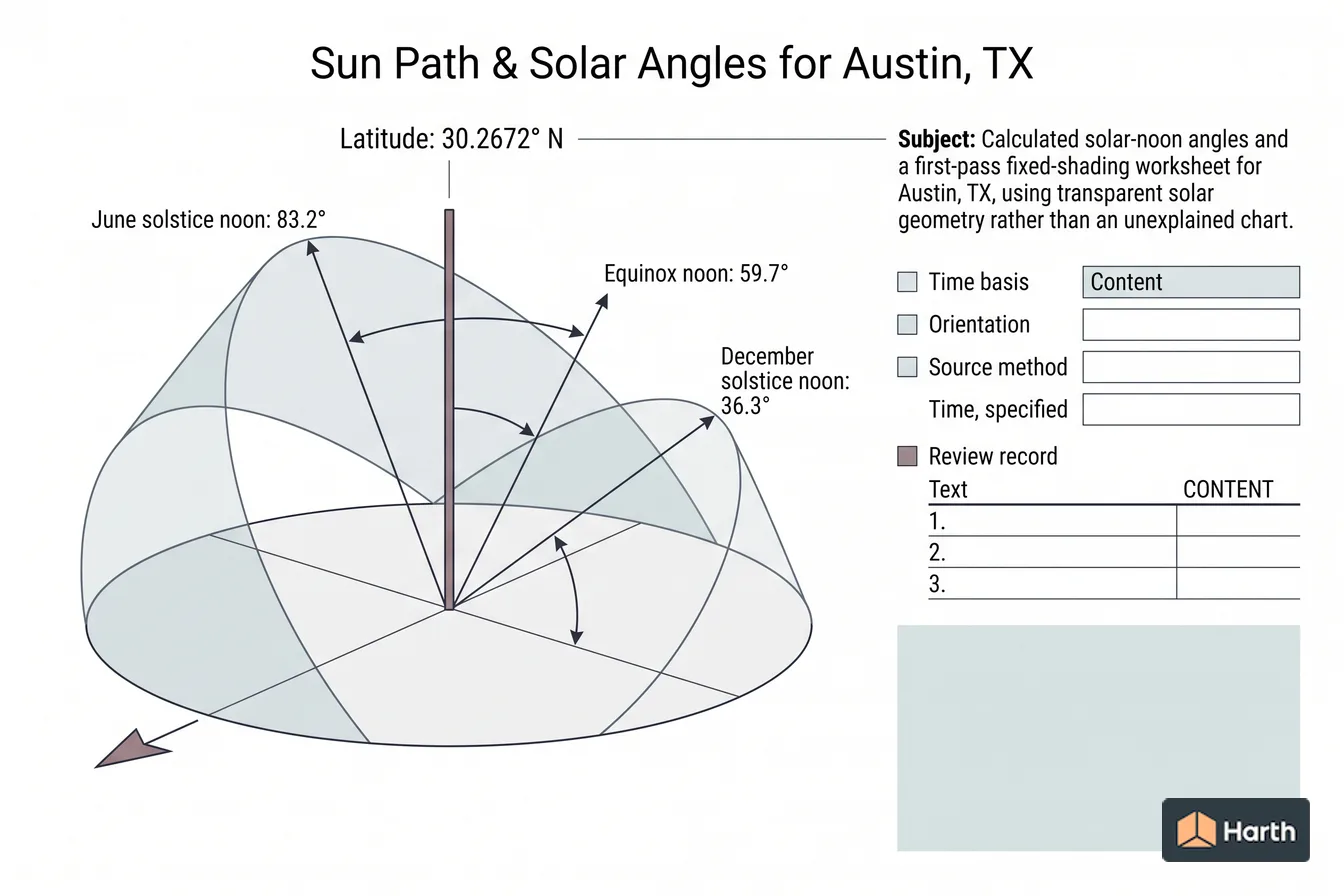
Which solar conditions control the result?
| Date | Declination | Altitude | Projection / vertical shade distance |
|---|---|---|---|
| June solstice | +23.44° | 83.17° | 0.120 |
| Equinox | 0° | 59.73° | 0.584 |
| December solstice | -23.44° | 36.29° | 1.362 |
Projection ratio = 1 / tan(solar altitude). Multiply the ratio by the vertical distance the noon shadow must cover. Use this only as a hand check before a full-year study.
Austin, TX shading record
Record facade azimuth, window head and sill, overhang height, required shaded dates and hours, coordinates (30.2672° N), time zone (America/Chicago), calculation method, surrounding obstructions, reviewer and date. Compare the full model against the three noon ratios above and retain screenshots of the critical summer and shoulder-season hours. Verify hourly positions with the NOAA Solar Calculator.
Where can you explore related guidance?
- Explore all solar data guidance
- Understanding Sun-Path Diagrams
- Solar Altitude and Azimuth: Meaning, Formulas & Worked Example
- Climate Design Data Workflow for Austin, TX
- Zoning in Austin, TX: District Families & Illustrative Standards
Sources and method
Original calculation using latitude 30.2672° N and declinations +23.44°, 0°, and -23.44°. Formula: altitude = 90° - |latitude - declination|. Time zone: America/Chicago. Verify occupied-hour positions with the NOAA Solar Calculator; values omit refraction, equation of time, terrain, obstructions, and facade azimuth.
Source links
Frequently asked questions
What is the sun angle in Austin, TX at the summer solstice?
The declination-only solar-noon altitude is approximately 83.2°. This is a transparent geometry check, not a substitute for an hourly solar-position calculation.
Related pages
- Sun Path & Solar Angles for Albuquerque, NM
Sun-path design data for Albuquerque, NM: solstice and equinox solar-noon altitude, shadow ratios, assumptions, and an architect-oriented shading worksheet.
- Sun Path & Solar Angles for Anchorage, AK
Sun-path design data for Anchorage, AK: solstice and equinox solar-noon altitude, shadow ratios, assumptions, and an architect-oriented shading worksheet.
- Sun Path & Solar Angles for Atlanta, GA
Sun-path design data for Atlanta, GA: solstice and equinox solar-noon altitude, shadow ratios, assumptions, and an architect-oriented shading worksheet.
- Sun Path & Solar Angles for Boise, ID
Sun-path design data for Boise, ID: solstice and equinox solar-noon altitude, shadow ratios, assumptions, and an architect-oriented shading worksheet.
- Sun Path & Solar Angles for Boston, MA
Sun-path design data for Boston, MA: solstice and equinox solar-noon altitude, shadow ratios, assumptions, and an architect-oriented shading worksheet.
- Sun Path & Solar Angles for Chicago, IL
Sun-path design data for Chicago, IL: solstice and equinox solar-noon altitude, shadow ratios, assumptions, and an architect-oriented shading worksheet.