Structural Design Loads
Ground Snow Load (pg) Explained for Architects
What ground snow load (pg) is, how it converts to a roof design load, and why regional variation and roof geometry drive the numbers architects work with.
On this page
Last updated August 14, 2026 · Concepts per ASCE 7 (Ch. 7); mapped ground snow loads and site-specific case-study regions from the ASCE Hazard Tool. Any values shown are illustrative and the official ASCE Hazard Tool + AHJ-adopted code govern. Official references: [ASCE Hazard Tool](https://ascehazardtool.org/); [ASCE/SEI 7-22](https://www.asce.org/publications-and-news/codes-and-standards/asce-sei-7-22).
Direct answer
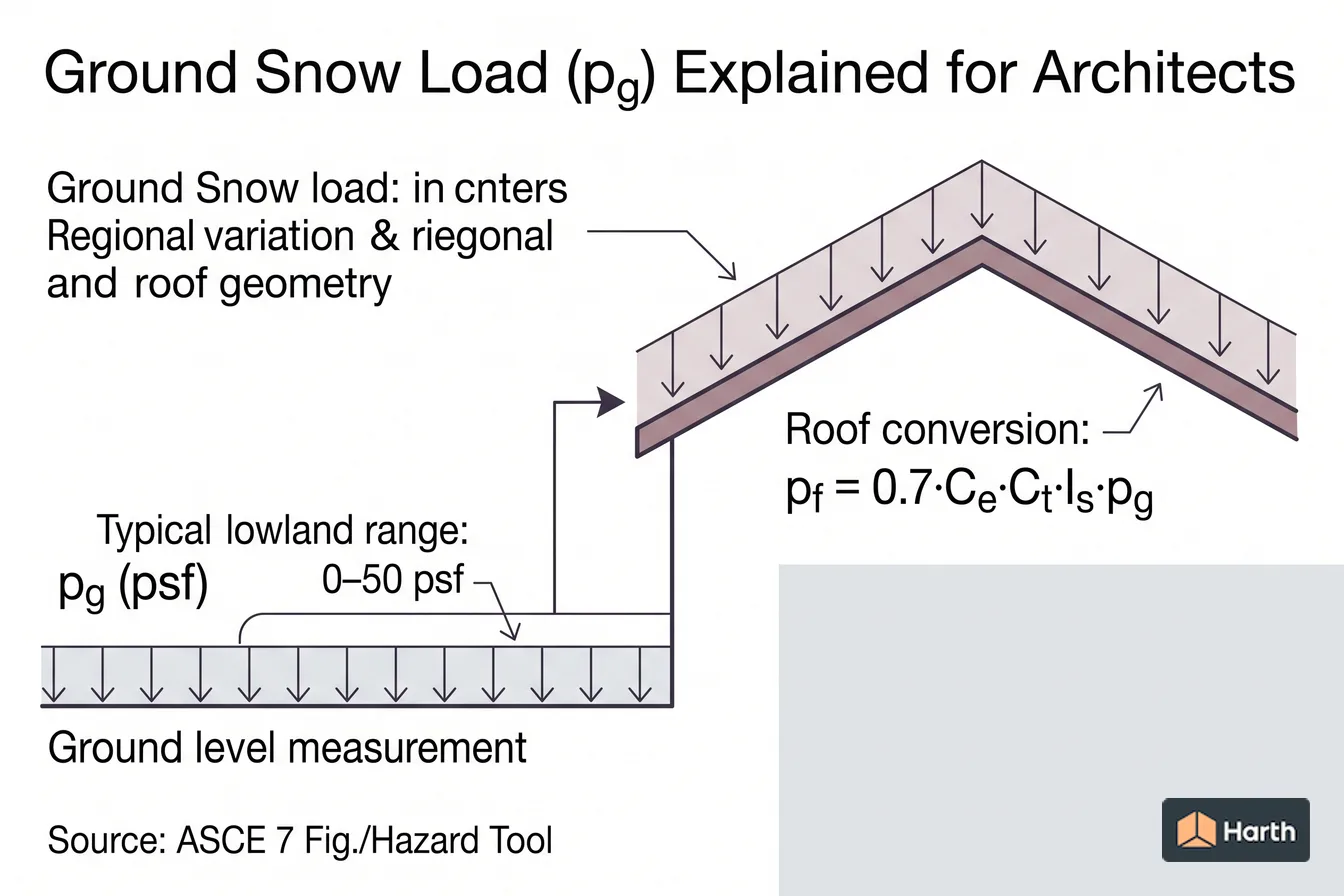
What ground snow load (pg) is, how it converts to a roof design load, and why regional variation and roof geometry drive the numbers architects work with. A key reference is typical lowland range: 0–50 psf; check the cited source, edition, units, and applicability before using it for design, compliance, procurement, or approval. Symbol is pg (psf); ground snow load. Typical lowland range is 0–50 psf; region dependent. Roof conversion is pf = 0.7·Ce·Ct·Is·pg; flat-roof snow load. Ground snow load (pg), in pounds per square foot (psf), is the reference snow load measured at ground level for a location. It is the starting point for roof snow design in ASCE 7 Chapter 7 — not the load the roof structure is actually designed for.
Content and cited inputs reviewed by Harth team · Published 2026-08-14 · Updated 2026-08-14.
What does this term mean?
Ground Snow Load (pg) Explained for Architects: What ground snow load (pg) is, how it converts to a roof design load, and why regional variation and roof geometry drive the numbers architects work with.
Which site and code inputs control the design?
Ground snow load (pg), in pounds per square foot (psf), is the reference snow load measured at ground level for a location. It is the starting point for roof snow design in ASCE 7 Chapter 7 — not the load the roof structure is actually designed for.
From ground to roof
The flat-roof snow load converts pg with several factors:
$$ p_f = 0.7 \cdot C_e \cdot C_t \cdot I_s \cdot p_g $$
| Factor | Meaning | Typical |
|---|---|---|
| 0.7 | Basic ground-to-roof factor | fixed |
| Ce | Exposure (wind scour) | 0.7–1.2 |
| Ct | Thermal (heated vs. cold roof) | 1.0–1.3 |
| Is | Importance (risk category) | 0.8–1.2 |
Sloped roofs apply a slope factor Cs; drift, sliding, and unbalanced conditions then add local loads that often govern connections and framing near steps, parapets, and valleys.
Regional variation
| Setting | Illustrative pg |
|---|---|
| Gulf Coast / low South | 0–5 psf |
| Mid-Atlantic lowlands | 20–30 psf |
| Upper Midwest / Northeast | 40–70 psf |
| Mountain / high elevation | Case study (CS) |
Snow load climbs sharply with elevation, which is why mountainous areas are handled as case-study (CS) zones requiring a site-specific value.
Get the authoritative value
Enter the project address in the ASCE Hazard Tool to pull the mapped pg (or the CS flag) for the AHJ-adopted code edition, then let your structural engineer carry it through the roof-load factors above.
Ground Snow Load (pg) Explained for Architects: structural-engineer handoff record
| Required input | Project entry |
|---|---|
| Site coordinates and jurisdiction | — |
| Adopted code / standard and edition | — |
| Risk category and occupancy basis | — |
| Official hazard-tool result and retrieval date | — |
| Site class, exposure, terrain or other relevant site input | — |
| Local amendments and authority confirmation | — |
| Engineer's derived design values | — |
| Engineer, checker and revision | — |
Stop condition: this page explains terminology and source workflow only. A generated diagram, map colour or generic example must not become a project design value.
Where can you explore related guidance?
- Explore all structural loads guidance
- Seismic Design Category & Site Class Explained (SDC A–F)
- Design Wind Speed (Vult), Risk Category Maps & Exposure B/C/D
Sources and method
Concepts per ASCE 7 (Ch. 7); mapped ground snow loads and site-specific case-study regions from the ASCE Hazard Tool. Any values shown are illustrative and the official ASCE Hazard Tool + AHJ-adopted code govern. Official references: ASCE Hazard Tool; ASCE/SEI 7-22.
Source links
Frequently asked questions
Is ground snow load the same as the load on my roof?
No. Ground snow load (pg) is the reference value measured at ground level. The roof design load is derived from it. The flat-roof snow load is pf = 0.7·Ce·Ct·Is·pg, where Ce is exposure, Ct is thermal, and Is is the importance factor tied to risk category. Sloped, curved, and multi-level roofs then apply additional factors — and drifting, sliding, and unbalanced snow can produce local loads well above pf.
Why do some regions show 'CS' instead of a number?
In mountainous and highly variable terrain, a single mapped value can't capture the swing in snowfall over short distances and elevation changes. ASCE 7 marks these as 'case study' (CS) zones, where a site-specific study — often by a local engineer or the state — establishes pg for that elevation and location. The ASCE Hazard Tool flags these areas.
How does ground snow load affect early design?
A high pg pushes toward steeper roof slopes to shed snow, heavier structure, and careful detailing at valleys, parapets, and roof-level changes where drifts accumulate. It also affects where you can place lower roofs, mechanical units, and rooftop amenities, since anything creating a step in the roof can trap a snow drift with a much higher local load.
Related pages
- Seismic Design Category & Site Class Explained (SDC A–F)
How SDS, SD1, site class and risk category set Seismic Design Category A–F, with the ASCE 7-22 site classes (BC, CD, DE) and IBC thresholds.
- Design Wind Speed (Vult), Risk Category Maps & Exposure B/C/D
Read design wind speed (Vult) from the right risk category map, then set Exposure B, C or D from upwind terrain using the ASCE 7 and IBC fetch rules.