Climate & Energy Design Data
Calgary Climatic Design Data for Building Projects
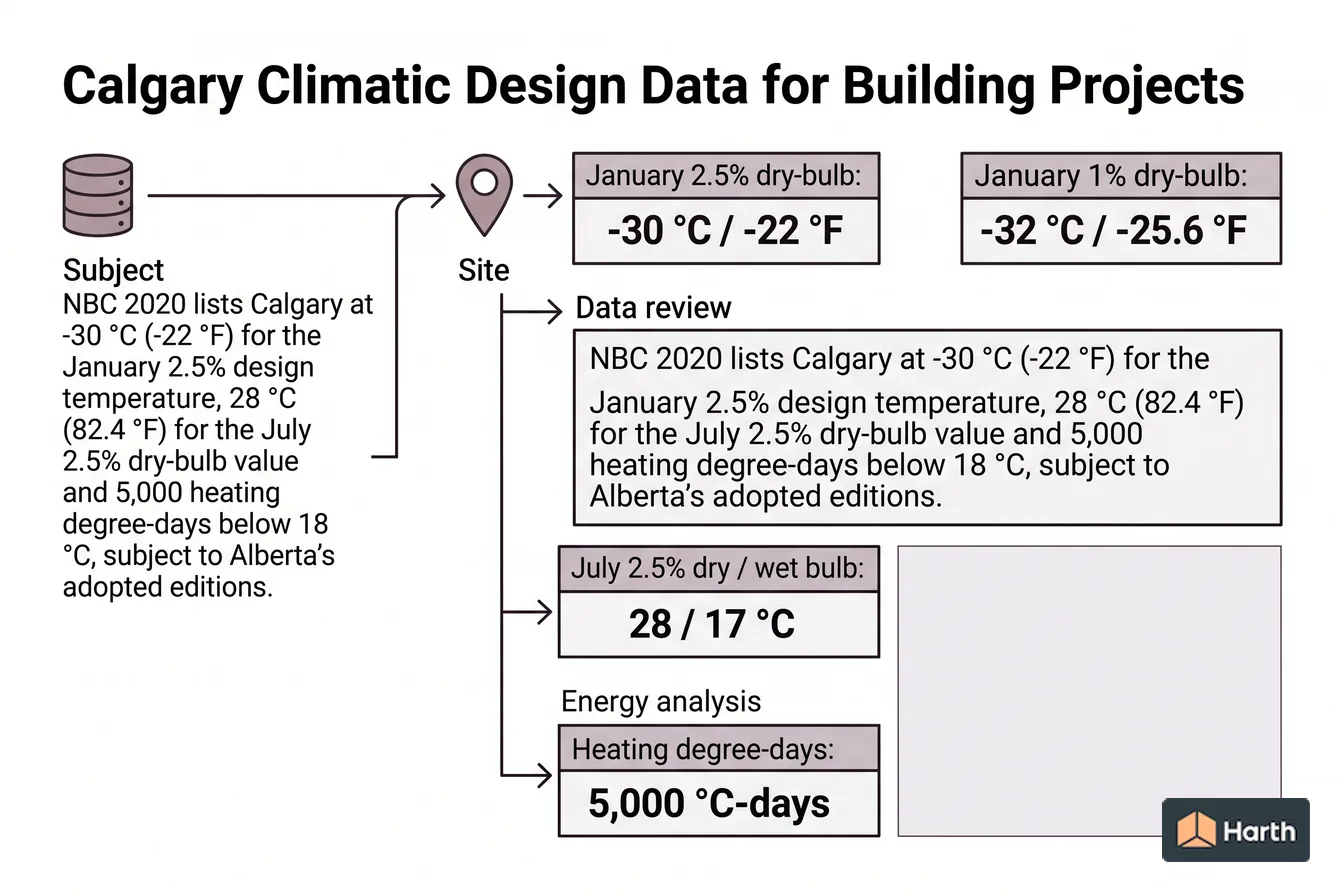
NBC 2020 lists Calgary at -30 °C (-22 °F) for the January 2.5% design temperature, 28 °C (82.4 °F) for the July 2.5% dry-bulb value and 5,000 heating degree-days below 18 °C, subject to Alberta's adopted editions.
On this page
Last updated August 26, 2026 · Selected Calgary fields from National Building Code of Canada 2020, Appendix C, Table C-2, first printing, checked against the official NRC publication; Government of Alberta for the codes currently in force and current printing; City of Calgary for permit and energy-code compliance scope. Sources: https://nrc-publications.canada.ca/eng/view/object/?id=515340b5-f4e0-4798-be69-692e4ec423e8 ; https://www.alberta.ca/building-codes-and-standards ; https://www.calgary.ca/development/commercial/new-buildings-additions-permits.html ; https://www.calgary.ca/development/permits/building-regulation-advisories.html . Verify all values and zone treatment against the current Alberta editions, amendments and AHJ direction; only selected temperature/HDD fields are excerpted, not the protected table as a whole.
Direct answer
For Calgary, use the current National Building Code – 2023 Alberta Edition and NECB 2020 as adopted, then confirm the precise climatic row and energy-zone rule. The selected national-table values show a demanding winter and a meaningful summer condition, but they do not replace site exposure, an hourly weather file or consultant design conditions. January 2.5% dry-bulb is -30 °C / -22 °F; NBC 2020 Calgary row. January 1% dry-bulb is -32 °C / -25.6 °F; Colder alternative basis. July 2.5% dry / wet bulb is 28 / 17 °C; 82.4 / 62.6 °F; Calgary row. The Government of Alberta's codes and standards page lists the National Building Code – 2023 Alberta Edition and NECB 2020 as the building and energy codes in force. As at this review, Alberta also lists a second printing of the 2023 Alberta Edition published in August 2026. A Calgary basis-of-design report should name that exact printing and any applicable STANDATA, amendments and transition conditions.
Content and cited inputs reviewed by Harth team · Published 2026-08-26 · Updated 2026-08-26.
Which climate inputs control the design?
The Government of Alberta's codes and standards page lists the National Building Code – 2023 Alberta Edition and NECB 2020 as the building and energy codes in force. As at this review, Alberta also lists a second printing of the 2023 Alberta Edition published in August 2026. A Calgary basis-of-design report should name that exact printing and any applicable STANDATA, amendments and transition conditions.
The City of Calgary states that new buildings and additions must comply with the NECB or the building code's small-building energy provisions as applicable. The City's advisories page also warns that advisories are interpretations and do not themselves have legal status. Preserve the difference between the adopted regulation, a formal bulletin, an advisory and project-specific AHJ correspondence.
Selected climatic baseline
The national NBC 2020 Calgary row is at 1,045 m (3,428 ft) elevation and provides a transparent adopted-era reference:
| Variable | SI | IP conversion |
|---|---|---|
| January dry-bulb, 2.5% | -30 °C | -22 °F |
| January dry-bulb, 1% | -32 °C | -25.6 °F |
| July dry-bulb, 2.5% | 28 °C | 82.4 °F |
| July wet-bulb, 2.5% | 17 °C | 62.6 °F |
| Degree-days below 18 °C / 65 °F | 5,000 °C-days | 9,000 °F-days |
These selected values must be checked in the current Alberta edition before design. A project at a materially different elevation or exposure still needs a site-selection record; a municipal label does not resolve terrain, wind, snow drifting or microclimate.
What the winter condition should trigger
A -30 °C (-22 °F) code baseline makes heat loss and surface temperature central concept-stage questions. The envelope model should use effective, not only nominal, thermal resistance and explicitly include slab edges, balconies, shelf angles, parapets, glazing frames and transitions. Airtightness should have a target, test method and responsibility. Hygrothermal analysis should use the assembly's actual materials and interior humidity assumptions.
Mechanical coordination should address the selected design percentile, heat-pump capacity at low outdoor temperature, defrost and supplemental heat, heat-recovery frost control, outside-air treatment, freeze protection and recovery after setback or outage. The architect does not need to size the plant, but the design brief should prevent those questions from being deferred until equipment selection.
Summer and shoulder-season design still matter
Calgary's heating-dominated profile does not erase a 28 °C (82.4 °F) July dry-bulb design condition. Large west glazing, high internal gains and limited night ventilation can create overheating. At schematic design, test external shade, glazing ratio, thermal mass, operable-window constraints and cooling or heat-pump operation with an hourly weather file.
Do not assume that the 17 °C (62.6 °F) July wet-bulb is coincident with the dry-bulb unless the governing calculation defines it that way. Likewise, do not replace the code conditions with a forecast extreme or monthly mean. The mechanical engineer should state the exact variable, percentile, station and source used for each load calculation.
Treat 5,000 degree-days carefully
The NBC row's 5,000 °C-day value is useful for energy classification, but it sits exactly where threshold wording and rounding can matter. The adopted NBC/NECB edition determines whether a boundary value belongs to one zone or the next and whether Alberta changes the national method. Cite the actual table or definition used by the energy modeller instead of writing a zone from memory.
This also illustrates why the climate zone, design temperatures and simulation weather must remain separate records. One selects prescriptive energy provisions, one supports peak or code applications, and one provides an hourly sequence for performance analysis.
Add future climate without losing the legal baseline
NBC 2025, released after Alberta's current editions, introduces projected climate data in the national model. Until Alberta adopts or otherwise accepts those provisions, label a future scenario as supplemental unless the AHJ says otherwise. For a long-lived Calgary building, compare present and future heating, cooling, precipitation and structural climate variables over the component service life, then retain the most demanding applicable case with its confidence and decision rule.
The final climate schedule should therefore show both the legal minimum basis and the resilience basis. That lets reviewers understand why a colder historical winter value may still control one system while a warmer future summer value controls another.
Calgary cold-climate coordination card
Selected adopted-era baseline
| Input | SI | IP conversion | Coordination trigger |
|---|---|---|---|
| Reference elevation | 1,045 m | 3,428 ft | Compare project elevation and exposure |
| January dry-bulb, 2.5% | -30 °C | -22 °F | Envelope/plant basis and frost strategy |
| January dry-bulb, 1% | -32 °C | -25.6 °F | Confirm selected winter reliability basis |
| July dry-bulb, 2.5% | 28 °C | 82.4 °F | Solar and sensible cooling study |
| July wet-bulb, 2.5% | 17 °C | 62.6 °F | Moisture/load basis; do not assume coincidence |
| Degree-days below 18 °C / 65 °F | 5,000 °C-days | 9,000 °F-days | Confirm energy-zone treatment in adopted code |
Sign-off matrix
| Topic | Required project entry | Owner |
|---|---|---|
| Governing code | NBC 2023 Alberta Edition printing/amendments, NECB 2020 printing, permit date | Code consultant / architect |
| Site match | Address, elevation, terrain/exposure and accepted Calgary row | Architect / structural engineer |
| Envelope | Effective R/RSI, bridge catalogue, airtightness, condensation and durability checks | Envelope consultant |
| Mechanical | Heating/cooling percentiles, coincident variables, heat-recovery frost control and backup philosophy | Mechanical engineer |
| Energy model | Exact weather file, release, station, compliance pathway and sensitivity cases | Energy modeller |
| Future service life | NBC 2025 adoption status or supplemental warming-level scenario | Owner / design team |
Boundary rule: 5,000 °C-days is a threshold-sensitive value in Canadian energy-zone systems. Use the classification and rounding rule printed in the adopted Alberta/NECB edition; do not assign a zone from this page alone.
Where can you explore related guidance?
- Explore all climate data guidance
- Canadian Climatic Design Data and the National Building Code
- Toronto Climatic Design Data for Building Projects
- Vancouver Climatic Design Data for Building Projects
- All climate & energy design data guidance for Canada
Sources and method
Selected Calgary fields from National Building Code of Canada 2020, Appendix C, Table C-2, first printing, checked against the official NRC publication; Government of Alberta for the codes currently in force and current printing; City of Calgary for permit and energy-code compliance scope. Sources: https://nrc-publications.canada.ca/eng/view/object/?id=515340b5-f4e0-4798-be69-692e4ec423e8 ; https://www.alberta.ca/building-codes-and-standards ; https://www.calgary.ca/development/commercial/new-buildings-additions-permits.html ; https://www.calgary.ca/development/permits/building-regulation-advisories.html . Verify all values and zone treatment against the current Alberta editions, amendments and AHJ direction; only selected temperature/HDD fields are excerpted, not the protected table as a whole.
Source links
Frequently asked questions
What winter design temperature is listed for Calgary?
The NBC 2020 Calgary row lists -30 °C (-22 °F) at the January 2.5% basis and -32 °C (-25.6 °F) at 1%. Verify the current value and application in the National Building Code – 2023 Alberta Edition and do not confuse the January convention with ASHRAE annual percentiles.
Which building and energy codes are in force in Calgary?
Alberta's official page lists the National Building Code – 2023 Alberta Edition and National Energy Code of Canada for Buildings 2020 as in force. It listed a second printing of the Alberta building code in August 2026. Record the printing, amendments, permit date and City interpretation used by the project.
What energy climate zone is Calgary in?
The selected Calgary row reports exactly 5,000 heating degree-days below 18 °C, a value at a classification threshold in Canadian energy-code systems. Confirm the zone definitions, inclusivity and any Alberta variation in the adopted NBC/NECB edition instead of assigning a zone from an informal chart.
Does Calgary's cold winter eliminate the need for summer analysis?
No. The same row lists a July 2.5% dry-bulb value of 28 °C (82.4 °F). Solar gain, glazing, internal loads, natural-ventilation limits and future warming can produce overheating or cooling demand even in a heating-dominated climate.
Related pages
- Climate Design Data: Cairns, Australia
Cairns, Australia climate design data (NASA POWER 2001–2020): annual mean 22.4 °C, monthly max 39.2 °C (November), min 7.5 °C (June), RH 81%; monthly table.
- Climate Design Data: Calabar, Nigeria
Calabar, Nigeria climate design data (NASA POWER 2001–2020): annual mean 25.9 °C, monthly max 33.7 °C (May), min 14.5 °C (January), RH 87%; monthly table.
- Climate Design Data: Calamba, Philippines
Calamba, Philippines climate design data (NASA POWER 2001–2020): annual mean 25.9 °C, monthly max 37.9 °C (August), min 16.0 °C (January), RH 85%.
- Climate Design Data: Calgary, Canada
Calgary, Canada climate design data (NASA POWER 2001–2020): annual mean 3.6 °C, monthly max 35.1 °C (July), min -34.6 °C (January), RH 71%; monthly table.
- Climate Design Data: Canberra, Australia
Canberra, Australia climate design data (NASA POWER 2001–2020): annual mean 12.6 °C, monthly max 40.5 °C (January), min -4.5 °C (August), RH 71%; monthly table.
- Climate Design Data: Cape Town, South Africa
Cape Town, South Africa climate design data (NASA POWER 2001–2020): annual mean 17.1 °C, monthly max 28.3 °C (October), min 9.2 °C (August), RH 79%.