Climate & Energy Design Data
Toronto Climatic Design Data for Building Projects
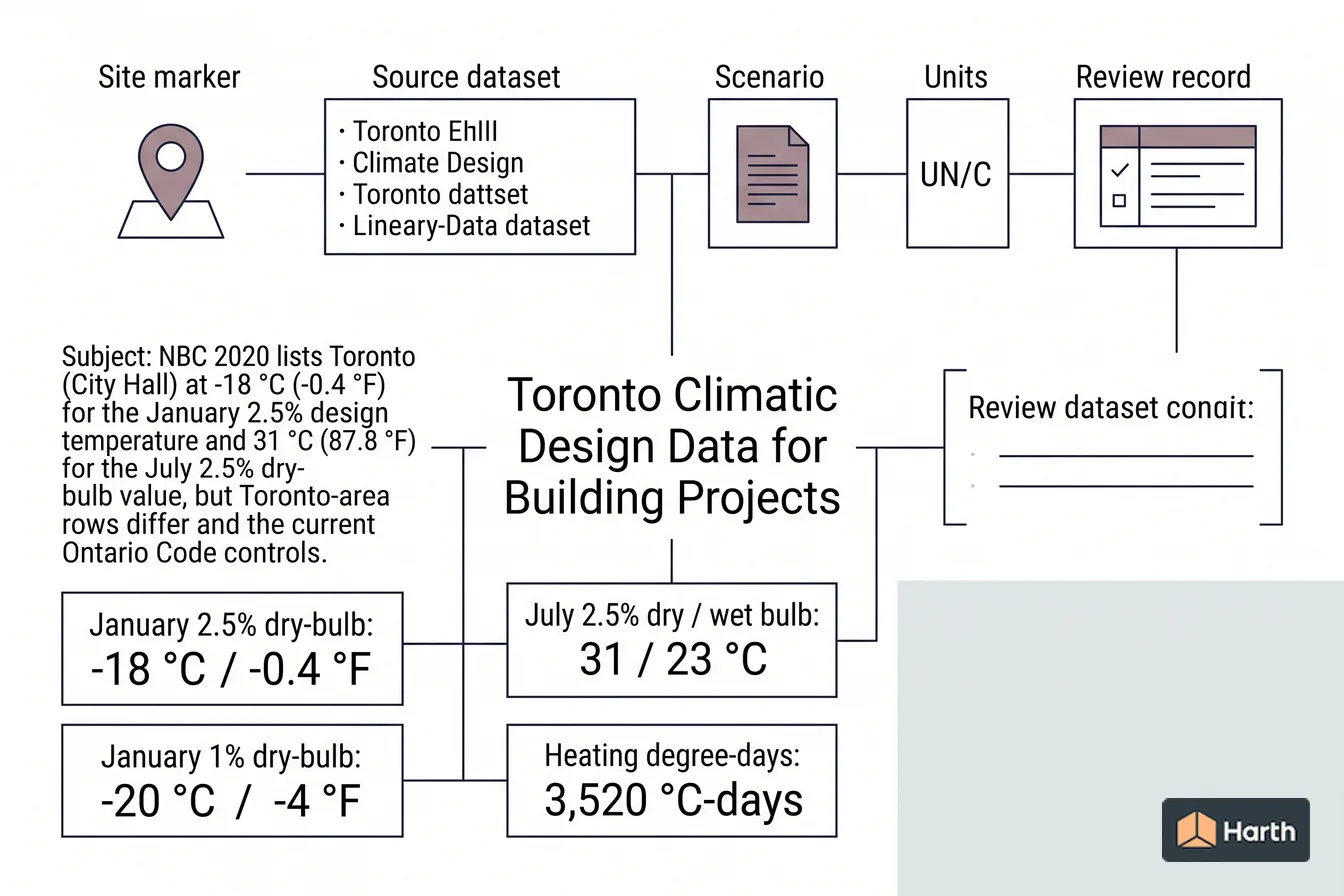
NBC 2020 lists Toronto (City Hall) at -18 °C (-0.4 °F) for the January 2.5% design temperature and 31 °C (87.8 °F) for the July 2.5% dry-bulb value, but Toronto-area rows differ and the current Ontario Code controls.
On this page
Last updated August 26, 2026 · Selected Toronto (City Hall) fields from National Building Code of Canada 2020, Appendix C, Table C-2, first printing, checked against the official NRC publication; Ontario Regulation 163/24 and Ontario's current Building Code page for adoption and update status; ClimateData.ca's federal-partner guidance for future design values. Sources: https://nrc-publications.canada.ca/eng/view/object/?id=515340b5-f4e0-4798-be69-692e4ec423e8 ; https://www.ontario.ca/laws/regulation/240163 ; https://www.ontario.ca/page/ontarios-building-code ; https://climatedata.ca/resource/introducing-future-building-design-values-choosing-and-using-future-climatic-design-data/ . Verify against the current Ontario Code compendium and AHJ; only selected temperature/HDD fields are excerpted, not the protected table as a whole.
Direct answer
For a Toronto project, verify the exact site against the 2024 Ontario Building Code before using a climatic row. The NBC 2020 City Hall excerpt is useful for orientation, but Etobicoke, North York and Scarborough have separate rows and a different site or future-climate brief may require different inputs. January 2.5% dry-bulb is -18 °C / -0.4 °F; NBC 2020 Toronto (City Hall) row. January 1% dry-bulb is -20 °C / -4 °F; Colder optional design basis in NBC 2020 framework. July 2.5% dry / wet bulb is 31 / 23 °C; 87.8 / 73.4 °F; Toronto (City Hall) row. The phrase "Toronto design temperature" hides an important location choice. NBC 2020 Table C-2 has a Toronto Metropolitan Region group with separate entries for Etobicoke, North York, Scarborough and Toronto (City Hall). The City Hall row is at 90 m (295 ft); the other listed locations have different elevations and winter values.
Content and cited inputs reviewed by Harth team · Published 2026-08-26 · Updated 2026-08-26.
Which climate inputs control the design?
The phrase "Toronto design temperature" hides an important location choice. NBC 2020 Table C-2 has a Toronto Metropolitan Region group with separate entries for Etobicoke, North York, Scarborough and Toronto (City Hall). The City Hall row is at 90 m (295 ft); the other listed locations have different elevations and winter values.
That means a downtown reference cannot be carried to every project merely because the postal address says Toronto. At project start, retain the exact address, coordinates and elevation, then record the selected climatic row and why it is accepted. For an unlisted or atypical site, obtain direction under the governing Ontario Code rather than averaging nearby rows.
Small excerpt, explicit statistical basis
The official NBC 2020 publication lists the following selected City Hall values.
| Variable | SI | IP conversion | What it means |
|---|---|---|---|
| January dry-bulb, 2.5% | -18 °C | -0.4 °F | January percentile used by referenced code applications |
| January dry-bulb, 1% | -20 °C | -4 °F | Colder alternative basis |
| July dry-bulb, 2.5% | 31 °C | 87.8 °F | Summer sensible condition under the NBC July convention |
| July wet-bulb, 2.5% | 23 °C | 73.4 °F | Summer moisture condition under the NBC July convention |
| Degree-days below 18 °C / 65 °F | 3,520 °C-days | 6,336 °F-days | Energy-climate classification input |
The conversions above are arithmetic, not a second official source. Do not relabel the January figures as annual ASHRAE percentiles, and do not use July dry- and wet-bulb entries as though they were necessarily coincident unless the governing method says so.
Ontario edition and City requirements are separate checks
Ontario Regulation 163/24 adopts NBC 2020 together with Ontario amendments as the province's building code. Ontario's Building Code page points users to the current 2024 Code Compendium and its filing date. A project record should state the precise compendium/amendment used and the permit transition, not only "OBC 2024."
City planning or green-building requirements can add another layer. The Toronto Green Standard, development approvals and owner requirements may demand modelling or resilience work beyond the minimum building code. Establish which requirements apply to the project type and approval path; they do not change the provenance of an Appendix C code value.
Use the values to frame, not finish, design
The winter values justify early attention to continuity of insulation, glazing performance, air leakage, thermal bridges and heat-recovery frost strategy. The summer dry- and wet-bulb values show that sensible cooling and moisture control both need an explicit services basis. The 3,520 °C-day heating index places Toronto in a heating-dominated context, but it does not answer overheating, solar gain or future cooling risk by itself.
At concept stage, compare at least three separate models or checks:
- the code-compliance basis using the adopted Ontario climatic values;
- the required typical-year hourly file for energy use and comfort; and
- a future-service-life scenario for overheating, cooling capacity and enclosure durability.
ClimateData.ca's future building design value guidance uses Toronto City Hall as a cooling example and explains how historical and future 2.5% July values can be compared. Since NBC 2025 now includes projected climatic data in the national model, state whether a future value comes from an adopted legal provision or a supplemental resilience study.
Information that still belongs in the consultant brief
This page does not select the final HVAC design percentile, CWEC station, wind pressure, snow load, rainfall intensity, flood elevation or future warming level. Each has a different use and governing source. The architect's job is to keep those inputs visible and traceable until the responsible consultant and AHJ confirm them.
Toronto climate basis card
The populated values below are a deliberately small excerpt of the NBC 2020 Toronto (City Hall) row. IP conversions are calculated from the published SI values and rounded to one decimal where needed. They are an orientation and audit aid, not a substitute for the current Ontario Code or project consultant's basis.
| Input | NBC 2020 Toronto (City Hall) excerpt | Project entry / verification |
|---|---|---|
| Reference elevation | 90 m / 295 ft | Site elevation and row-selection rationale: — |
| January dry-bulb, 2.5% | -18 °C / -0.4 °F | Adopted-code value and use: — |
| January dry-bulb, 1% | -20 °C / -4 °F | Selected percentile and reason: — |
| July dry-bulb, 2.5% | 31 °C / 87.8 °F | Sensible-load source confirmed by: — |
| July wet-bulb, 2.5% | 23 °C / 73.4 °F | Latent-load source confirmed by: — |
| Degree-days below 18 °C / 65 °F | 3,520 °C-days / 6,336 °F-days | Energy-zone/code-path confirmation: — |
| Release check | Required record |
|---|---|
| Jurisdiction | City of Toronto, Ontario regulation/code edition, amendment and permit transition |
| Location | Exact address/elevation; why City Hall, Etobicoke, North York, Scarborough or another accepted source applies |
| Weather file | Exact CWEC/CWEEDS or compliance file name, station, release and modeller |
| Future climate | Service life, NBC 2025 adoption status or supplemental Design Value Explorer scenario |
| Review | Architect, mechanical engineer, energy modeller and AHJ comments/date |
Stop rule: Toronto's metropolitan rows are not identical. Do not use the City Hall excerpt for a suburban or elevated site until the location choice and governing Ontario table are confirmed.
Where can you explore related guidance?
- Explore all climate data guidance
- Canadian Climatic Design Data and the National Building Code
- Vancouver Climatic Design Data for Building Projects
- Calgary Climatic Design Data for Building Projects
- All climate & energy design data guidance for Canada
Sources and method
Selected Toronto (City Hall) fields from National Building Code of Canada 2020, Appendix C, Table C-2, first printing, checked against the official NRC publication; Ontario Regulation 163/24 and Ontario's current Building Code page for adoption and update status; ClimateData.ca's federal-partner guidance for future design values. Sources: https://nrc-publications.canada.ca/eng/view/object/?id=515340b5-f4e0-4798-be69-692e4ec423e8 ; https://www.ontario.ca/laws/regulation/240163 ; https://www.ontario.ca/page/ontarios-building-code ; https://climatedata.ca/resource/introducing-future-building-design-values-choosing-and-using-future-climatic-design-data/ . Verify against the current Ontario Code compendium and AHJ; only selected temperature/HDD fields are excerpted, not the protected table as a whole.
Source links
Frequently asked questions
What winter design temperature is listed for Toronto?
The NBC 2020 Toronto (City Hall) row lists -18 °C (-0.4 °F) at the January 2.5% basis and -20 °C (-4 °F) at 1%. Those are January percentile conventions, not ASHRAE annual 99% or 99.6% values. Confirm the row and governing Ontario Code before design.
Can one Toronto climatic row be used everywhere in the city?
Not automatically. NBC 2020 separately lists City Hall, Etobicoke, North York and Scarborough, and it also lists surrounding municipalities. Match the project address and elevation to the row accepted under the current Ontario Code and document the selection with the AHJ and consultants.
Does Ontario currently enforce NBC 2025 projected climatic data?
Do not assume so. Ontario Regulation 163/24 adopts NBC 2020 as amended by Ontario's amendment document for the 2024 Ontario Building Code. NBC 2025 is the newer national model, but its provisions require jurisdictional adoption. Confirm later amendments and permit transition with Ontario and the City.
Should a Toronto energy model use the Appendix C design temperatures as its weather file?
No. Appendix C values are discrete code design variables. An energy model requires a documented hourly file such as the exact CWEC file or another file required by its compliance pathway. Record the file release, station and model purpose separately from peak design conditions.
Related pages
- Climate Design Data: Tirunelveli, India
Tirunelveli, India climate design data (NASA POWER 2001–2020): annual mean 25.8 °C, monthly max 39.8 °C (April), min 14.6 °C (December), RH 79%; monthly table.
- Climate Design Data: Toowoomba, Australia
Toowoomba, Australia climate design data (NASA POWER 2001–2020): annual mean 18.7 °C, monthly max 43.1 °C (February), min -3.5 °C (July), RH 66%; monthly table.
- Climate Design Data: Toronto, Canada
Toronto, Canada climate design data (NASA POWER 2001–2020): annual mean 9.1 °C, monthly max 32.2 °C (July), min -22.6 °C (February), RH 79%; monthly table.
- Climate Design Data: Townsville, Australia
Townsville, Australia climate design data (NASA POWER 2001–2020): annual mean 24.1 °C, monthly max 42.1 °C (November), min 5.9 °C (July), RH 71%; monthly table.
- Climate Design Data: Tralee, Ireland
Tralee, Ireland climate design data (NASA POWER 2001–2020): annual mean 11.1 °C, monthly max 24.0 °C (July), min -1.7 °C (March), RH 85%; monthly table.
- Climate Design Data: Trois-Rivières, Canada
Trois-Rivières, Canada climate design data (NASA POWER 2001–2020): annual mean 4.5 °C, monthly max 34.0 °C (June), min -42.1 °C (January), RH 87%.