Climate & Energy Design Data
Vancouver Climatic Design Data for Building Projects
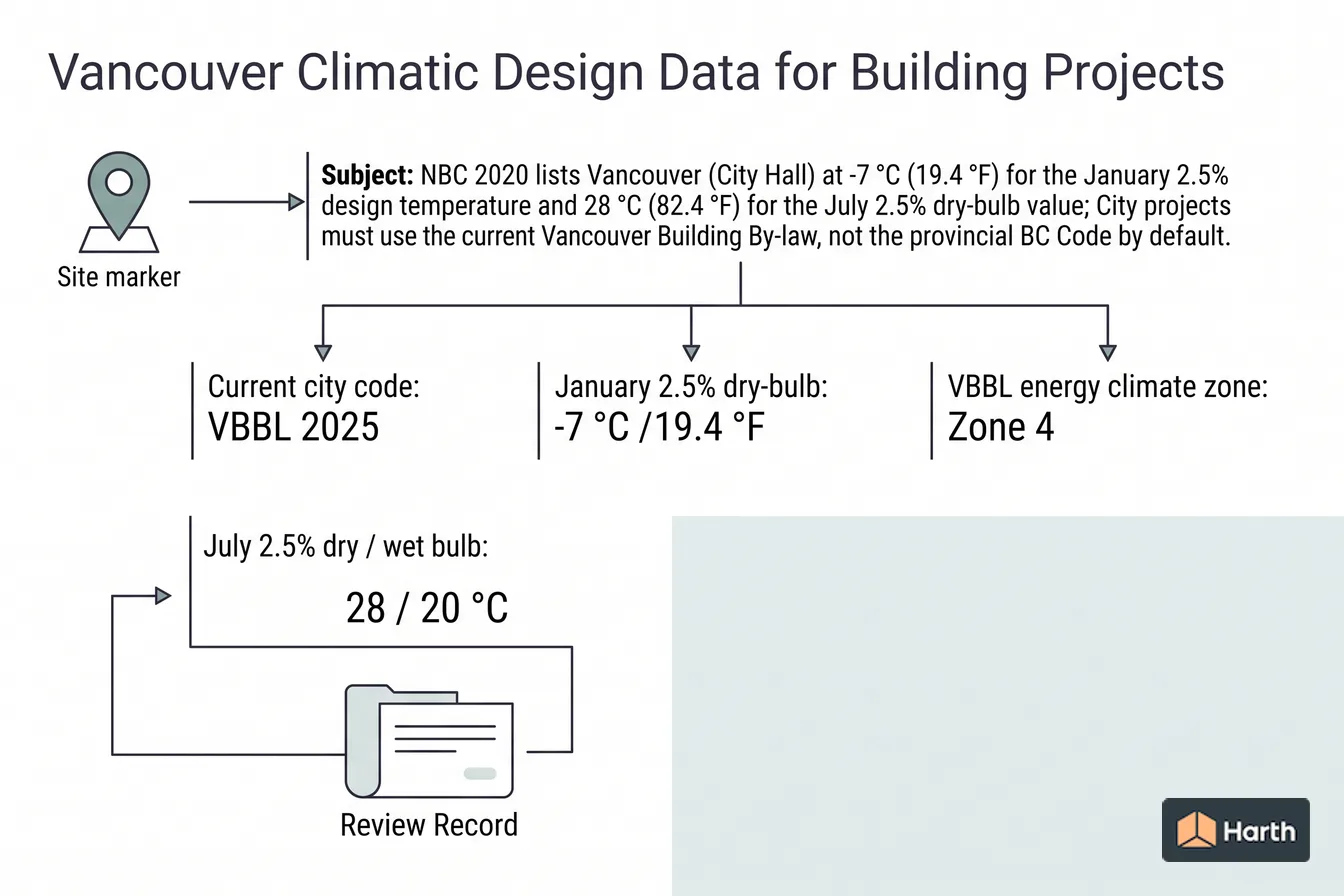
NBC 2020 lists Vancouver (City Hall) at -7 °C (19.4 °F) for the January 2.5% design temperature and 28 °C (82.4 °F) for the July 2.5% dry-bulb value; City projects must use the current Vancouver Building By-law, not the provincial BC Code by default.
On this page
Last updated August 26, 2026 · Selected Vancouver (City Hall) fields from National Building Code of Canada 2020, Appendix C, Table C-2, first printing, checked against the official NRC publication; City of Vancouver current VBBL energy requirements for 2025 edition applicability, ASHRAE 90.1-2019/NECB 2020 conditions and climate zone 4; Province of British Columbia for the boundary between BCBC and Vancouver. Sources: https://nrc-publications.canada.ca/eng/view/object/?id=515340b5-f4e0-4798-be69-692e4ec423e8 ; https://vancouver.ca/home-property-development/large-building-energy-requirements-forms-checklists.aspx ; https://vancouver.ca/home-property-development/energy-efficiency-requirements-and-resources-for-homes.aspx ; https://www2.gov.bc.ca/gov/content/industry/construction-industry/building-codes-standards/bc-codes/2024-bc-codes . Verify the current VBBL consolidation and AHJ direction; only selected temperature/HDD fields are excerpted, not the protected table as a whole.
Direct answer
For a City of Vancouver project, establish VBBL 2025 applicability first. The City's current energy guidance treats Vancouver as climate zone 4 for specified ASHRAE and NECB paths, while the climatic design row and hourly weather file remain separate inputs that must be verified for the exact site and purpose. January 2.5% dry-bulb is -7 °C / 19.4 °F; NBC 2020 Vancouver (City Hall) row. July 2.5% dry / wet bulb is 28 / 20 °C; 82.4 / 68 °F; Vancouver (City Hall) row. VBBL energy climate zone is Zone 4; City instruction for current ASHRAE/NECB compliance paths. The first question is whether the site is inside the City of Vancouver. The Province's BC Building Code 2024 page expressly says the BC Code does not apply in Vancouver because the City has its own building by-law. A Burnaby, Richmond, Surrey or North Vancouver project therefore should not inherit a Vancouver worksheet unchanged.
Content and cited inputs reviewed by Harth team · Published 2026-08-26 · Updated 2026-08-26.
Which climate inputs control the design?
The first question is whether the site is inside the City of Vancouver. The Province's BC Building Code 2024 page expressly says the BC Code does not apply in Vancouver because the City has its own building by-law. A Burnaby, Richmond, Surrey or North Vancouver project therefore should not inherit a Vancouver worksheet unchanged.
The City's current residential energy page states that VBBL 2025 took effect on 15 September 2025. Record the permit date, current consolidated by-law, amendments and project scope. Older projects may have a transition basis, while alterations and new construction can follow different sections.
Code design data and energy climate zone are different fields
The City's large-building energy guidance says that, effective 15 September 2025, specified pathways use ASHRAE 90.1-2019 or NECB 2020 and that Vancouver is to be considered climate zone 4. The page also sets pathway-specific conditions. That zone selects energy provisions; it does not supply every climatic load or the hourly weather sequence.
A small excerpt from the NBC 2020 Vancouver (City Hall) climatic row shows the distinction:
| Variable | SI | IP conversion | Design use to confirm |
|---|---|---|---|
| January dry-bulb, 2.5% | -7 °C | 19.4 °F | Adopted-code heating basis |
| January dry-bulb, 1% | -9 °C | 15.8 °F | Colder alternative basis |
| July dry-bulb, 2.5% | 28 °C | 82.4 °F | Summer sensible condition |
| July wet-bulb, 2.5% | 20 °C | 68 °F | Summer moisture condition |
| Degree-days below 18 °C / 65 °F | 2,825 °C-days | 5,085 °F-days | Energy classification input |
These figures come from the 40 m (131 ft) City Hall row. NBC 2020 also lists Vancouver at Granville Street and 41st Avenue at 120 m (394 ft), with a different winter and HDD profile. Select the row under the VBBL rather than silently averaging or choosing the more convenient condition.
Design consequences of a mild coastal baseline
Relative to Toronto and Calgary, Vancouver's code winter condition is mild, but that does not make the enclosure simple. The early brief should test rain control, drainage, drying potential, thermal bridges, glazing comfort, air leakage and mechanical moisture control together. Keep driving-rain and precipitation variables tied to their adopted code rows and facade exposure analysis; the Zone 4 label alone is not a rain design value.
The 28 °C (82.4 °F) July dry-bulb baseline also should not be read as a claim that passive measures always prevent overheating. Orientation, glazing area, external shade, internal gains, smoke events, acoustics and the future service-life climate all influence whether natural ventilation is viable and how cooling is sized. VBBL requirements and owner resilience targets may demand more than a historical typical-year model.
Three files or values to preserve separately
- Code climatic row: current VBBL source, location, variables and edition for minimum compliance.
- Hourly simulation file: exact file name, station/grid, release, provider and compliance or design purpose.
- Future scenario: adopted NBC 2025 value where legally applicable, or an explicitly supplemental Design Value Explorer/future-weather scenario with warming level and service life.
A future file cannot replace the required compliance file without approval, and a CWEC typical year cannot replace a code percentile or snow/wind value. Run both present and future cases where the brief requires long-term resilience, then state which case controls each design decision.
Close the location loop
Before issue, the architect and consultants should sign off the site address and elevation, VBBL edition, energy pathway, climatic row, hourly file and future scenario. If the project is outside the City, restart the jurisdiction and location lookup under the BC Code and local authority rather than carrying over Vancouver City Hall data.
Vancouver four-track climate sheet
| Track | Verified starting point | Project decision to complete |
|---|---|---|
| Legal code | VBBL 2025 took effect 15 September 2025 | Permit date, current consolidation, transition and applicable Part: — |
| Energy pathway | City guidance says treat Vancouver as climate zone 4 under its ASHRAE 90.1-2019 and NECB 2020 pathways | Selected pathway, VBBL conditions and modeller confirmation: — |
| Climatic row | NBC 2020 Vancouver (City Hall), elevation 40 m / 131 ft | Confirm the VBBL climatic table/row and site applicability: — |
| Simulation and future | Separate hourly file and future-service-life scenario | File release/station; warming level/horizon; reviewer: — |
Selected City Hall excerpt
| Input | SI | IP conversion |
|---|---|---|
| January dry-bulb, 2.5% | -7 °C | 19.4 °F |
| January dry-bulb, 1% | -9 °C | 15.8 °F |
| July dry-bulb, 2.5% | 28 °C | 82.4 °F |
| July wet-bulb, 2.5% | 20 °C | 68 °F |
| Degree-days below 18 °C / 65 °F | 2,825 °C-days | 5,085 °F-days |
Boundary check: the NBC table also contains a separate Vancouver row for Granville Street and 41st Avenue and rows for other Metro Vancouver locations. Do not treat the City Hall row or the City of Vancouver's energy-zone instruction as a regional default.
Where can you explore related guidance?
- Explore all climate data guidance
- Canadian Climatic Design Data and the National Building Code
- Toronto Climatic Design Data for Building Projects
- Calgary Climatic Design Data for Building Projects
- All climate & energy design data guidance for Canada
Sources and method
Selected Vancouver (City Hall) fields from National Building Code of Canada 2020, Appendix C, Table C-2, first printing, checked against the official NRC publication; City of Vancouver current VBBL energy requirements for 2025 edition applicability, ASHRAE 90.1-2019/NECB 2020 conditions and climate zone 4; Province of British Columbia for the boundary between BCBC and Vancouver. Sources: https://nrc-publications.canada.ca/eng/view/object/?id=515340b5-f4e0-4798-be69-692e4ec423e8 ; https://vancouver.ca/home-property-development/large-building-energy-requirements-forms-checklists.aspx ; https://vancouver.ca/home-property-development/energy-efficiency-requirements-and-resources-for-homes.aspx ; https://www2.gov.bc.ca/gov/content/industry/construction-industry/building-codes-standards/bc-codes/2024-bc-codes . Verify the current VBBL consolidation and AHJ direction; only selected temperature/HDD fields are excerpted, not the protected table as a whole.
Source links
Frequently asked questions
What winter design temperature is listed for Vancouver City Hall?
The NBC 2020 Vancouver (City Hall) row lists -7 °C (19.4 °F) at the January 2.5% basis and -9 °C (15.8 °F) at 1%. Confirm those values in the current Vancouver Building By-law framework and do not relabel them as ASHRAE annual design percentiles.
What energy climate zone does Vancouver use?
The City of Vancouver's current large-building guidance says Vancouver is to be considered climate zone 4 for its ASHRAE 90.1-2019 and NECB 2020 compliance paths. Apply all VBBL conditions for the chosen path; the zone does not replace Appendix C loads or a simulation weather file.
Does the BC Building Code 2024 apply inside the City of Vancouver?
The Province states that the BC Building Code does not apply in the City of Vancouver, which has its own building by-law. Confirm whether the project is inside city boundaries and use the current VBBL and City permit guidance. Metro Vancouver is not one building-code jurisdiction.
Can Vancouver City Hall climate data represent every Metro Vancouver site?
No. NBC 2020 lists multiple Vancouver-region locations and even a second City of Vancouver row at Granville Street and 41st Avenue. Elevation, distance from the water and local exposure can matter. Document the exact site and accepted row or station.
Related pages
- Climate Design Data: Umuahia, Nigeria
Umuahia, Nigeria climate design data (NASA POWER 2001–2020): annual mean 25.5 °C, monthly max 34.2 °C (February), min 12.7 °C (January), RH 86%; monthly table.
- Climate Design Data: Uyo, Nigeria
Uyo, Nigeria climate design data (NASA POWER 2001–2020): annual mean 25.9 °C, monthly max 33.7 °C (May), min 14.5 °C (January), RH 87%; monthly table.
- Climate Design Data: Vadodara, India
Vadodara, India climate design data (NASA POWER 2001–2020): annual mean 27.4 °C, monthly max 48.6 °C (May), min 5.7 °C (February), RH 52%; monthly table.
- Climate Design Data: Vancouver, Canada
Vancouver, Canada climate design data (NASA POWER 2001–2020): annual mean 10.6 °C, monthly max 31.9 °C (July), min -10.7 °C (January), RH 81%; monthly table.
- Climate Design Data: Varanasi, India
Varanasi, India climate design data (NASA POWER 2001–2020): annual mean 26.6 °C, monthly max 48.7 °C (June), min 2.2 °C (December), RH 52%; monthly table.
- Climate Design Data: Vereeniging, South Africa
Vereeniging, South Africa climate design data (NASA POWER 2001–2020): annual mean 17.0 °C, monthly max 39.4 °C (January), min -5.7 °C (June), RH 54%.