Climate & Energy Design Data
Canadian Climatic Design Data and the National Building Code
Canada's National Building Code is a model code, not automatically the law: first establish the edition adopted by the province, territory or municipality, then use its climatic table for code values and keep ECCC simulation files and future-climate scenarios on separate tracks.
On this page
Last updated August 26, 2026 · National Research Council Canada and the Canadian Board for Harmonized Construction Codes for NBC 2025 and NBC 2020; Environment and Climate Change Canada for engineering climate datasets; NRC for the Design Value Explorer. Official sources: https://nrc-publications.canada.ca/eng/view/object/?id=adf1ad94-7ea8-4b08-a19f-653ebb7f45f6 ; https://nrc-publications.canada.ca/eng/view/object/?id=515340b5-f4e0-4798-be69-692e4ec423e8 ; https://www.climate.weather.gc.ca/prods_servs/engineering_e.html ; https://nrc.canada.ca/en/stories/improving-access-historical-projected-climatic-design-variables . The AHJ-adopted code and amendments govern a project; this page does not reproduce code tables or replace professional interpretation.
Direct answer
Start with the authority having jurisdiction and permit date. Use the climatic values in the adopted code for compliance, ECCC CWEEDS/CWEC files for their documented simulation purposes, and NBC 2025 projected values only where adopted or explicitly accepted as a resilience basis. Current national model is NBC 2025; Published 22 December 2025; adoption is jurisdiction-specific. Future climate is 50-year trends; Projected climatic data introduced in NBC 2025. Simulation datasets is CWEEDS / CWEC; ECCC hourly source data and typical-year files; not code load tables. The National Building Code of Canada 2025 is the newest national model code. The NRC describes it as a technical model that becomes minimum law only after an authority adopts or adapts it. That distinction is essential in 2026: several major jurisdictions still enforce codes based on NBC 2020 even though NBC 2025 is available.
Content and cited inputs reviewed by Harth team · Published 2026-08-26 · Updated 2026-08-26.
What does this term mean?
Canadian Climatic Design Data and the National Building Code: Canada's National Building Code is a model code, not automatically the law: first establish the edition adopted by the province, territory or municipality, then use its climatic table for code values and keep ECCC simulation files and future-climate scenarios on separate tracks.
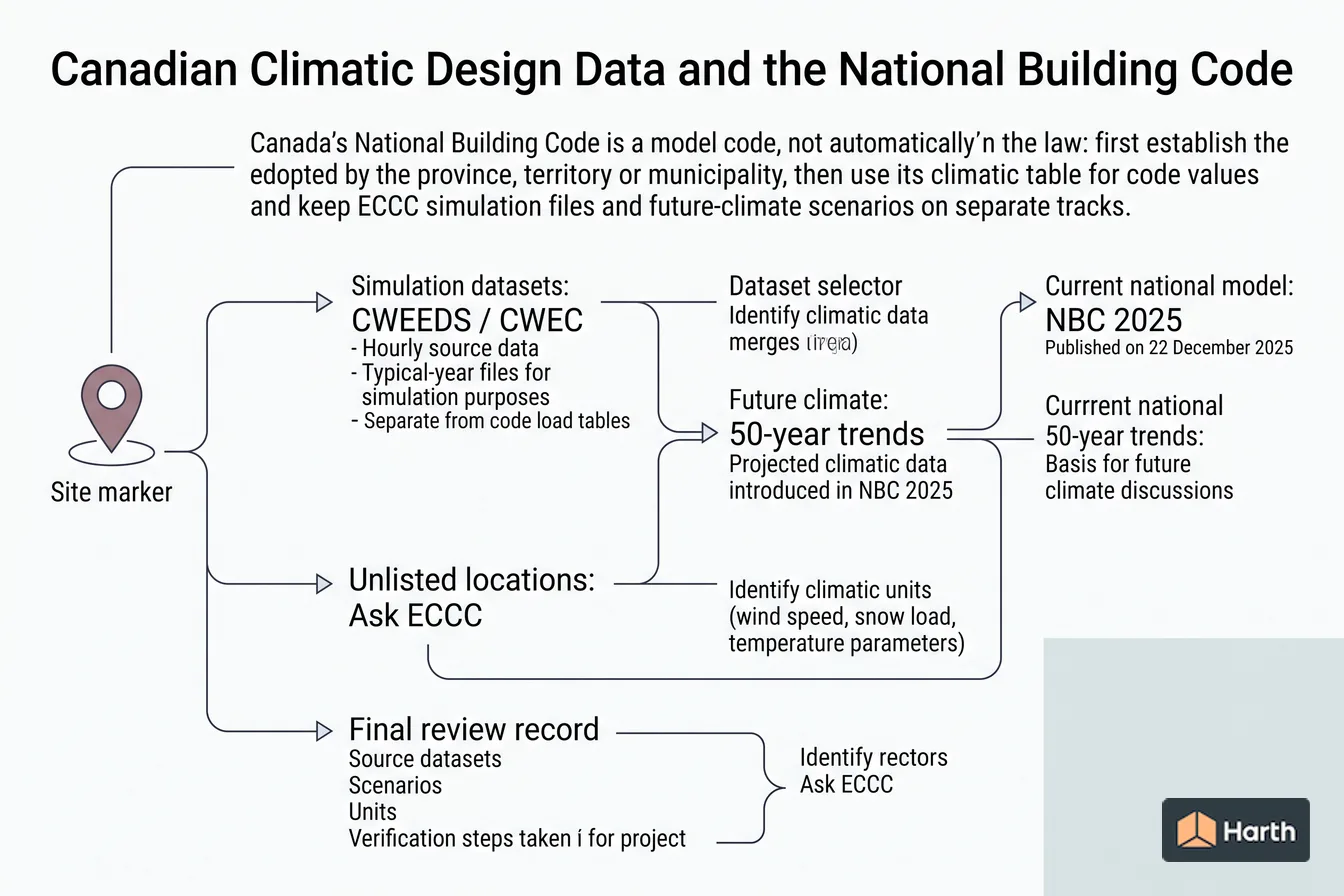
Which climate inputs control the design?
The National Building Code of Canada 2025 is the newest national model code. The NRC describes it as a technical model that becomes minimum law only after an authority adopts or adapts it. That distinction is essential in 2026: several major jurisdictions still enforce codes based on NBC 2020 even though NBC 2025 is available.
A climate note should therefore begin with the province or territory, municipality, permit milestone and governing code title—not simply "NBC." Record the printing and revision package too. A newer national publication may be valuable guidance, but it does not silently supersede the edition named in local regulation.
What the adopted climatic table does
Appendix C of NBC 2020 contains location rows for variables used by different code provisions. They include January and July design temperatures, heating degree-days below 18 °C (65 °F), rain and precipitation measures, moisture index, driving-rain pressure, snow loads and wind pressures. Each variable has its own statistical basis and application; the row is not a general weather summary.
NBC 2020 distinguishes the January 2.5% and 1% dry-bulb values. Its explanatory note says the 2.5% value is the least restrictive accepted for the relevant code application and that a designer may select the colder 1% value. July dry- and wet-bulb values use a 2.5% July basis. These are not the same percentiles as ASHRAE annual 99%, 99.6%, 1% or 0.4% design conditions. Always name the convention instead of writing only "winter design temperature."
Four climate sources that should not be merged
| Source | Proper use | Required label | Common misuse |
|---|---|---|---|
| AHJ-adopted NBC or provincial/municipal code | Compliance values and legal minimums | Code title, edition, printing, table, location | Assuming the newest national model is already adopted |
| Adopted NBC/NECB energy provisions | Energy climate zone and envelope/HVAC provisions | Edition, HDD value and zone method | Importing ASHRAE or IECC suffixes without checking the Canadian pathway |
| ECCC CWEEDS/CWEC | Hourly analysis and typical-year energy calculations | Dataset release, station, period and file | Treating a typical year as an extreme-design dataset |
| Projected design values | Service-life resilience and, under NBC 2025 adoption, specified future climate inputs | Code status, warming level/horizon and variable | Mixing future values into an adopted-era row without explanation |
ECCC says the July 2020 CWEEDS release covers 564 Canadian locations and extends observations through 2017; CWEC files are typical years built by selecting representative months. Those release details must travel with a model because they affect reproducibility. A newer weather file should not be substituted halfway through a compliance model without documenting the change.
NBC 2025 changes the future-climate conversation
The national board states that NBC 2025 introduces projected climatic data anticipating trends over the next 50 years. This moves future climate from a separate research topic into the national model-code framework. The legal question remains local: has the jurisdiction adopted those provisions, and for which permit date?
For scenario work outside an adopted NBC 2025 requirement, the NRC's Design Value Explorer guidance explains that the tool provides 19 historical and projected design variables for more than 600 locations, including downloadable maps and tables. Record the selected global-warming level or horizon, service life, variable confidence and decision rule. Do not label an advisory scenario as the current code minimum.
A defensible schematic workflow
- Confirm the AHJ, application date, building scope and adopted building and energy codes.
- Select the exact code location row or obtain ECCC/AHJ direction for an unlisted site.
- Record each climate variable with its code provision, statistical basis and SI/IP units.
- Select the energy-model weather file independently and preserve its version and station metadata.
- Ask the mechanical, structural and envelope consultants to confirm their design-condition sources.
- Run an explicit service-life future-climate check and state whether it is mandatory or supplemental.
- Review local flood, wildfire, rainfall, wind, snow and other hazards separately; an energy climate zone does not resolve them.
This workflow is intentionally source-first. It prevents a plausible-looking number from surviving into design after its location, edition or statistical meaning has been lost.
Canadian climate-input register
Copy this register into the basis-of-design report. A convenient value cannot move from one row to another unless the governing document expressly permits it.
| Project input | Project record | Controlling or preferred source | Evidence to retain | Stop condition |
|---|---|---|---|---|
| Authority and permit date | Province/territory, municipality, application date: — | Authority having jurisdiction (AHJ) | Written edition, amendment and transition confirmation | Applicable edition is unknown |
| Code climatic value | Location row, variable and units: — | Climatic table in the adopted building code; ECCC Engineering Climate Services for an unlisted municipality | Code title/printing, table and row, value, retrieval date | A value was copied from a different city or edition |
| Energy climate zone | Zone and heating degree-days: — | Adopted NBC/NECB energy provisions | Code edition, HDD source and zone lookup | Zone inferred from a U.S. map or city nickname |
| Whole-building simulation | File name, station and period: — | ECCC CWEEDS/CWEC or the file required by the compliance pathway | File version, station, period, format and modeller | A design percentile is being used as an hourly file |
| Peak HVAC condition | Heating/cooling variable and percentile: — | Source required by the adopted code, specification and mechanical engineer | Station/location, edition, percentile, coincident variable and units | A record extreme, climate normal or CWEC hour is being substituted |
| Future service-life check | Service life, warming level and selected value: — | Adopted NBC 2025 provisions where in force; otherwise an AHJ-approved resilience brief using the Design Value Explorer | Scenario or warming level, horizon, variable, confidence and reviewer | Future data are silently presented as current legal minimums |
| Site hazards | Wind, snow, rain, flood, wildfire, permafrost and other applicable hazards: — | Hazard-specific code provisions and local/provincial authorities | Site output, return period, load combination and edition | An energy climate zone is being used as a hazard proxy |
Release gate
Every numeric entry must identify the decision it supports, location, source title and edition, units, statistical basis or return period, retrieval date and responsible reviewer. Keep a field blank when its provenance is incomplete.
Where can you explore related guidance?
- Explore all climate data guidance
- Toronto Climatic Design Data for Building Projects
- Vancouver Climatic Design Data for Building Projects
- Calgary Climatic Design Data for Building Projects
- All climate & energy design data guidance for Canada
Sources and method
National Research Council Canada and the Canadian Board for Harmonized Construction Codes for NBC 2025 and NBC 2020; Environment and Climate Change Canada for engineering climate datasets; NRC for the Design Value Explorer. Official sources: https://nrc-publications.canada.ca/eng/view/object/?id=adf1ad94-7ea8-4b08-a19f-653ebb7f45f6 ; https://nrc-publications.canada.ca/eng/view/object/?id=515340b5-f4e0-4798-be69-692e4ec423e8 ; https://www.climate.weather.gc.ca/prods_servs/engineering_e.html ; https://nrc.canada.ca/en/stories/improving-access-historical-projected-climatic-design-variables . The AHJ-adopted code and amendments govern a project; this page does not reproduce code tables or replace professional interpretation.
Source links
Frequently asked questions
Is the National Building Code of Canada automatically law everywhere in Canada?
No. The NBC is a national model. It becomes enforceable only when a province, territory or other authorized jurisdiction adopts or adapts it. Confirm the locally applicable edition, amendments, effective dates and transition rules with the AHJ before selecting climatic values.
What changed about climate data in NBC 2025?
The Canadian Board for Harmonized Construction Codes says NBC 2025 includes projected climatic data that anticipate climate trends over the next 50 years. That does not make NBC 2025 the governing code in a jurisdiction that still enforces a 2020-based edition; record whether future values are a legal requirement, an accepted alternative or a supplemental resilience study.
Are CWEC weather files the same as NBC climatic design values?
No. ECCC describes CWEC as a typical year assembled from twelve representative months selected from multi-year CWEEDS hourly data. NBC climatic tables provide specified design variables and statistical criteria for code applications. A typical-year simulation file cannot replace a code snow, wind, rain or design-temperature value.
What should be done when a municipality is not listed in the code climatic table?
Do not borrow the nearest city's row without review. NBC 2020 notes direct users to Environment and Climate Change Canada's Engineering Climate Services for municipalities not listed in Appendix C. Record the requested location, returned values, source date and the AHJ's acceptance.
Related pages
- ASHRAE / IECC Climate Zones Explained (Zones 1–8, A/B/C)
ASHRAE 169 / IECC climate zones 0–8 with HDD and CDD limits, A/B/C moisture rules, county lookup, 2021 map changes and example cities for 1A, 4A and 4C.
- Climate & Energy Design Data: Australia
Australia climate & energy design data for architects: 27 city pages covering climate design data, each with a reproducible location record and source path.
- Climate & Energy Design Data: Canada
Canada climate & energy design data for architects: 26 city pages covering climate design data, each with a reproducible location record and source path.
- Climate Design Data: Aba, Nigeria
Aba, Nigeria climate design data (NASA POWER 2001–2020): annual mean 25.7 °C, monthly max 34.5 °C (February), min 13.5 °C (January), RH 87%; monthly table.
- Climate Design Data: Abeokuta, Nigeria
Abeokuta, Nigeria climate design data (NASA POWER 2001–2020): annual mean 25.7 °C, monthly max 35.5 °C (February), min 11.1 °C (January), RH 86%; monthly table.
- Climate Design Data: Aberdeen, UK
Aberdeen, UK climate design data (NASA POWER 2001–2020): annual mean 9.4 °C, monthly max 22.1 °C (July), min -1.1 °C (March), RH 85%; monthly table.