Climate & Energy Design Data
UK Building Climate and Weather Data Explained
For UK building work, use Met Office observations to understand local climate, a CIBSE TRY for annual energy assessment, a CIBSE DSY for overheating analysis, and the nation-specific building-regulations documents that apply on the project's submission date.
On this page
Last updated August 26, 2026 · Checked 26 August 2026 against the [Met Office UK climate maps and data service](https://www.metoffice.gov.uk/research/climate/maps-and-data), [HadUK-Grid documentation](https://www.metoffice.gov.uk/research/climate/maps-and-data/data/haduk-grid/haduk-grid), [CIBSE Weather Data service](https://www.cibse.org/weatherdata) and its [2025 technical briefing](https://www.cibse.org/media/t4efqq4r/technical-briefing-cibse-weather-data-2025-v11.pdf). Regulatory scope and edition notes come from official [England](https://www.gov.uk/government/publications/conservation-of-fuel-and-power-approved-document-l), [Scotland](https://www.gov.scot/collections/building-standards/), [Wales](https://www.gov.wales/building-regulations-approved-documents) and [Northern Ireland](https://www.finance-ni.gov.uk/articles/building-regulations-technical-booklets) publication pages. CIBSE file contents and tabulated design criteria are licensed and are not reproduced here.
Direct answer
There is no single UK building-climate lookup. Start with public Met Office observations for context, use CIBSE's 2025 selector to choose the licensed TRY or DSY zone for simulation, and then check the current rules for England, Scotland, Wales or Northern Ireland. Record the source, station or zone, release, observation period, scenario, units and regulatory transition date with every design input. Public observed baseline is Met Office 1991–2020 normals; context, not HVAC sizing. Annual simulation is CIBSE TRY; typical reference year. Overheating simulation is CIBSE DSY1 / DSY2 / DSY3; different hot-event characteristics. The Met Office's location pages and HadUK-Grid are valuable public datasets. HadUK-Grid interpolates station observations to a 1 km grid and covers variables including temperature, precipitation, sunshine, wind, humidity and frost at available time steps. Those products describe climate; they do not automatically provide a compliant simulation file or plant-sizing condition.
Content and cited inputs reviewed by Harth team · Published 2026-08-26 · Updated 2026-08-26.
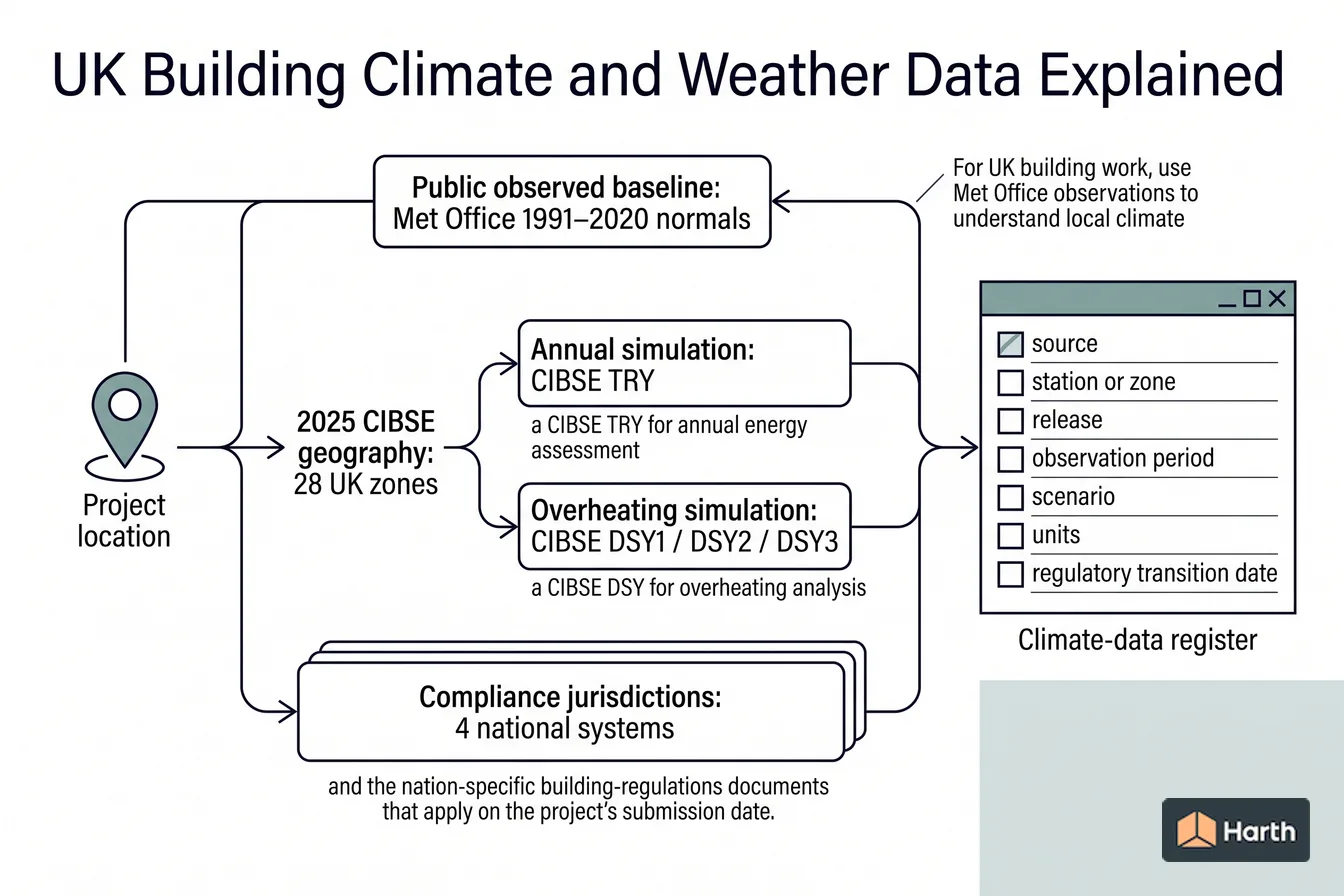
Which climate inputs control the design?
| Design question | Appropriate starting source | Record with the value | Do not substitute |
|---|---|---|---|
| What has the local climate usually been like? | Met Office station normals or HadUK-Grid | station/grid cell, variable, 1991–2020 period, units | a forecast or record extreme |
| What weather should an annual energy model use? | CIBSE 2025 TRY selected for the site | zone, file name, release/version, scenario and percentile | twelve monthly averages |
| How should overheating be stress-tested? | CIBSE 2025 DSY1, DSY2 and DSY3 as the assessment requires | zone, hot-event type, period, emissions scenario and probability percentile | a TRY or one recent summer without justification |
| What outdoor design criterion sizes plant? | the criterion and source agreed by the building-services engineer | source edition, location, criterion/percentile and units | a Met Office monthly mean |
| What establishes compliance? | current guidance for the UK nation and project type | jurisdiction, edition, submission date and transition route | guidance from another UK nation |
The Met Office's location pages and HadUK-Grid are valuable public datasets. HadUK-Grid interpolates station observations to a 1 km grid and covers variables including temperature, precipitation, sunshine, wind, humidity and frost at available time steps. Those products describe climate; they do not automatically provide a compliant simulation file or plant-sizing condition.
Choosing CIBSE weather data
CIBSE's 2025 release represents the UK with 28 climate zones. The official technical briefing directs users to a selection tool where a postcode or longitude and latitude identifies the appropriate zone. The release provides EPW files and distinguishes two jobs:
- TRY: annual energy assessment using a typical reference year.
- DSY1: a moderate hot event described by CIBSE as having a one-in-seven-year likelihood.
- DSY2: the most intense hot event in the source record.
- DSY3: the longest-duration hot event in the source record.
The 2025 baseline files were constructed from Met Office data recorded from 1994 to 2023. Future TRY and DSY files are available for stated time periods, emissions scenarios and probability percentiles. Keep the full file name in the model record: it encodes the zone, file type, future period, scenario, probability percentile, provider and version.
Jurisdiction and edition check
| Project location | Official compliance family at 26 August 2026 | Edition caveat to record |
|---|---|---|
| England | Approved Documents L and O | 2021 AD L incorporating 2023 amendments remains relevant before the 2026 edition takes effect; AD L 2026 takes effect on 24 March 2027 for non-higher-risk work and 24 September 2027 for higher-risk work, subject to transitions. Part O covers overheating in new residential buildings. |
| Scotland | Building Standards Technical Handbooks | April 2026 domestic and non-domestic handbooks apply to warrants submitted, or non-warrant work begun, on or after 6 April 2026. Use the handbook tied to the warrant date. |
| Wales | Welsh Approved Documents | 2022 AD L remains the current route in August 2026; the published 2026 AD L takes effect on 4 March 2027, subject to transitional provisions. Welsh documents are not the English documents. |
| Northern Ireland | Building Regulations Technical Booklets | The official collection lists F1 and F2 dated June 2022; check the current collection and amendment booklets when plans are deposited or notice is given. |
An edition label alone is insufficient. Record whether the work is domestic or non-domestic, the application or warrant date, commencement status and any higher-risk-building route.
A reproducible selection workflow
- Fix the project address, UK nation, building use, application route and target dates.
- Use Met Office station normals or HadUK-Grid to understand the observed baseline; document why the station or grid cell represents the site.
- Use CIBSE's selector with the project postcode or coordinates and save the selected 2025 zone.
- Assign a TRY to annual performance work and the required DSY set to overheating work; do not use either as an undocumented proxy for plant sizing.
- Agree any present-day and future scenarios with the client and design team, then lock full file names and checksums in the model issue record.
- Confirm the national regulatory edition and transitional provision immediately before the compliance submission.
What this guide deliberately does not publish
This page does not reproduce CIBSE Guide A design tables, licensed TRY/DSY hourly data or a city-to-zone table. It also does not turn climate normals into invented heating or cooling design temperatures. Those boundaries make the public figures auditable while keeping licensed and criterion-specific inputs in their proper project records.
Project climate-data register
Copy this register into the model QA record before design inputs are frozen. A blank is a visible unresolved decision, not permission to use a default.
| Input role | Project record | Acceptance check |
|---|---|---|
| Site | postcode, coordinates, elevation and exposure notes | matches the planning/building-control site |
| Observed context | Met Office station or HadUK-Grid cell, variable, period and retrieval date | source and representativeness reviewed |
| Annual model | full CIBSE TRY file name, zone, release and checksum | zone selected from site location |
| Overheating | DSY1/2/3 file names and reason each is included or excluded | assessment method and building scope agree |
| Future climate | future period, RCP/emissions scenario and probability percentile | client/design-life brief agrees |
| Plant sizing | source, edition, location, criterion/percentile and units | building-services engineer approves |
| Compliance | UK nation, document, edition, building type and transition date | building-control route confirmed |
| QA | modeller, checker, software/version and issue date | independently checked before issue |
Where can you explore related guidance?
- Explore all climate data guidance
- Climate Design Data for London, UK
- Climate Design Data for Manchester, UK
- Climate Design Data for Edinburgh, UK
- All climate & energy design data guidance for United Kingdom
Sources and method
Checked 26 August 2026 against the Met Office UK climate maps and data service, HadUK-Grid documentation, CIBSE Weather Data service and its 2025 technical briefing. Regulatory scope and edition notes come from official England, Scotland, Wales and Northern Ireland publication pages. CIBSE file contents and tabulated design criteria are licensed and are not reproduced here.
Source links
Frequently asked questions
Is a Met Office monthly climate average an HVAC design temperature?
No. A monthly normal averages observed conditions over a stated 30-year period. Plant sizing uses defined design criteria and an agreed calculation method. Record the source and percentile or criterion used; do not substitute a January mean minimum or a weather-app extreme for a design temperature.
What is the difference between a CIBSE TRY and DSY?
A Test Reference Year is assembled to represent typical long-term conditions and is used for annual energy assessment. A Design Summer Year represents hot-event conditions for overheating analysis. The 2025 release provides DSY1, DSY2 and DSY3 to test moderate, intense and long-duration heat events respectively, so one file should not silently stand in for all three risks.
Does the same energy guidance apply across the United Kingdom?
No. England and Wales publish separate Approved Documents, Scotland uses its Building Standards Technical Handbooks, and Northern Ireland uses Technical Booklets. The applicable edition also depends on submission, commencement, building type and transitional provisions.
Can a CIBSE city name be assigned to every project in that city?
Do not assume that from the city name alone. CIBSE's 2025 release uses 28 zones and provides a selection tool that accepts a postcode or coordinates. Save the selector result with the project record and document any judgement where terrain, coast, altitude or an urban site makes representativeness uncertain.
Related pages
- Climate & Energy Design Data: New Zealand
New Zealand climate & energy design data for architects: 24 city pages covering climate design data, each with a reproducible location record and source path.
- Climate & Energy Design Data: Nigeria
Nigeria climate & energy design data for architects: 41 city pages covering climate design data, each with a reproducible location record and source path.
- Climate & Energy Design Data: Philippines
Philippines climate & energy design data for architects: 16 city pages covering climate design data, each with a reproducible location record and source path.
- Climate & Energy Design Data: South Africa
South Africa climate & energy design data for architects: 27 city pages covering climate design data, each with a reproducible location record and source path.
- Climate & Energy Design Data: United Arab Emirates
United Arab Emirates climate & energy design data for architects: 9 city pages with reproducible location records and source paths.
- Climate & Energy Design Data: United Kingdom
United Kingdom climate & energy design data for architects: 38 city pages with reproducible location records and source paths.