Climate & Energy Design Data
Climate Design Data for London, UK
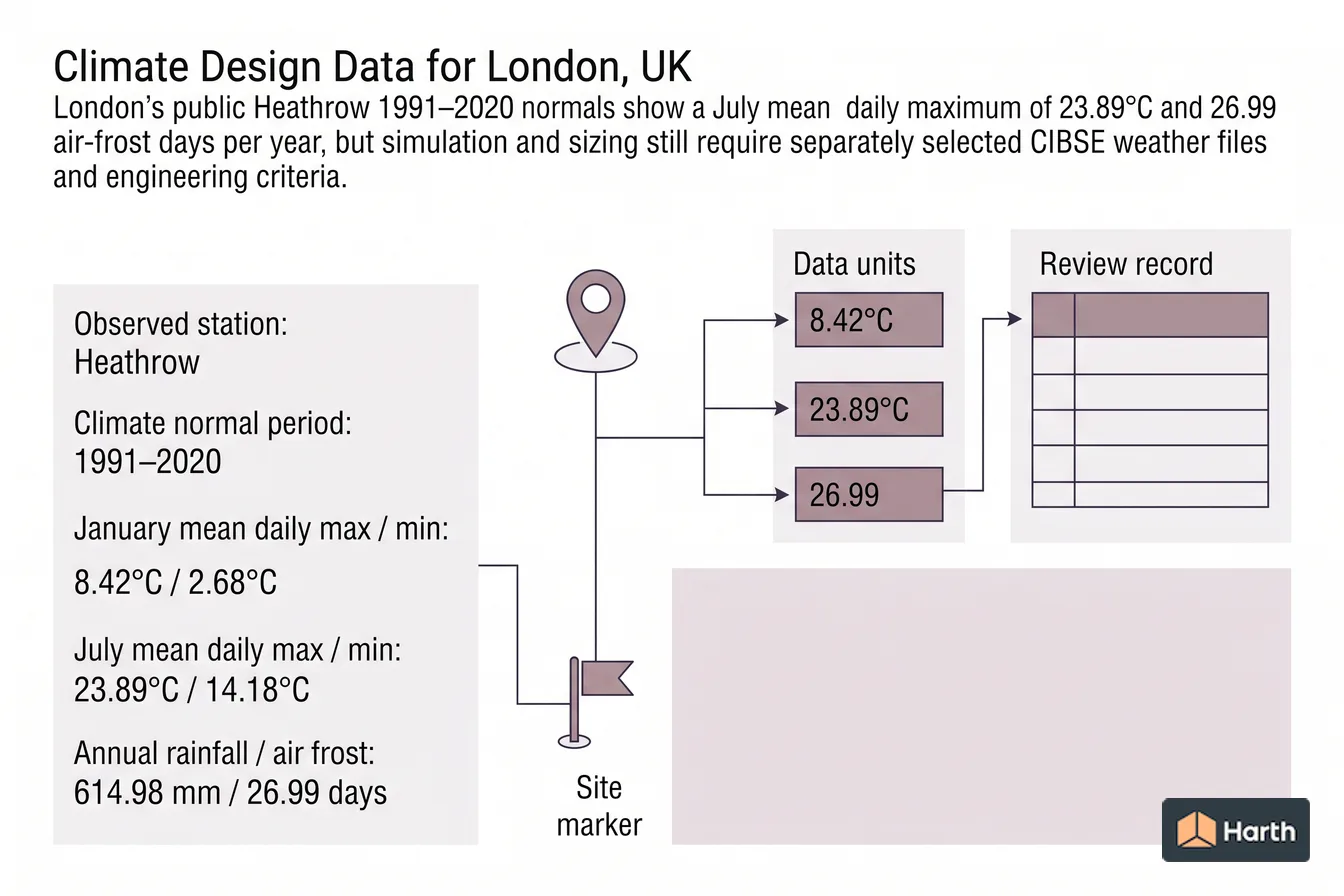
London's public Heathrow 1991–2020 normals show a July mean daily maximum of 23.89°C and 26.99 air-frost days per year, but simulation and sizing still require separately selected CIBSE weather files and engineering criteria.
On this page
Last updated August 26, 2026 · Observed figures are from the official [Met Office Heathrow location-specific long-term averages](https://www.metoffice.gov.uk/research/climate/maps-and-data/location-specific-long-term-averages/gcpsvg3nc), station Heathrow, climate period 1991–2020, retrieved 26 August 2026. The Met Office describes these pages as samples for general interest rather than formal climate monitoring. Weather-file roles and the 1994–2023 baseline observation period are from [CIBSE Weather Data](https://www.cibse.org/weatherdata) and the [2025 technical briefing](https://www.cibse.org/media/t4efqq4r/technical-briefing-cibse-weather-data-2025-v11.pdf); select the actual project zone by postcode or coordinates and obtain licensed files from CIBSE. English compliance references are the official [Approved Document L collection](https://www.gov.uk/government/publications/conservation-of-fuel-and-power-approved-document-l), [Approved Document L 2026 notice](https://www.gov.uk/government/publications/approved-document-l-2026) and [Approved Document O](https://www.gov.uk/government/publications/overheating-approved-document-o). No CIBSE tabulated values are reproduced.
Direct answer
Use Heathrow's Met Office 1991–2020 normals as a transparent London-area baseline, not as HVAC design temperatures. For modelling, select the project's CIBSE 2025 zone by postcode or coordinates, use a TRY for annual assessment and the required DSY1/2/3 files for overheating, then apply the English Approved Documents and transition rules relevant to the submission date. Observed station is Heathrow; London-area baseline; verify site representativeness. Climate normal period is 1991–2020; Met Office public averages. January mean daily max / min is 8.42°C / 2.68°C; not heating design temperatures. These are observed long-term averages for the named station. Heathrow is a defensible public London-area reference, but an airport site in west London is not automatically representative of a dense central street, an exposed riverside plot or every edge-of-city site. Record the project's distance, elevation, urban form and exposure before accepting it as context.
Content and cited inputs reviewed by Harth team · Published 2026-08-26 · Updated 2026-08-26.
Which climate inputs control the design?
| Heathrow normal, 1991–2020 | January | July | Annual |
|---|---|---|---|
| Mean daily maximum temperature | 8.42°C | 23.89°C | 15.67°C |
| Mean daily minimum temperature | 2.68°C | 14.18°C | 7.83°C |
| Rainfall | 58.83 mm | 45.80 mm | 614.98 mm |
| Days of air frost | 6.80 | 0.00 | 26.99 |
| Sunshine | 61.09 h | 217.81 h | 1,674.81 h |
These are observed long-term averages for the named station. Heathrow is a defensible public London-area reference, but an airport site in west London is not automatically representative of a dense central street, an exposed riverside plot or every edge-of-city site. Record the project's distance, elevation, urban form and exposure before accepting it as context.
Translate the observations into design questions
The normals indicate a milder winter and warmer summer baseline than the Manchester and Edinburgh references in this tranche. They do not quantify a London heatwave or urban heat-island penalty. For design, split the work:
- use the public normals to communicate seasonal context and to challenge obviously mismatched inputs;
- use CIBSE's location selector and a TRY for annual operational-energy simulation;
- use the applicable DSY1, DSY2 and DSY3 files to test the relevant forms of heat event;
- model internal gains, solar exposure, window operation, security, noise and air quality rather than assuming night ventilation is available;
- obtain a named, edition-controlled design criterion from the building-services engineer for heating and cooling plant sizing.
London overheating and façade decisions
A July mean daily maximum of 23.89°C must not be treated as a worst case. CIBSE's DSY method exists because hot-event intensity and duration affect buildings differently. At concept stage, test orientation, glazing area, g-value, external shading, exposed thermal mass and purge-ventilation feasibility before relying on active cooling. Preserve a usable strategy: an opening area that is blocked by noise, pollution, security or guarding constraints is not equivalent to dependable heat rejection.
For new residential work in England, Approved Document O provides a simplified and a dynamic thermal route within its scope. The weather-file and modelling assumptions must match the selected route. Planning policy, local guidance and the project brief can add requirements, so Part O is a floor for the applicable work rather than a universal statement of good performance.
English edition checkpoint
At this page's review date, the 2021 Approved Document L incorporating 2023 amendments remains relevant for current work. The published 2026 Approved Document L has later effective dates in 2027, with a separate date for higher-risk work and transitional rules. Before fixing fabric, systems and reporting assumptions, record:
| Compliance field | London project entry |
|---|---|
| Building type and work | dwelling / other; new / existing |
| Building-control route | local authority / registered building control approver / Building Safety Regulator as applicable |
| Application and commencement dates | exact dates |
| Approved Document L edition | edition justified by transition |
| Part O scope and method | in/out of scope; simplified/dynamic |
| CIBSE files | full TRY/DSY file names and versions |
Limits
The table is useful for orientation and QA, not a compliance dataset. It contains no CIBSE hourly weather, Guide A design values, degree-days or invented percentile temperatures. A project team must license or otherwise lawfully access the required CIBSE material and document the selected site, zone, release and criterion.
London design-climate handoff sheet
| Decision | Evidence to attach | London-specific challenge | Owner / status |
|---|---|---|---|
| Observed baseline | Heathrow 1991–2020 source URL and retrieval date | Is west-London airport exposure representative? | |
| CIBSE zone | postcode/coordinate selector result | Does the precise site fall in the assumed 2025 zone? | |
| Annual weather | full TRY file name and checksum | Is the release consistent across models? | |
| Heat stress | DSY1/2/3 files and inclusion rationale | Are intense and long events both tested? | |
| Urban context | site note on shade, canyon geometry, night-time temperatures | Has urban heat been addressed without inventing a station correction? | |
| Ventilation usability | noise, pollution, security, guarding and occupant-control review | Can openings actually be used during hot weather? | |
| Regulation | AD L edition/transition and Part O scope/method | Are 2026 publication and 2027 effective dates distinguished? | |
| Plant sizing | named source, criterion, units and engineer approval | Is it separate from the monthly normals? |
Where can you explore related guidance?
- Explore all climate data guidance
- UK Building Climate and Weather Data Explained
- Climate Design Data for Manchester, UK
- Climate Design Data for Edinburgh, UK
- All climate & energy design data guidance for United Kingdom
Sources and method
Observed figures are from the official Met Office Heathrow location-specific long-term averages, station Heathrow, climate period 1991–2020, retrieved 26 August 2026. The Met Office describes these pages as samples for general interest rather than formal climate monitoring. Weather-file roles and the 1994–2023 baseline observation period are from CIBSE Weather Data and the 2025 technical briefing; select the actual project zone by postcode or coordinates and obtain licensed files from CIBSE. English compliance references are the official Approved Document L collection, Approved Document L 2026 notice and Approved Document O. No CIBSE tabulated values are reproduced.
Source links
Frequently asked questions
Which CIBSE weather file should a London project use?
Enter the project postcode or coordinates in CIBSE's current weather-data selector and retain the resulting zone record. Use the corresponding 2025 TRY for annual assessment and the DSY set required by the overheating method. Do not infer the zone solely from the word London, because the site and release matter.
Can 23.89°C be used as London's summer design temperature?
No. It is Heathrow's 1991–2020 July mean daily maximum. An overheating weather year, a plant-sizing criterion and a monthly normal answer different questions. Use the chosen CIBSE DSY for dynamic overheating assessment and a separately documented engineering design condition for sizing.
Does Approved Document O apply to every London building?
No. The official guidance applies to new residential buildings in England, including the residential categories in its scope. Confirm the building use and work type. Other overheating obligations, planning requirements, client standards and professional duties may still matter outside that scope.
Is the 2026 edition of Approved Document L already the normal compliance route in London?
Not in August 2026. The 2026 edition is published but takes effect on 24 March 2027 for work not connected with higher-risk building work and 24 September 2027 for higher-risk work, subject to transitional provisions. Record the project's route rather than choosing by publication year alone.
Related pages
- Climate Design Data: Lodwar, Kenya
Lodwar, Kenya climate design data (NASA POWER 2001–2020): annual mean 29.4 °C, monthly max 40.9 °C (April), min 17.2 °C (January), RH 46%; monthly table.
- Climate Design Data: London, Canada
London, Canada climate design data (NASA POWER 2001–2020): annual mean 8.8 °C, monthly max 36.8 °C (August), min -26.1 °C (February), RH 77%; monthly table.
- Climate Design Data: London, UK
London, UK climate design data (NASA POWER 2001–2020): annual mean 10.4 °C, monthly max 34.0 °C (July), min -8.2 °C (January), RH 85%; monthly table.
- Climate Design Data: Lucknow, India
Lucknow, India climate design data (NASA POWER 2001–2020): annual mean 26.0 °C, monthly max 49.4 °C (June), min 1.0 °C (December), RH 51%; monthly table.
- Climate Design Data: Ludhiana, India
Ludhiana, India climate design data (NASA POWER 2001–2020): annual mean 25.3 °C, monthly max 50.0 °C (June), min -1.0 °C (January), RH 43%; monthly table.
- Climate Design Data: Luton, UK
Luton, UK climate design data (NASA POWER 2001–2020): annual mean 10.0 °C, monthly max 34.2 °C (July), min -8.2 °C (February), RH 85%; monthly table.