Climate & Energy Design Data
Climate Design Data for Manchester, UK
Woodford's public 1991–2020 normals provide a transparent Greater Manchester reference—20.66°C July mean daily maximum, 868.40 mm annual rainfall and 39.95 air-frost days—but they are context, not CIBSE simulation or sizing data.
On this page
Last updated August 26, 2026 · Observed figures are from the official [Met Office Woodford location-specific long-term averages](https://www.metoffice.gov.uk/research/climate/maps-and-data/location-specific-long-term-averages/gcqrqyr80), station Woodford in Greater Manchester, climate period 1991–2020, retrieved 26 August 2026. Woodford is presented as a regional proxy, not a universal Manchester station; the Met Office describes its location pages as samples for general interest rather than formal climate monitoring. Weather-file roles and the 1994–2023 baseline observation period are from [CIBSE Weather Data](https://www.cibse.org/weatherdata) and the [2025 technical briefing](https://www.cibse.org/media/t4efqq4r/technical-briefing-cibse-weather-data-2025-v11.pdf); select the project zone by postcode or coordinates and obtain licensed files from CIBSE. English compliance references are official [Approved Document L](https://www.gov.uk/government/publications/conservation-of-fuel-and-power-approved-document-l), [Approved Document L 2026](https://www.gov.uk/government/publications/approved-document-l-2026) and [Approved Document O](https://www.gov.uk/government/publications/overheating-approved-document-o) pages. No CIBSE tabulated values are reproduced.
Direct answer
Use the Met Office Woodford 1991–2020 normals as an explicitly labelled Greater Manchester proxy, then test whether the station represents the actual site. Select the CIBSE 2025 weather zone by project postcode or coordinates, use a TRY for annual assessment and the required DSYs for overheating, and confirm the English Approved Document edition and transition route. Observed proxy station is Woodford; Greater Manchester; test site representativeness. Climate normal period is 1991–2020; Met Office public averages. January mean daily max / min is 7.11°C / 1.07°C; not heating design temperatures. Woodford provides an official, reproducible Greater Manchester reference. Its value lies partly in making the proxy visible. A city-centre site can differ through urban form and waste heat; the Pennine fringe can differ through elevation and exposure; and local shelter changes wind and driving-rain conditions. Do not hide those differences behind a city label.
Content and cited inputs reviewed by Harth team · Published 2026-08-26 · Updated 2026-08-26.
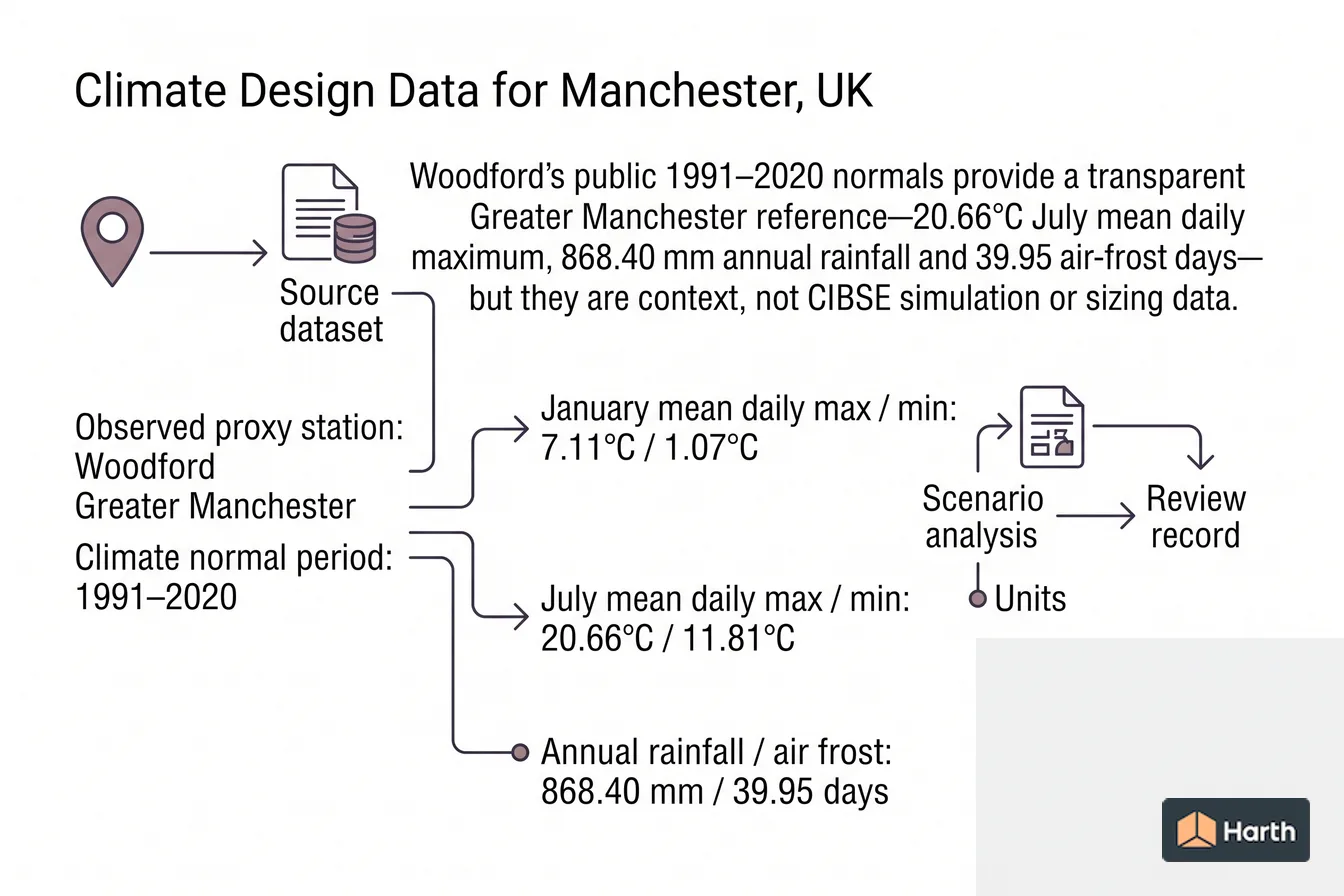
Which climate inputs control the design?
| Woodford normal, 1991–2020 | January | July | Annual |
|---|---|---|---|
| Mean daily maximum temperature | 7.11°C | 20.66°C | 13.62°C |
| Mean daily minimum temperature | 1.07°C | 11.81°C | 5.85°C |
| Rainfall | 77.00 mm | 80.19 mm | 868.40 mm |
| Days of air frost | 8.82 | 0.00 | 39.95 |
| Sunshine | 45.09 h | 157.07 h | 1,385.10 h |
Woodford provides an official, reproducible Greater Manchester reference. Its value lies partly in making the proxy visible. A city-centre site can differ through urban form and waste heat; the Pennine fringe can differ through elevation and exposure; and local shelter changes wind and driving-rain conditions. Do not hide those differences behind a city label.
What the baseline suggests—and what it cannot decide
Relative to the London reference in this tranche, Woodford's normals are cooler, wetter and less sunny. That is useful when setting early questions about fabric heat loss, rain exposure, daylight/solar availability and outdoor-space use. It is not a licence to derive plant capacity, façade pressure or drainage intensity from monthly data.
| Early design question | Evidence after concept stage |
|---|---|
| How should seasonal heat loss and solar gain be represented? | selected CIBSE TRY plus documented envelope and internal-gain assumptions |
| Can summer comfort be maintained during different hot events? | applicable CIBSE DSY1, DSY2 and DSY3 simulations |
| Is natural ventilation dependable? | site noise, pollution, security, wind and opening-control evidence |
| What rain exposure should the envelope resist? | project-specific exposure assessment and applicable standard, not annual rainfall alone |
| What sizes heating or cooling plant? | engineer-approved design criterion with source edition and units |
Select, do not guess, the CIBSE zone
CIBSE's 2025 weather geography contains 28 zones. Enter the project postcode or coordinates in the official selection tool and archive the result. Then use the full TRY or DSY file name rather than a shorthand such as “Manchester weather”. The identifier carries the zone, file role, time period, emissions scenario, probability percentile and version needed for reproducibility.
For a long-life building, agree whether present-day files alone are sufficient. Future files are scenario-dependent rather than forecasts of a single outcome. The brief should state the design life and resilience question first; only then should the team choose future periods and probability percentiles.
English compliance and overheating
Manchester is in England, so Scottish, Welsh and Northern Irish energy guidance does not apply. At the review date, distinguish the current English Approved Document L route from the published 2026 edition with 2027 effective dates. For new residential buildings within scope, Approved Document O provides routes for overheating mitigation.
Keep the compliance model and wider design-risk model legible. A calculation that satisfies a regulatory method may not answer a client's future-climate or operational-resilience question. Conversely, a resilience scenario does not replace the required regulatory run. Label both.
Limits
The figures above are Met Office normals, not CIBSE design data. They do not include degree-days, design dry-bulb or wet-bulb values, wind pressures, rain intensities or licensed hourly weather. Obtain and record the authoritative input for each task.
Manchester proxy-station suitability scorecard
Score each factor close, materially different or unknown and resolve every unknown that could change the model decision.
| Factor | Woodford reference | Project comparison | Consequence / action |
|---|---|---|---|
| Position | Greater Manchester suburban/airfield context | retain or reject as observed-context proxy | |
| Elevation and terrain | record from authoritative station/site metadata | assess lapse/exposure difference without inventing a correction | |
| Urban form | less dense than central Manchester | address shade, thermal storage and night-time heat separately | |
| Wind exposure | station normal available, but not façade pressure | commission/select task-specific wind evidence | |
| Rain context | 868.40 mm annual normal | obtain exposure/design-rain input for envelope or drainage | |
| Simulation zone | not assigned by this normals table | save CIBSE postcode/coordinate selector result | |
| Regulation | England | record AD L edition/transition and Part O scope | |
| Approval | proxy reviewer, discipline and date | sign before it appears in a report |
Where can you explore related guidance?
- Explore all climate data guidance
- UK Building Climate and Weather Data Explained
- Climate Design Data for London, UK
- Climate Design Data for Edinburgh, UK
- All climate & energy design data guidance for United Kingdom
Sources and method
Observed figures are from the official Met Office Woodford location-specific long-term averages, station Woodford in Greater Manchester, climate period 1991–2020, retrieved 26 August 2026. Woodford is presented as a regional proxy, not a universal Manchester station; the Met Office describes its location pages as samples for general interest rather than formal climate monitoring. Weather-file roles and the 1994–2023 baseline observation period are from CIBSE Weather Data and the 2025 technical briefing; select the project zone by postcode or coordinates and obtain licensed files from CIBSE. English compliance references are official Approved Document L, Approved Document L 2026 and Approved Document O pages. No CIBSE tabulated values are reproduced.
Source links
Frequently asked questions
Why use Woodford for a Manchester page?
The Met Office publishes a complete 1991–2020 location-specific normals table for Woodford in Greater Manchester. It is a reproducible public proxy, not a claim that one station represents every city-centre, upland-edge or exposed site. The project record should explain whether its location, elevation and exposure make Woodford suitable.
Is 868.40 mm the rainfall to use in drainage design?
No. It is average annual rainfall at Woodford for 1991–2020. Drainage design depends on the applicable rainfall intensity, duration, return period, climate allowance, site and standard. The annual normal is useful climate context but not a design-storm input.
Should Manchester annual energy and overheating models use the same weather file?
No. CIBSE describes a TRY as the file for annual energy assessment and DSYs as the files for overheating risk. Select the applicable 2025 zone for the precise site, then retain each full file name and its purpose in the model QA record.
Which Part L edition applies in Manchester in 2026?
The answer depends on the work and transition route. At 26 August 2026 the 2021 edition incorporating 2023 amendments remains relevant; the published 2026 edition takes effect in March 2027 for non-higher-risk work and September 2027 for higher-risk work, subject to transitions. Confirm with the building-control route.
Related pages
- Climate Design Data: Malacca, Malaysia
Malacca, Malaysia climate design data (NASA POWER 2001–2020): annual mean 27.5 °C, monthly max 34.9 °C (April), min 21.8 °C (February), RH 82%; monthly table.
- Climate Design Data: Malindi, Kenya
Malindi, Kenya climate design data (NASA POWER 2001–2020): annual mean 26.9 °C, monthly max 38.1 °C (February), min 18.4 °C (July), RH 74%; monthly table.
- Climate Design Data: Manchester, UK
Manchester, UK climate design data (NASA POWER 2001–2020): annual mean 9.1 °C, monthly max 28.0 °C (July), min -7.6 °C (December), RH 89%; monthly table.
- Climate Design Data: Mandera, Kenya
Mandera, Kenya climate design data (NASA POWER 2001–2020): annual mean 29.0 °C, monthly max 41.7 °C (March), min 13.3 °C (January), RH 50%; monthly table.
- Climate Design Data: Mandurah, Australia
Mandurah, Australia climate design data (NASA POWER 2001–2020): annual mean 18.8 °C, monthly max 37.5 °C (January), min 7.7 °C (August), RH 69%; monthly table.
- Climate Design Data: Masterton, New Zealand
Masterton, New Zealand climate design data (NASA POWER 2001–2020): annual mean 11.9 °C, monthly max 30.9 °C (January), min -1.3 °C (July), RH 84%.