Climate & Energy Design Data
Climate Design Data for Edinburgh, UK
Edinburgh Gogarbank's public 1991–2020 normals show a July mean daily maximum of 19.40°C, 784.29 mm annual rainfall and 48.01 air-frost days; project models still need selected CIBSE files and current Scottish warrant guidance.
On this page
Last updated August 26, 2026 · Observed figures are from the official [Met Office Edinburgh Gogarbank location-specific long-term averages](https://www.metoffice.gov.uk/research/climate/maps-and-data/location-specific-long-term-averages/gcvw5vmsn), station Edinburgh Gogarbank, climate period 1991–2020, retrieved 26 August 2026. The Met Office describes these pages as samples for general interest rather than formal climate monitoring. Weather-file roles and the 1994–2023 baseline observation period are from [CIBSE Weather Data](https://www.cibse.org/weatherdata) and the [2025 technical briefing](https://www.cibse.org/media/t4efqq4r/technical-briefing-cibse-weather-data-2025-v11.pdf); select the project zone by postcode or coordinates and obtain licensed files from CIBSE. Scottish compliance references are the official [Building Standards collection](https://www.gov.scot/collections/building-standards/), [April 2026 domestic Technical Handbook](https://www.gov.scot/publications/building-standards-technical-handbook-domestic-april-2026-pdf/) and [April 2026 non-domestic Technical Handbook](https://www.gov.scot/publications/building-standards-technical-handbook-non-domestic-april-2026-pdf/). No CIBSE tabulated values are reproduced.
Direct answer
Use Edinburgh Gogarbank's Met Office 1991–2020 normals as observed local context, not as design temperatures. Select the project's CIBSE 2025 zone by postcode or coordinates, use a TRY and the required DSYs for their stated modelling purposes, and use the April 2026 Scottish domestic or non-domestic Technical Handbook for warrants submitted on or after 6 April 2026. Observed station is Edinburgh Gogarbank; test representativeness for the project site. Climate normal period is 1991–2020; Met Office public averages. January mean daily max / min is 6.90°C / 1.52°C; not heating design temperatures. The Met Office table reports wind in knots even though this page's project convention is metric. For calculations, preserve the source unit and make any conversion explicitly rather than silently relabelling it. The wind normal is not a structural wind action, façade pressure or natural-ventilation boundary condition by itself.
Content and cited inputs reviewed by Harth team · Published 2026-08-26 · Updated 2026-08-26.
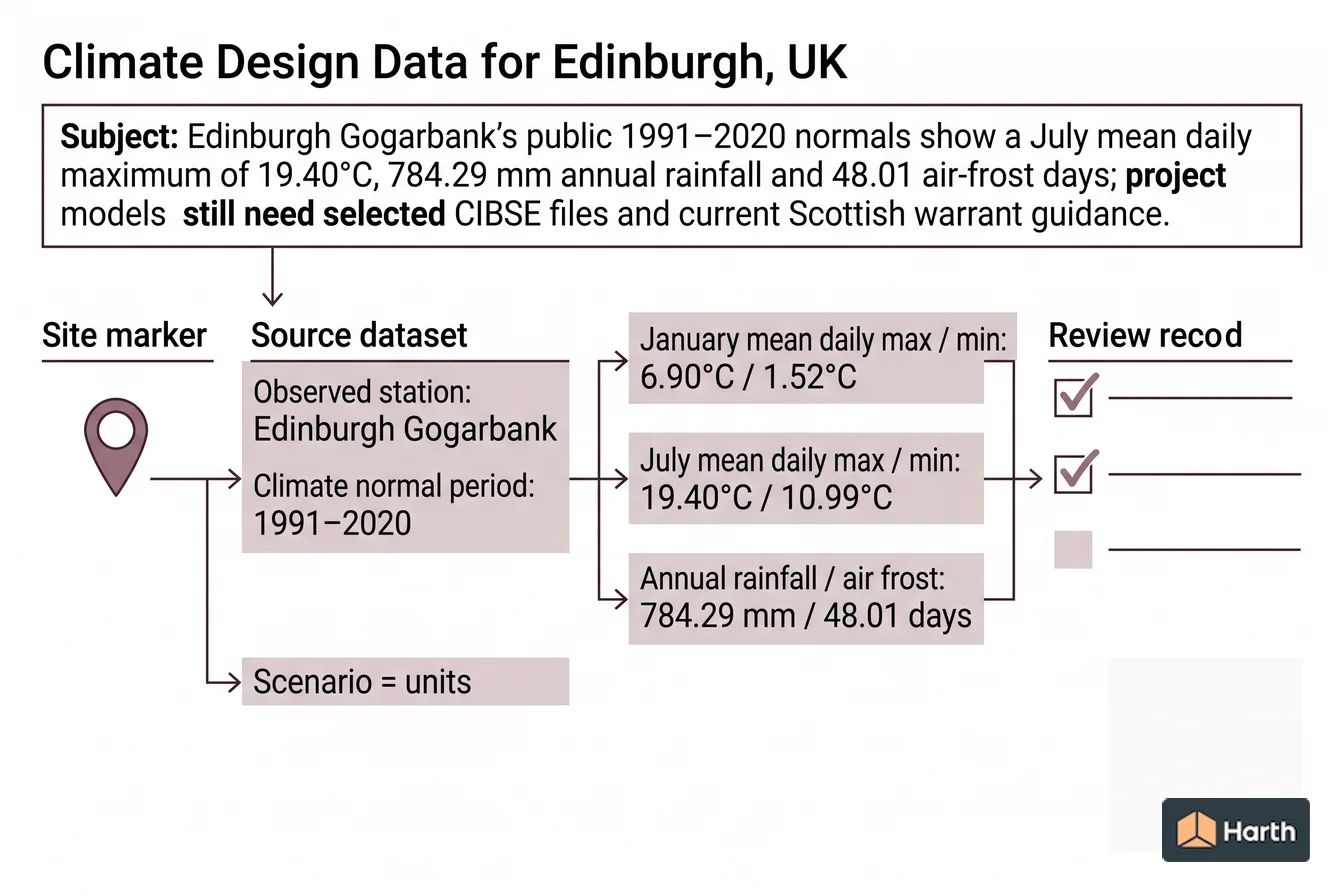
Which climate inputs control the design?
| Edinburgh Gogarbank normal, 1991–2020 | January | July | Annual |
|---|---|---|---|
| Mean daily maximum temperature | 6.90°C | 19.40°C | 12.80°C |
| Mean daily minimum temperature | 1.52°C | 10.99°C | 5.78°C |
| Rainfall | 73.01 mm | 71.85 mm | 784.29 mm |
| Days of air frost | 9.99 | 0.00 | 48.01 |
| Mean wind speed at 10 m | 9.56 kn | 6.74 kn | 8.15 kn |
The Met Office table reports wind in knots even though this page's project convention is metric. For calculations, preserve the source unit and make any conversion explicitly rather than silently relabelling it. The wind normal is not a structural wind action, façade pressure or natural-ventilation boundary condition by itself.
Gogarbank lies west of central Edinburgh. Coastal influence, elevation, topographic exposure and dense urban form can make a project site behave differently. Use the station as a documented baseline and explain representativeness; do not apply an unsupported city-centre correction.
Design implications to investigate
Compared with the London and Manchester reference stations in this first tranche, Gogarbank has the coolest July mean daily maximum and the most annual air-frost days. Those comparisons support questions, not prescriptive answers:
- test fabric heat loss, thermal bridging and airtightness with the applicable Scottish compliance methodology and project assumptions;
- assess exposed-site wind and rain with task-specific standards and site evidence;
- retain solar-control and overheating analysis because monthly normals do not capture hot events or high internal gains;
- test whether window opening is practical under wind, noise, security and occupant-control constraints;
- keep moisture and condensation analysis tied to the actual construction, indoor conditions and exposure rather than a broad city label.
Weather files for energy and overheating
Use CIBSE's 2025 selector with the actual postcode or coordinates. Archive the selected zone and full file names. A TRY supports annual assessment; DSY1, DSY2 and DSY3 represent different hot-event characteristics for overheating work. If future weather is included, state the future period, emissions scenario and probability percentile and connect the choice to the building life and resilience brief.
Do not use the table above to reconstruct a CIBSE file. Hourly relationships between temperature, humidity, solar radiation, wind and cloud matter to simulation and cannot be recovered from monthly means.
Scottish warrant and edition checkpoint
The Scottish Government states that the April 2026 domestic and non-domestic Technical Handbooks apply to warrants submitted on or after 6 April 2026, and to work not requiring a warrant commenced from that date. The handbooks explain how the standards in the Building (Scotland) Regulations 2004 may be achieved.
| Warrant record | Required entry |
|---|---|
| Project classification | domestic or non-domestic |
| Warrant submission date | exact date |
| Technical Handbook | title and edition tied to that date |
| Energy method/model | calculation method, software/version and weather inputs |
| CIBSE files | zone, TRY/DSY purpose, full file names and versions |
| Future-weather study | separate scenario record where required |
| Review | designer, modeller and independent checker |
English Approved Documents are not an alternative compliance route in Edinburgh. Similarly, a generic “UK Part L” note is too ambiguous for a Scottish issue set.
Limits
This page publishes public Met Office normals with their period and station. It does not publish licensed CIBSE hourly files or Guide A tables, and it does not supply structural wind, design rainfall, degree-day or HVAC sizing criteria. Each must come from the authoritative task-specific source.
Edinburgh climate-to-warrant handoff
| Controlled input | Source record | Project decision | Checker |
|---|---|---|---|
| Observed context | Edinburgh Gogarbank, Met Office 1991–2020, retrieval date | station suitability and limitations | |
| Weather geography | CIBSE 2025 postcode/coordinate selector result | selected zone | |
| Annual simulation | full TRY file name, scenario/version and checksum | model runs using it | |
| Overheating | DSY1/2/3 file names and method rationale | events tested and pass/fail criteria | |
| Future resilience | time period, emissions scenario and probability percentile | reason linked to design life | |
| Plant sizing | design source, edition, criterion/percentile and units | engineer approval | |
| Scottish compliance | domestic/non-domestic handbook and April 2026 applicability check | warrant route and transition | |
| Site exposure | elevation, coast/topography, wind and rain evidence | task-specific actions |
Where can you explore related guidance?
- Explore all climate data guidance
- UK Building Climate and Weather Data Explained
- Climate Design Data for London, UK
- Climate Design Data for Manchester, UK
- All climate & energy design data guidance for United Kingdom
Sources and method
Observed figures are from the official Met Office Edinburgh Gogarbank location-specific long-term averages, station Edinburgh Gogarbank, climate period 1991–2020, retrieved 26 August 2026. The Met Office describes these pages as samples for general interest rather than formal climate monitoring. Weather-file roles and the 1994–2023 baseline observation period are from CIBSE Weather Data and the 2025 technical briefing; select the project zone by postcode or coordinates and obtain licensed files from CIBSE. Scottish compliance references are the official Building Standards collection, April 2026 domestic Technical Handbook and April 2026 non-domestic Technical Handbook. No CIBSE tabulated values are reproduced.
Source links
Frequently asked questions
Can Edinburgh Gogarbank normals be used as heating design temperatures?
No. The January mean daily maximum and minimum are monthly climate normals. Heating plant sizing requires a named design condition or criterion, source edition, location and units agreed by the building-services engineer.
Does a cool July normal remove overheating risk in Edinburgh?
No. A monthly average hides hot-event intensity and duration, internal gains and solar exposure. Use the CIBSE DSY files appropriate to the project and assess whether ventilation, shading and controls remain usable during the tested events.
Which Scottish Technical Handbook applies to an Edinburgh project?
Choose domestic or non-domestic guidance according to the building and use the edition tied to the warrant or work date. The April 2026 handbooks apply to building warrants submitted on or after 6 April 2026 and to work not requiring a warrant commenced from that date. Earlier projects can remain tied to earlier editions.
Does English Approved Document L apply in Edinburgh?
No. Edinburgh projects follow the Building (Scotland) Regulations and Scottish Technical Handbooks. UK-wide sources such as CIBSE weather data can support modelling, but the compliance framework and evidence route are Scottish.
Related pages
- Climate Design Data: Durban, South Africa
Durban, South Africa climate design data (NASA POWER 2001–2020): annual mean 22.2 °C, monthly max 31.4 °C (September), min 12.6 °C (June), RH 77%.
- Climate Design Data: East London, South Africa
East London, South Africa climate design data (NASA POWER 2001–2020): annual mean 20.2 °C, monthly max 31.6 °C (February), min 10.0 °C (August), RH 76%.
- Climate Design Data: Edinburgh, UK
Edinburgh, UK climate design data (NASA POWER 2001–2020): annual mean 8.4 °C, monthly max 25.5 °C (August), min -5.7 °C (December), RH 88%; monthly table.
- Climate Design Data: Edmonton, Canada
Edmonton, Canada climate design data (NASA POWER 2001–2020): annual mean 3.5 °C, monthly max 34.8 °C (July), min -42.7 °C (January), RH 76%; monthly table.
- Climate Design Data: Eldoret, Kenya
Eldoret, Kenya climate design data (NASA POWER 2001–2020): annual mean 18.9 °C, monthly max 33.9 °C (February), min 8.2 °C (January), RH 75%; monthly table.
- Climate Design Data: Emalahleni, South Africa
Emalahleni, South Africa climate design data (NASA POWER 2001–2020): annual mean 16.5 °C, monthly max 38.1 °C (January), min -5.3 °C (August), RH 59%.