Australian courtyard garden
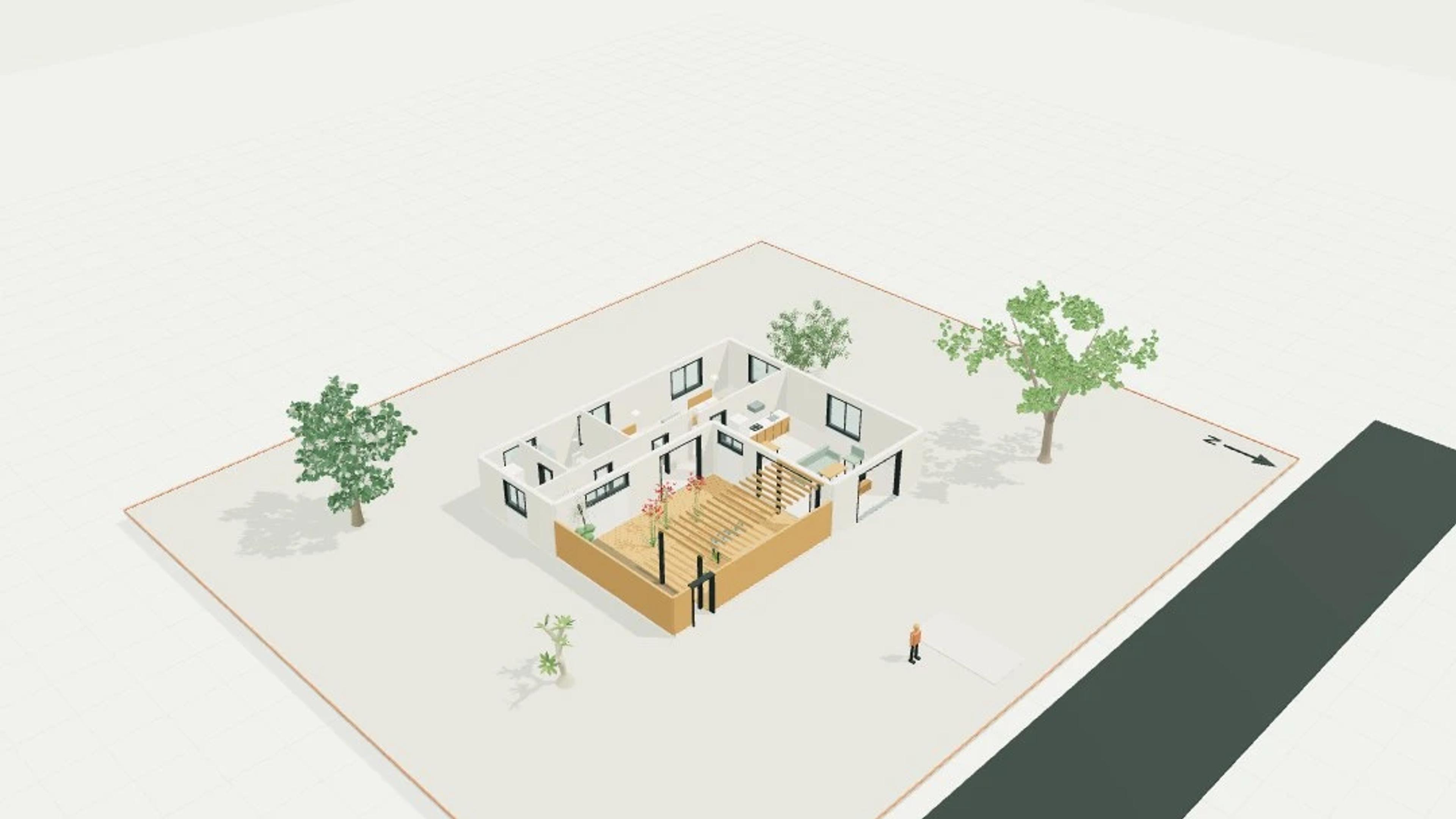
Australian courtyard garden is an L2 showcase built from real Harth library objects: 16 parameterised instances of 8 distinct objects. The background is authored geometry — a 15 × 12 m inspection floor with context massing, a north point and a 1.7 m scale figure — so every planting item in the scene is a live, editable library instance rather than fixed mesh.
Open it and the planting objects keep their parameters and connector metadata, so the agent can inspect, check and correct them.
Original reference-informed architectural template; no survey, scaleVerified=false.
Metres; local +X right, +Y up, +Z rear; ground FFL=0.
Furniture, structure and engineering details inferred; not construction or code-compliance documentation.
North is local -Z. No real address is supplied by this category brief; site, terrain and sun orientation are design assumptions.
Published plans/photos informed typology, not dimensions. Google 3D Maps was not imported: this archetype has no identified site to register map data against.
Original single-storey L plan has a 9 × 7 m open courtyard enclosed by house wings and garden screens.
Real library geometry and parameters are retained. GLB and IFC are static inspection mirrors; use the placement package to create editable Harth library instances.
No routing solver or persisted connection graph is claimed. The documented port pairs are authored joints, and every unused port is listed.
Nominal design geometry; no engineering rating, code compliance, horticultural suitability or cadastral accuracy is claimed.
Try these prompts with the agent:
Inspect the Australian planting palette and identify canopy, shrub and ground layers.
Check that courtyard paths and doors remain clear of mature canopy and shrub bounds.
Replace one kangaroo paw with a new seeded instance while retaining odd-number grouping.
Explain the nominal summer shade arrangement on the north side; do not infer horticultural suitability from geometry alone.
Size | 15 × 12 m, 1 named level, 101 selectable assemblies |
Objects | 16 library instances, 8 object types |
Scenes | 3 saved views |