Architecture & BIM Software Comparisons
ASCE 7-16 vs. ASCE 7-22: What Changed? (2026)
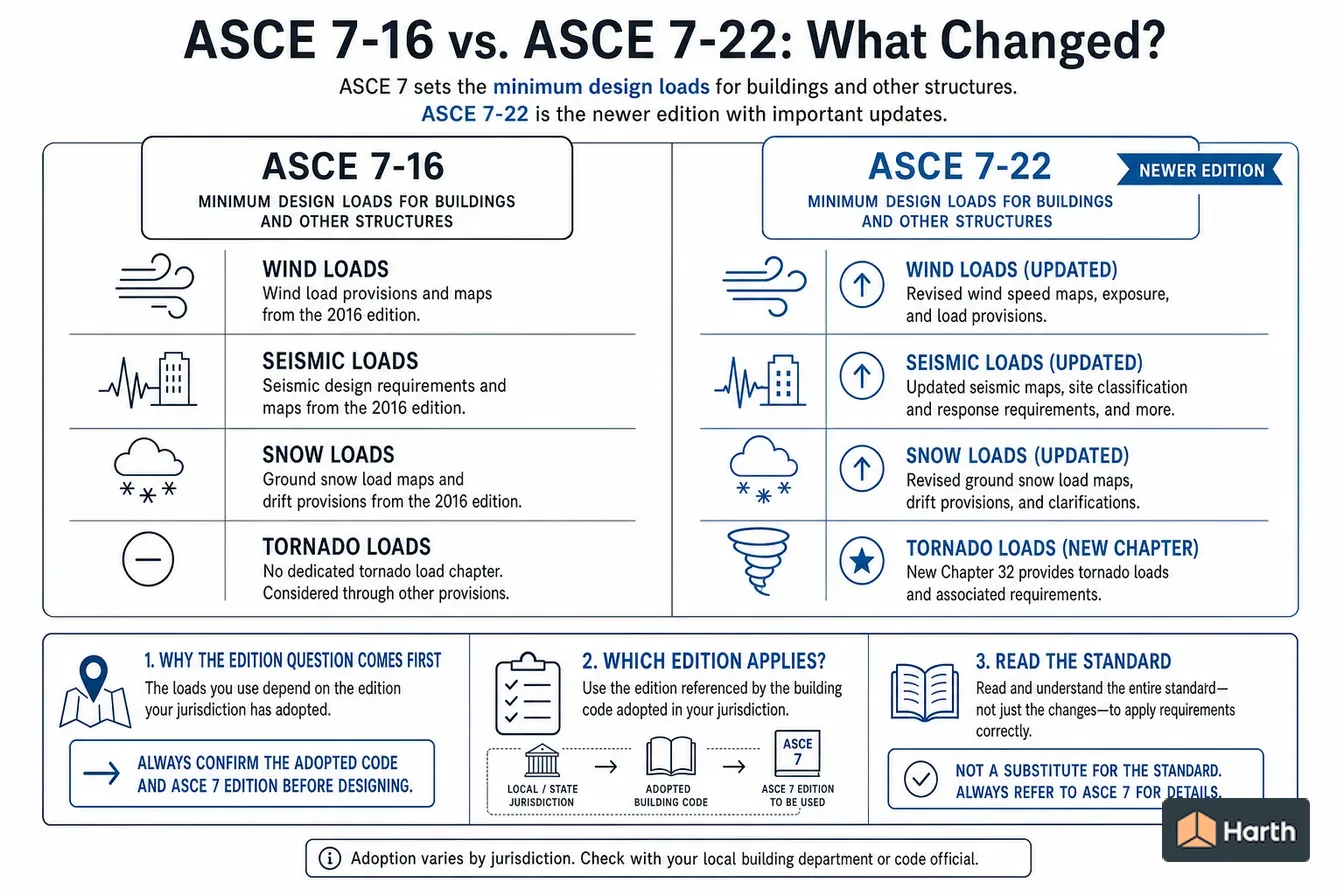
ASCE 7-22 is the newer edition of the minimum design loads standard, with notable updates to wind, seismic, snow, and especially a new tornado load chapter. Which edition applies depends on the code your jurisdiction has adopted.
On this page
Last updated October 27, 2026 · Compiled from ASCE, ICC and USGS sources, checked 2026-10-27: the [ASCE/SEI 7-22 publication page](https://www.asce.org/publications-and-news/codes-and-standards/asce-sei-7-22) (title, scope and list of new provisions); ICC's Building Safety Journal, [Release of ASCE/SEI 7-22 brings important changes](https://www.iccsafe.org/building-safety-journal/bsj-technical/release-of-asce-sei-7-22-brings-important-changes-to-structural-loading-standard/) (release date and change list); STRUCTURE magazine, [2024 IBC significant structural changes, part 6: loads](https://www.structuremag.org/article/2024-ibc-significant-structural-changes-part-6-loads/) (IBC 2024 Sections 1608, 1609.5 and 1611, tornado thresholds and recurrence intervals) and [Snow and rain loads in ASCE 7-22](https://www.structuremag.org/article/snow-and-rain-loads-in-asce-7-22/) (reliability-targeted snow, load factor and W2). Seismic values were retrieved from the [USGS Seismic Design Web Services](https://earthquake.usgs.gov/ws/designmaps/) for ASCE 7-16 and ASCE 7-22; snow, wind, ice, rain and tornado values are available from the [ASCE Hazard Tool](https://ascehazardtool.org/). These are edition-level orientation notes, not design values: read every provision in the edition your adopted building code references and confirm with the structural engineer of record.
Direct answer
ASCE/SEI 7-22, released in December 2021, is the edition of Minimum Design Loads and Associated Criteria for Buildings and Other Structures referenced by the 2024 IBC; the 2018 and 2021 IBC reference ASCE 7-16. The 2022 edition adds Chapter 32, which requires tornado loads for Risk Category III and IV buildings in the tornado-prone region unless the tornado speed is below 60 mph. Ground snow loads became reliability-targeted, strength-level values with separate maps for each risk category, so the snow importance factor was removed and the LRFD snow load factor dropped from 1.6 to 1.0. Seismic design moved to multi-period response spectra at 22 periods, eliminating the Fa and Fv site coefficients and adding site classes BC, CD and DE. Wind, rain, ice, tsunami and nonstructural component provisions also changed. The edition you must use is the one referenced by the building code your jurisdiction has adopted, not simply the newest one.
Content and cited inputs reviewed by Harth team · Published 2026-08-18 · Updated 2026-10-27.
What are the key takeaways?
- Use the ASCE 7 edition your adopted building code references: 7-16 with the 2018 or 2021 IBC, 7-22 with the 2024 IBC.
- ASCE 7-22 adds tornado loads for Risk Category III and IV buildings in the tornado-prone region.
- Snow loads are now strength-level and mapped per risk category, so load combinations use 1.0S, not 1.6S.
- Seismic site factors Fa and Fv are gone; read multi-period spectra from the USGS or ASCE tools.
What are the key differences between ASCE 7-16 and ASCE 7-22?
ASCE/SEI 7 sets the minimum loads that US building codes require structures to resist. The 2022 edition (ASCE 7-22) was released in December 2021 and is referenced by the 2024 IBC; the 2016 edition (ASCE 7-16) is referenced by the 2018 and 2021 IBC. The changes reach almost every environmental load:
| Hazard | ASCE 7-16 | ASCE 7-22 |
|---|---|---|
| Tornado | No tornado design requirements | New Chapter 32 with tornado speed maps for Risk Category III and IV buildings in the tornado-prone region |
| Snow | 50-year ground snow load map, snow importance factor, LRFD factor 1.6 | Reliability-targeted, strength-level ground snow loads with a map for each risk category; importance factor removed; LRFD factor 1.0; new winter wind parameter in drift calculations |
| Seismic | Two-period spectrum from SDS and SD1 with Fa and Fv site coefficients | Multi-period response spectra at 22 periods from USGS data; Fa and Fv eliminated; site classes BC, CD and DE added |
| Nonstructural components | Fp from ap and Rp | Chapter 13 rewritten around CAR, Rpo, Hf and Rμ |
| Wind | Basic wind speed maps by risk category | Updated hurricane coastline wind speeds; new provisions for main wind-force resisting systems and components and cladding of elevated buildings |
| Rain | Rain load from static and hydraulic head | Ponding head considered explicitly in design rain loads |
| Ice | Atmospheric ice maps | Risk-targeted atmospheric ice loads for the continental US and Alaska |
| Tsunami | Chapter 6 | Updated data for Hawaii and California; provisions for aboveground horizontal pipelines |
| Other | Not applicable | Emergency vehicle loads; alternative method for loads from water in soil; target reliability tables for tsunami and extraordinary loads |
| Hazard data | Maps in the standard plus online tools | Digital data for all hazards in the ASCE Hazard Tool |
Which edition do I have to use?
The edition is set by the building code your jurisdiction adopted, not by publication date. ASCE 7 enters law by reference: IBC Chapter 16 points to a specific edition, and that edition governs wherever that IBC is in force.
| Adopted building code | ASCE 7 edition referenced |
|---|---|
| 2018 IBC | ASCE 7-16 |
| 2021 IBC | ASCE 7-16 |
| 2024 IBC | ASCE 7-22 |
Many states are still on the 2018 or 2021 IBC, and some amend the structural chapter. Mixing editions, for example taking ASCE 7-22 snow loads into an ASCE 7-16 design, needs the building official's approval as an alternative, because the load factors and combinations were recalibrated together.
What changed in seismic design?
ASCE 7-22 replaced the two-point spectrum with multi-period response spectra (MPRS). The USGS web service for ASCE 7-22 returns design and MCER spectra at 22 periods from 0 to 10 seconds, together with SDS, SD1 and the seismic design category. Because site amplification is built into those values, the Fa and Fv coefficient tables are gone, and three intermediate site classes, BC, CD and DE, were added. When soil data are not available, the default is the most critical of Site Classes C, CD and D at each period.
This fixes a practical problem in ASCE 7-16. Under ASCE 7-16, Section 11.4.8 generally requires a site-specific ground motion hazard analysis for Site Class D sites where S1 is 0.2 g or greater, unless an exception is used. The USGS ASCE 7-16 service therefore returns no Fv and no SD1 for those sites, which include five of the six reference points in the comparison table below. ASCE 7-22 provides SD1 directly; the comparison table below shows the effect.
Chapter 13 also changed for nonstructural components. The component amplification factor ap and response modification factor Rp were replaced by a resonance factor CAR, a component strength factor Rpo, a height factor Hf and a structure ductility factor Rμ, so anchorage forces for equipment, cladding and partitions need recalculating rather than updating.
What changed in snow loads?
ASCE 7-22 adopted reliability-targeted ground snow loads, intended to fix the uneven reliability of roofs designed to the 50-year snow load in different parts of the country. There is a ground snow load map for each risk category, so the separate snow importance factor was removed. The values are strength-level, so the LRFD load factor on snow drops from 1.6 to 1.0, and allowable stress design uses a 0.7 factor to give roughly equivalent strength. Drift calculations add a winter wind parameter, W2, the share of time from October to April with wind speed of at least 10 mph. The 2024 IBC added Section 1608.2.1 to convert the strength-level values to equivalent ASD values.
What are tornado loads in ASCE 7-22?
Chapter 32 is the first time ASCE 7 has required design for tornadoes. It applies to Risk Category III and IV buildings and other structures in the tornado-prone region, which IBC Figure 1609.5 shows roughly as the US east of the Continental Divide. Tornado speeds use the same mean recurrence intervals as the Chapter 26 wind speeds for those categories, 1,700 years for Risk Category III and 3,000 years for Risk Category IV. Where the mapped tornado speed is below 60 mph, tornado design is not required. Risk Category I and II buildings are excluded because, at their shorter return periods, tornado loads generally do not control over Chapter 26 wind loads. Tornado loads are checked alongside ordinary wind loads; they do not automatically govern.
What does this mean for architects?
Most changes land on the structural engineer, but several reach the architect's decisions early: the risk category assigned to a school, hospital or assembly building now decides whether tornado loads apply and which snow map is used; site class and geotechnical scope affect seismic values; and rooftop equipment, canopies, cladding and partitions need anchorage designed to the new Chapter 13. Confirm the governing ASCE 7 edition in the code analysis at concept stage, and ask the engineer which hazard changes affect the structural system.
Same site, two editions: USGS seismic design values compared
Harth queried the USGS Seismic Design Web Services on 2026-10-27 for six city-centre reference points, using Risk Category II and Site Class D in both editions so the only variable is the standard. Coordinates are reference points, not project sites; a real project needs its own coordinates, site class and geotechnical data.
| Reference point (lat, long) | ASCE 7-16 Ss / S1 (g) | ASCE 7-16 SDS (g) | ASCE 7-16 SD1 (g) | ASCE 7-22 SDS (g) | ASCE 7-22 SD1 (g) | ASCE 7-22 SDC |
|---|---|---|---|---|---|---|
| Los Angeles, CA (34.0522, -118.2437) | 1.974 / 0.703 | 1.316 | Site-specific per 11.4.8 | 1.52 | 1.11 | D |
| Seattle, WA (47.6062, -122.3321) | 1.400 / 0.488 | 0.933 | Site-specific per 11.4.8 | 1.15 | 0.92 | D |
| Salt Lake City, UT (40.7608, -111.8910) | 1.496 / 0.544 | 0.997 | Site-specific per 11.4.8 | 1.10 | 0.83 | D |
| Memphis, TN (35.1495, -90.0490) | 1.023 / 0.347 | 0.744 | Site-specific per 11.4.8 | 0.75 | 0.48 | D |
| Charleston, SC (32.7765, -79.9311) | 1.313 / 0.386 | 0.875 | Site-specific per 11.4.8 | 0.72 | 0.47 | D |
| Boston, MA (42.3601, -71.0589) | 0.270 / 0.065 | 0.285 | 0.105 | 0.20 | 0.077 | B |
What the comparison shows:
- At the five higher-hazard points, ASCE 7-16 with Site Class D leaves SD1 to a site-specific analysis (the USGS service returns Fv as "See Section 11.4.8"), while ASCE 7-22 gives a usable SD1 directly.
- SDS rose under ASCE 7-22 at Los Angeles, Seattle and Salt Lake City and fell at Charleston and Boston; at Memphis it was nearly unchanged. Do not assume a new edition always raises or lowers seismic demand.
- With an unknown site class in ASCE 7-22 (the default, taken as the most critical of C, CD and D), the Los Angeles point returns SDS 1.58 g and SD1 1.11 g, higher than Site Class D alone at short periods.
ASCE 7-16 to ASCE 7-22 transition checklist
| Item | ASCE 7-16 practice | ASCE 7-22 practice | Action for the design team | Reference |
|---|---|---|---|---|
| Governing edition | Referenced by the 2018 and 2021 IBC | Referenced by the 2024 IBC | Record the adopted IBC and ASCE 7 edition in the code analysis | IBC Chapter 16 and Chapter 35 |
| Risk category | Sets importance factors | Also selects the snow map and triggers tornado design for III and IV | Fix the risk category at concept stage | ASCE 7 Table 1.5-1 |
| Tornado | Not required | Chapter 32 for Risk Category III and IV in the tornado-prone region where tornado speed is 60 mph or more | Check the tornado-prone region map and tornado speed for schools, shelters, hospitals and large assembly buildings | ASCE 7-22 Chapter 32; IBC 2024 Section 1609.5 |
| Ground snow load | 50-year map with importance factor | Risk-category map, strength-level, no importance factor | Retrieve values from the ASCE Hazard Tool and use 1.0S in LRFD | ASCE 7-22 Chapter 7; IBC 2024 Section 1608 |
| Snow drift | Ground snow load and roof geometry | Adds winter wind parameter W2 | Expect drift changes at parapets, roof steps and rooftop units | ASCE 7-22 Chapter 7 |
| Seismic values | SDS and SD1 from mapped values times Fa and Fv | Multi-period spectra and SDS and SD1 from USGS data | Ask the geotechnical engineer for the new site class designations | ASCE 7-22 Chapters 11 and 20 |
| Nonstructural anchorage | ap and Rp | CAR, Rpo, Hf and Rμ | Recalculate equipment and cladding anchorage | ASCE 7-22 Chapter 13 |
| Rain | Static and hydraulic head | Ponding head included explicitly | Coordinate roof drain and overflow design with the structural load | ASCE 7-22 Chapter 8; IBC 2024 Section 1611 |
Where can you explore related guidance?
- Explore all comparisons guidance
- IBC vs. IRC: Which Building Code Applies? (2026)
- Seismic Design Category & Site Class Explained (SDC A–F)
- Ground Snow Load (pg) Explained for Architects
- Design Wind Speed (Vult), Risk Category Maps & Exposure B/C/D
Sources and method
Compiled from ASCE, ICC and USGS sources, checked 2026-10-27: the ASCE/SEI 7-22 publication page (title, scope and list of new provisions); ICC's Building Safety Journal, Release of ASCE/SEI 7-22 brings important changes (release date and change list); STRUCTURE magazine, 2024 IBC significant structural changes, part 6: loads (IBC 2024 Sections 1608, 1609.5 and 1611, tornado thresholds and recurrence intervals) and Snow and rain loads in ASCE 7-22 (reliability-targeted snow, load factor and W2). Seismic values were retrieved from the USGS Seismic Design Web Services for ASCE 7-16 and ASCE 7-22; snow, wind, ice, rain and tornado values are available from the ASCE Hazard Tool. These are edition-level orientation notes, not design values: read every provision in the edition your adopted building code references and confirm with the structural engineer of record.
Source links
Frequently asked questions
What are the key differences between ASCE 7-22 and ASCE 7-16?
ASCE 7-22 adds tornado loads (Chapter 32), replaces 50-year ground snow loads with reliability-targeted values mapped by risk category, moves seismic design to multi-period response spectra without Fa and Fv, adds site classes BC, CD and DE, overhauls nonstructural component forces in Chapter 13, and updates wind speeds along the hurricane coastline, rain ponding, atmospheric ice and tsunami data.
What version of the IBC references ASCE 7-22?
The 2024 International Building Code references ASCE 7-22. The 2018 and 2021 IBC reference ASCE 7-16. A jurisdiction still enforcing the 2018 or 2021 IBC therefore uses ASCE 7-16 even though a newer edition exists, unless its adopting ordinance says otherwise. Confirm the adopted code and any amendments with the building department.
What does ASCE 7-22 stand for?
ASCE is the American Society of Civil Engineers, SEI is its Structural Engineering Institute, 7 is the standard's number and 22 is the edition year. The full title is Minimum Design Loads and Associated Criteria for Buildings and Other Structures. It sets dead, live, soil, flood, tsunami, snow, rain, ice, seismic, wind, tornado and fire loads and their load combinations.
What is the ASCE 7-22 soil classification?
ASCE 7-22 uses site classes A, B, BC, C, CD, D, DE, E and F, adding BC, CD and DE between the classes used in ASCE 7-16 and basing classification more strongly on shear wave velocity. Where soil data are not known in enough detail, the default is the most critical of Site Classes C, CD and D.
What is the latest edition of ASCE 7?
ASCE/SEI 7-22 is the current published edition, released in December 2021 with a 2022 edition year. The next edition is being developed as ASCE 7-28. ASCE 7-16 is superseded as a standard but remains legally in force wherever the adopted building code references it.
Is there an official ASCE 7-22 or ASCE 7-16 PDF?
ASCE sells the standards in print, as PDF e-books and through its ASCE Library and AMPLIFY digital platforms; copies posted elsewhere online are generally not authorised. Site-specific hazard values can be retrieved from the ASCE Hazard Tool, and seismic design parameters for both editions are available from the USGS Seismic Design Web Services.
Related pages
- CAD vs. BIM: What's the Real Difference? (2026)
CAD vs. BIM for architects: drawings vs. a data-rich model, whether Revit and AutoCAD are BIM or CAD, which to learn, and when each fits.
- IBC vs. IRC: Which Building Code Applies? (2026)
IBC vs. IRC: the IRC covers houses, duplexes and townhouses up to 3 stories (R101.2); the IBC covers everything else. Decision tree and worked examples.
- IFC vs. BCF: Model Data vs. Model Issues (2026)
IFC vs. BCF: IFC shares the model, BCF shares issues about it. What a .bcf file contains, BCF 2.1 vs 3.0, and how to open one.
- IFC vs. RVT: Open Exchange vs. Native Revit (2026)
IFC vs. RVT: what each file carries, which IFC version Revit exports, how to open IFC in Revit, and when to share each format.